Commonplace Books in the Classroom: Organizing Ideas and Making Art

art, Classes, Environment, Humanities, STS Faculty

By Christy Tidwell and Erica Haugtvedt

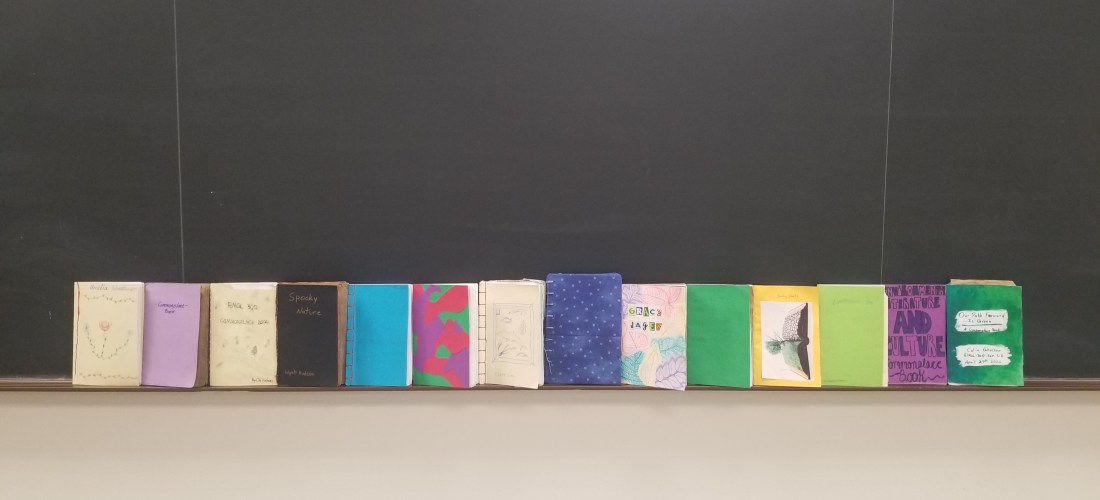
This semester, we both asked students in our classes (Introduction to Humanities and Environmental Literature & Culture) to create commonplace books. We found this to be a successful way to get students thinking about core ideas from class and to encourage creative activity. Read on for more information about commonplace books, how we used them, and how students responded!

What Are Commonplace Books?

Commonplace books have a long history – extending as far back as people have had easy access to paper and writing utensils – and are a way of organizing information for yourself. They can overlap with journals or diaries, but they’re also for classifying and indexing information to find later, and they have taken various shapes over time as they have served different purposes for different groups of people. Religious leaders’ commonplace books in the 17th century, for instance, look and function differently than young ladies’ commonplace books in the 19th. Adam Smyth provides a pretty standard definition of them: “the commonplace book presents a series of thematic headings under which aphorisms are distributed, gathered from reading, or, more rarely, from conversation, and deemed in some way useful or exemplary” (91).
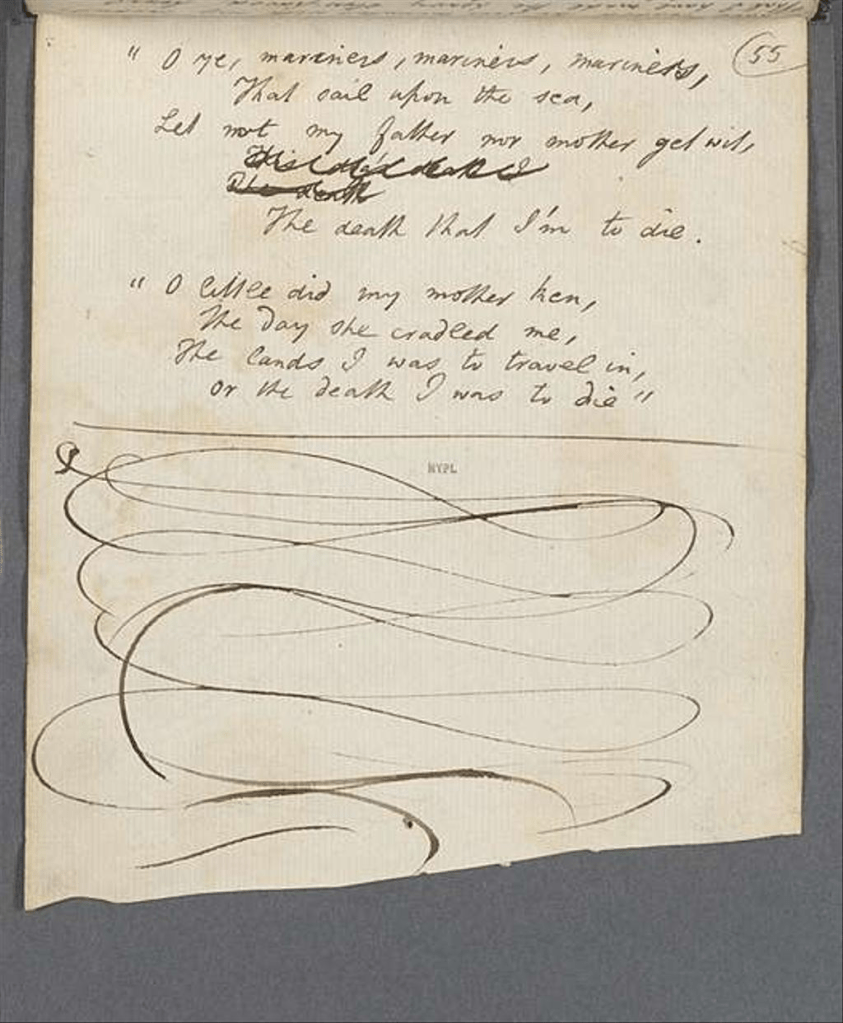
Page from a commonplace book by author Charles Lamb (1775-1834). Public domain.

However, Smyth also notes that actual commonplace books only sometimes followed this description. He writes,

The experience of reading manuscript commonplace books is often an experience of baffled delight – delight at pages so crammed with text that annotations spill over the binding and covers; at devotional aphorisms jostling with bawdy epigrams and recipes . . . ; at scraps of printed pages glued into the manuscript; at prose merging with verse merging with financial accounts merging with illustrations; at blank pages, and gaps; at entire printed books bound into the centre of manuscripts; at the construction of a single manuscript out of many different sized pages; at the recycling of old, often medieval texts in the binding of manuscripts; at texts that simultaneously ‘begin’ from various points within their pages and    proceed in various directions, so that it becomes meaningless to talk of a front or back, a beginning or an end. (90-91)

Smyth goes on to describe this as an “eclecticism of inclusions” and “rampantly inventive materialism” (91), descriptions which beautifully highlight the flexibility and openness of commonplace books and their inherently physical nature. Both of these elements are closely tied to goals of humanities classrooms that emphasize practicing and learning about a wide range of modes of expression (e.g., film, art, literature, philosophy) and that value creators’ and students’ experiences of the world.
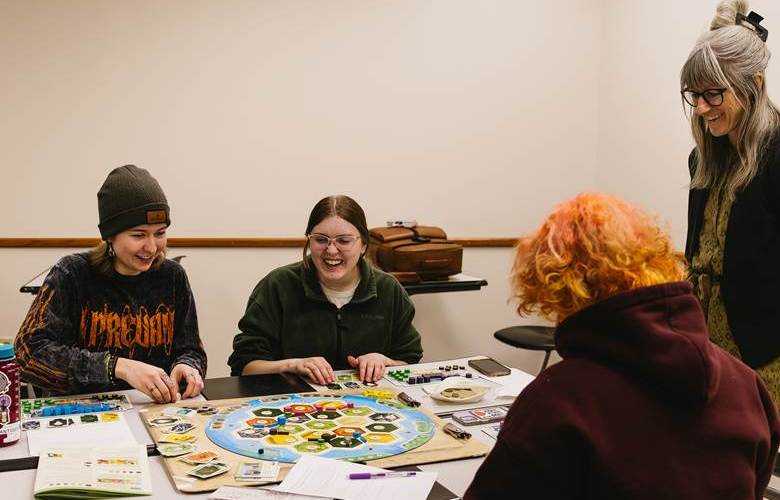
Students sit at a table playing the board game while Dr. Witlacil observes.

What can games teach us about climate change?: Playing CATAN – New Energies for World Climate Games Day

Classes, Environment

By Mary Witlacil

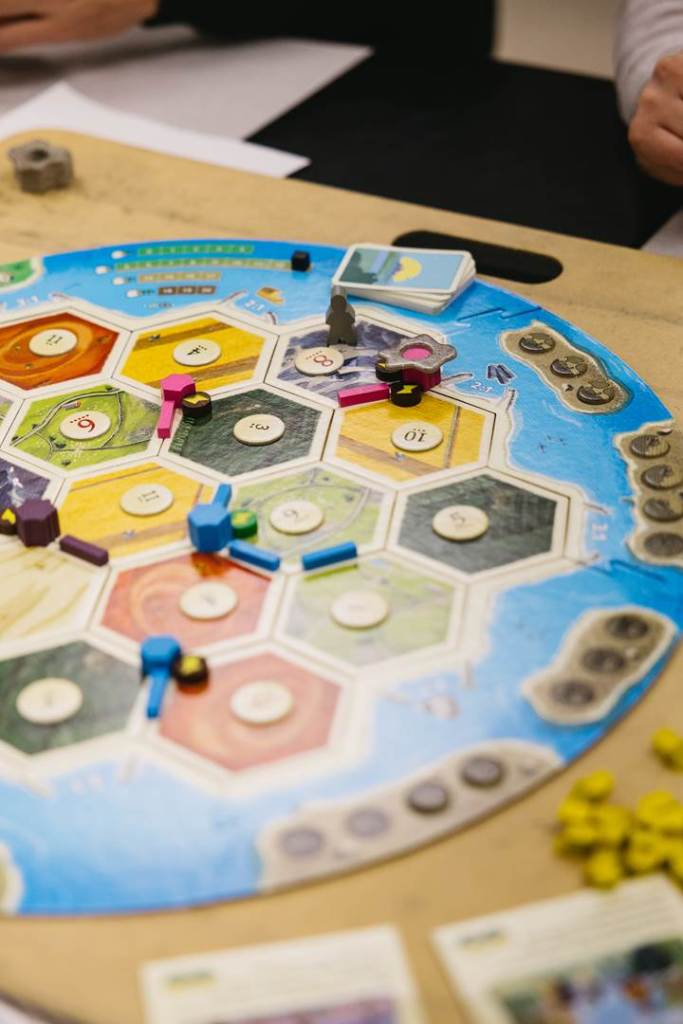
Earlier this semester, students in Environmental Law and Policy (POLS 407) played CATAN – New Energies for the second annual Worldwide Climate Games Day. New Energies is an updated version of CATAN, where players jockey to collect enough resources to build out their society and develop their energy infrastructure. Players can choose to develop cheaper fossil fuels to collect more resources or opt for more expensive renewable energy plants. With more fossil fuel power plants the global footprint climbs higher, which increases the likelihood of triggering a natural disaster or a pollution event.

A Catan game board midway thorugh play, featuring tokens distributed across the game world.

The game gives players a choice between working collaboratively to bring down their global carbon footprint, or teaming up against each other to build out their fossil fuel energy grids. One group of students played cooperatively by trading resources with each other and exclusively building out renewable energy. Reflecting on this strategy, one student noted that the game helped them recognize the role international cooperation plays in combatting climate change.

What Do You Love About Parks?: STS at the Earth Day Expo

Environment, Events

This past weekend, the STS program set up tables at the Earth Day Expo (held on the campus of Western Dakota Tech here in Rapid City) to share information about STS and ask visitors to think about parks as a piece of nature we regularly interact with.

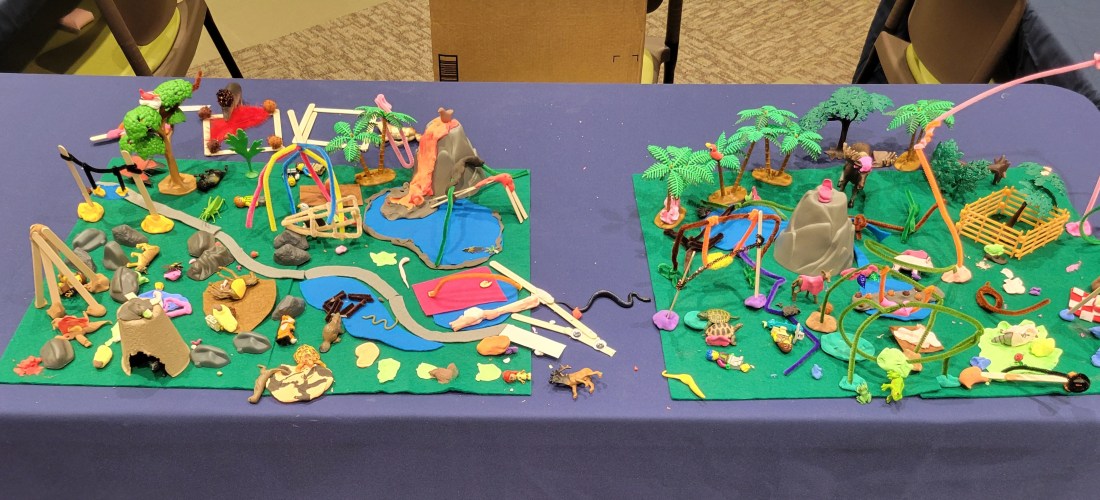
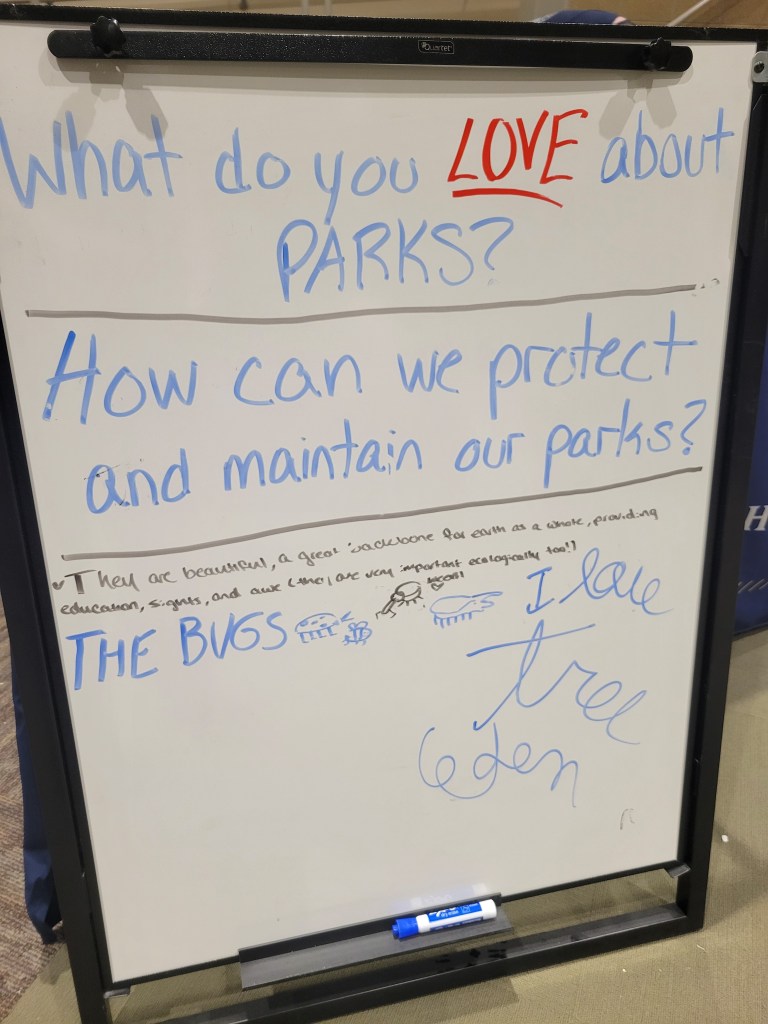
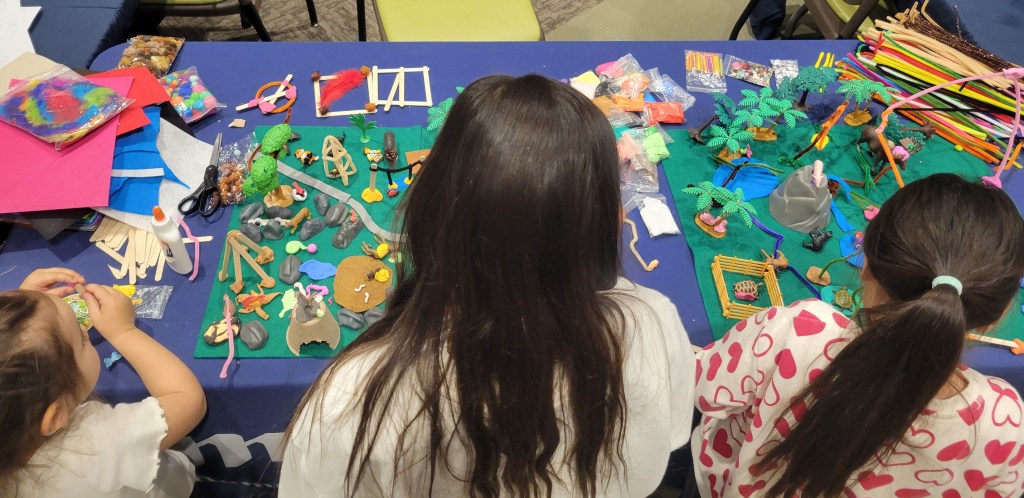
With a whiteboard for sharing ideas in response to the key question – What do you love about parks? – and a table for visitors to build their ideal park, we invited lots of hands-on participation and engagement.

Parks are a great way to practice STS ways of thinking at any age, since they are intersections between natural and social spaces and they are shaped by our technologies as well as our social needs and expectations. Plus, it’s fun to play with toys, felt, and clay!

We hope to be back at the Earth Day Expo again next year!

Whiteboard with the question What do you LOVE about parks? at the top. Answers focus on beauty and education, bugs, and trees.
Some of the answers to our question about what we love about parks.
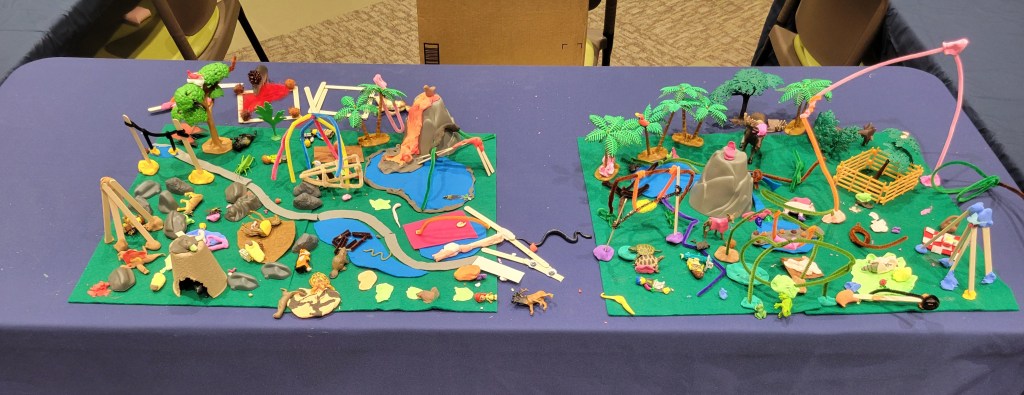
Two green felt park spaces with trees and paths and ponds and animals, etc.
Some very full park designs!
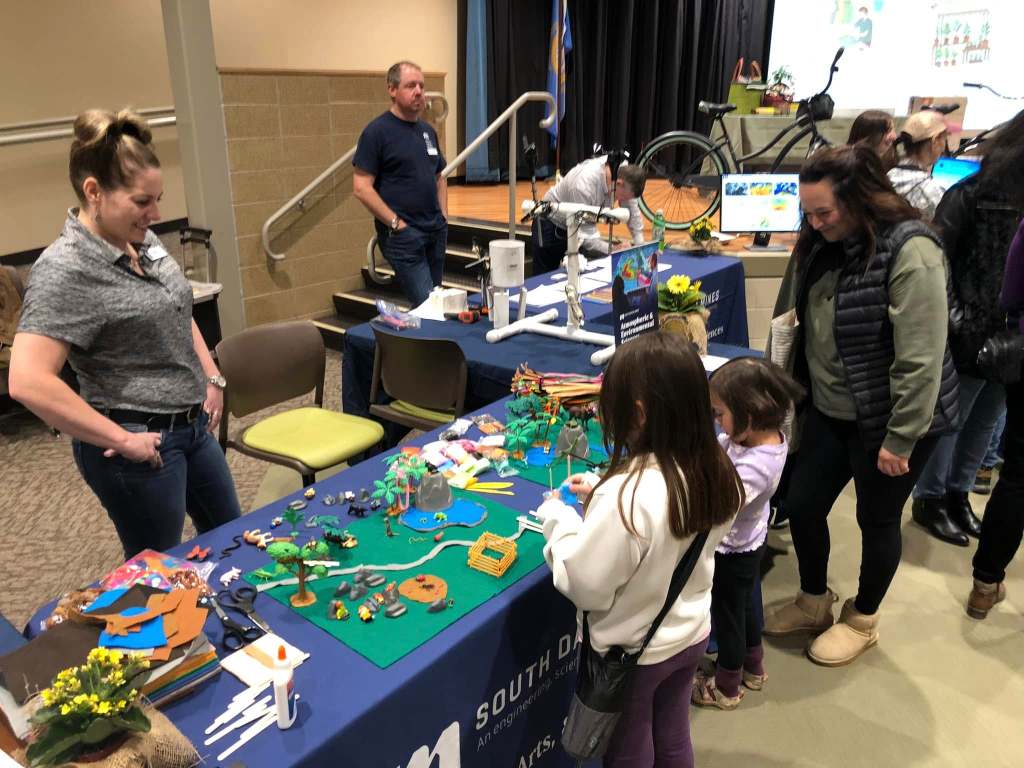
Dr. Pritchard observes children working on park design elements.
Dr. Kayla Pritchard at the table while kids build parts of a park. (Photo credit: Rapid City Municipal Government.)
A few children - seen from behind - working on park elements.
Kids working on park development.

Science communication in the community: Trinity Eco Prayer Park

Classes, communication, Environment

By Erica Haugtvedt

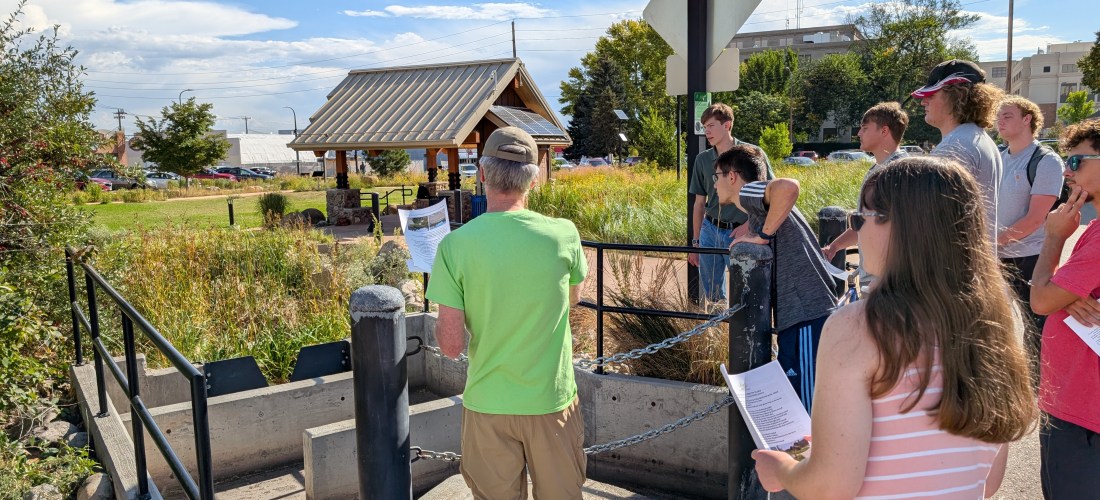
Students in ENGL 289: STEM Communication for Public and Technical Audiences are partnering with Trinity Eco Prayer Park to leverage their science expertise and science communication skills to help the park face real-world problems. Trinity Eco Prayer Park is a private park owned by the Trinity Lutheran Church Foundation that models sustainable stewardship of the environment. The park naturally filters stormwater for 2/3 of its concrete-heavy city block through native plant species that represent five local biomes from the Great Plains and Black Hills. 

Laws Below the Surface

Environment, STS Students

By Parker Smith

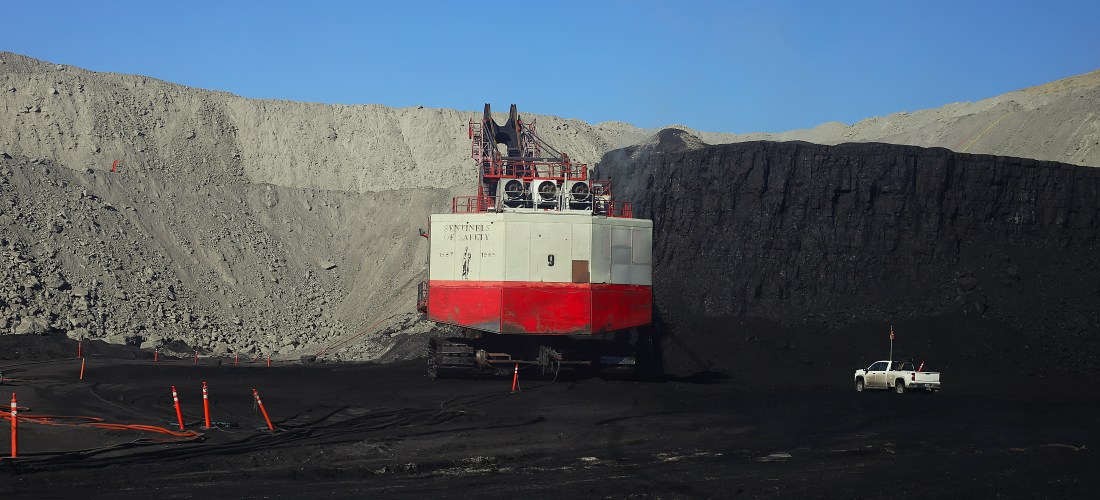
Land rights and mineral rights are a big issue in the mining industry. Mineral rights apply to most solids and liquids beneath the surface of the Earth, like coal, gold, and oil. The distinctions are more complex when you start to look at the laws. Materials like gravel and sand can be mined but are under a “materials” label. Other things are listed under “locatable minerals,” which includes metallic minerals (e.g., gold and silver) and non-metallic minerals (e.g., mica and asbestos). 

Mining companies don’t usually own mineral rights to the land they mine. Depending on how the mineral rights are owned, a mining company has to go through different means to get them. If they’re privately owned, they have to discuss leasing or purchase with the owner. If the government owns them, they can request to mine them out. 

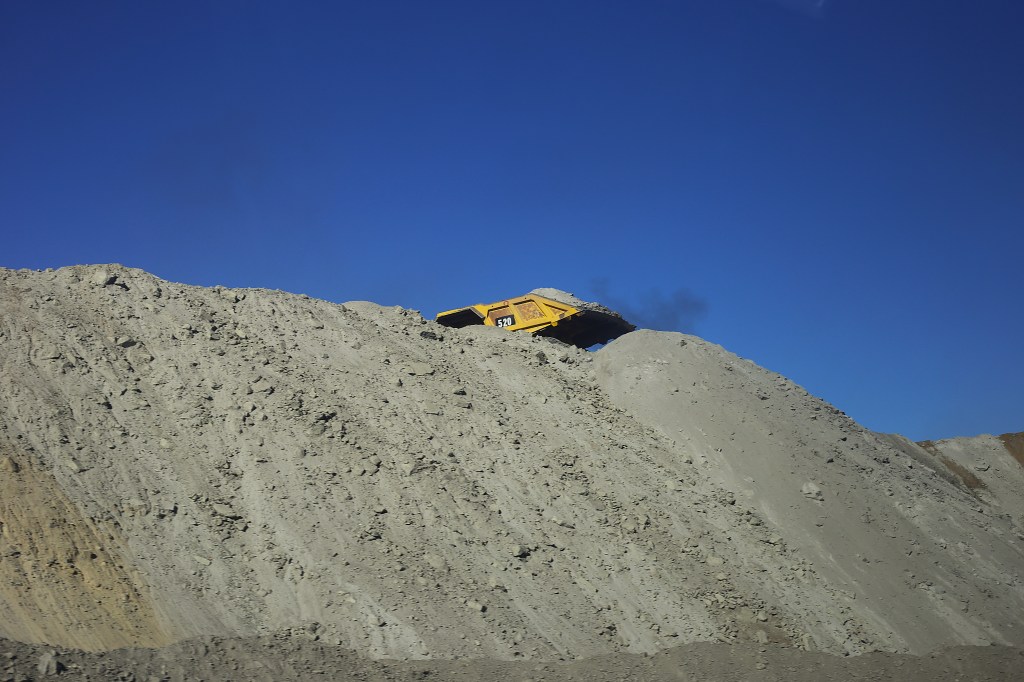
Haul truck dumping overburden. Photo by Parker Smith.

The General Mining Act of 1872 allowed the federal government to give private citizens and companies the “right to locate.” This right isn’t a transfer of mineral rights but instead gives private citizens and companies a right to mine out the materials and use, sell, or modify them. The only updates to this mining legislation have been for workplace safety and minor edits, nothing that would change the structure of mining or the system of claims. 

Claims are sorted into two most common categories: lode claims and placer claims. Lode claims are characterized by their well-defined boundaries including one main mineral, whereas placer claims provide for all the minerals in the area affected by the claim. For example, gravel mines are usually placer claims because they aren’t characterized by one distinct vein. This system is also managed and overseen by two separate government organizations: the US Bureau of Land Management and the US Forest Service. If the leasable minerals are on National Forest Service land, then the two organizations work together to decide if and how to lease them. 

It Spins Me Right Round: What’s The Big Deal With Tornadoes?

Atmospheric Science Students, Environment, STS Students

By Cory Schultz

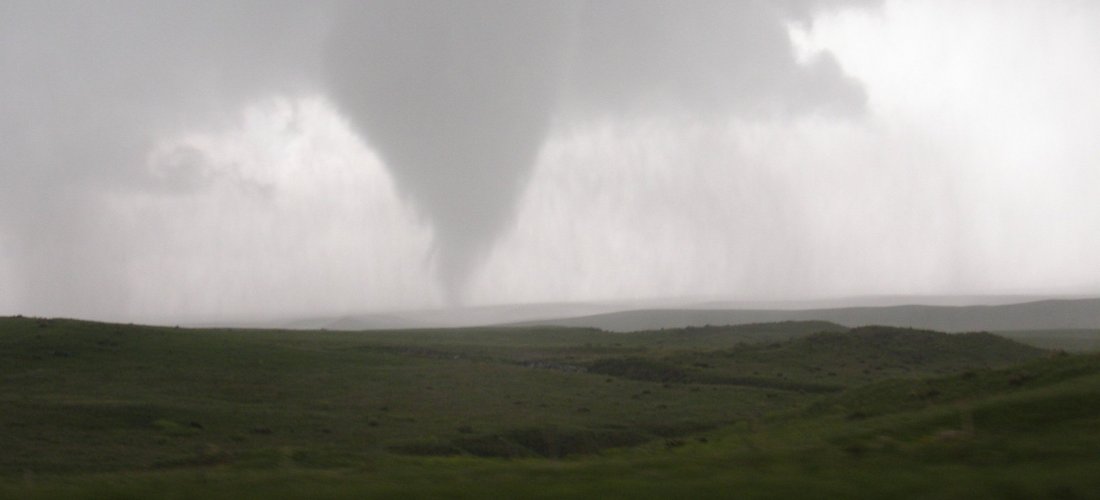
If you look at the annual average number of tornadoes per country, the United States reigns supreme, whether we like it or not. And if we look at South Dakota, the state is not without its share of tornadic activity. For instance, as Dennis Todey, Jay Trobec, and H. Michael Mogil write, “A massive outbreak of tornadoes placed the state in the severe weather record book on the evening of June 24, 2003” (19). On that day, sixty-seven tornadoes touched down over a 6-hour period, a single-state record tornado occurrence.

So, you may be thinking to yourself right now, “I live in the Black Hills region of South Dakota. We don’t have a problem with tornadoes.” Well, what if I told you that tornado activity has increased in the Northern Black Hills of South Dakota in the last decade? This increase in activity is not typical for the Northern Black Hills, since only nine tornadoes have been reported in this region since NOAA started gathering tornado data in 1950. What makes this even more alarming is that, of these nine cases, four have occurred in the last decade. This increase is the focus of my capstone with my two-part research question: Do the Northern Black Hills tornadoes that occurred in 2015, 2018, and 2020 have any similar characteristics to each other? Will this help determine when new tornadoes will form over the same region? 

Map of the Black Hills showing tornado tracks and the strength of the tornadoes. A handful are circled west of Lead, SD.
Map of Northern Black Hills tornado tracks and strengths on the EF scale. Red circles indicate tornadoes being researched for this capstone. Source: National Oceanic and Atmospheric Administration

Planting Seeds: Anchoring Ethics in the Dirt

Classes, Environment, teaching

By Christy Tidwell

My Environmental Ethics & STEM class asks big questions about knowledge, values, justice, and responsibility – both individual and systemic – related to environmental issues. Although I try to situate these conversations in specific, real-world examples, they can still sometimes seem abstract or beyond the scale of my students’ reach. They may wonder what they can do to address climate change, for instance, or to change corporate policy.

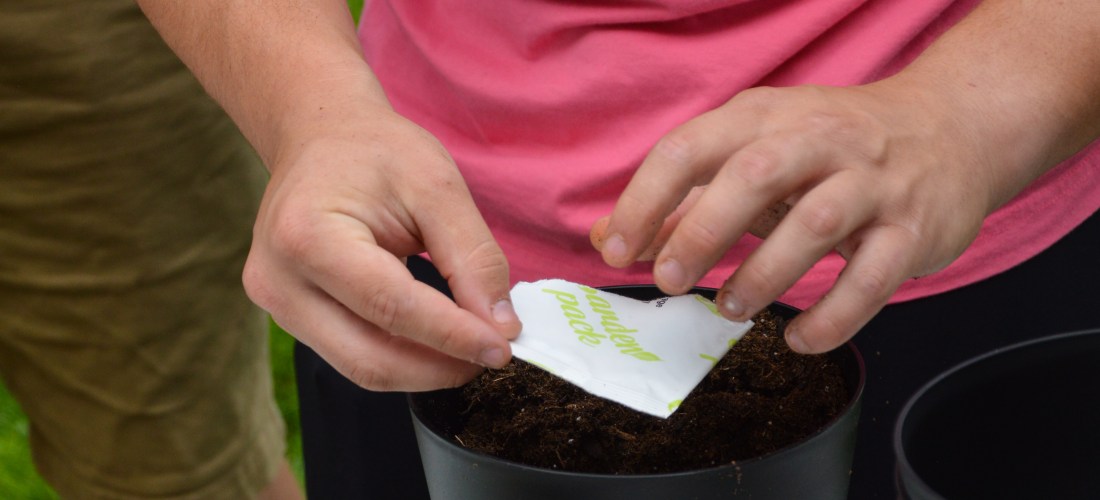
But they can, of course, make a difference, and we look for ways to identify the actions they can take (again, not just individually but within larger contexts). In the meantime, to help connect us more fully to the environment, this semester I asked my students to plant seeds and to do their best to grow them and keep them alive. It’s my hope that working to protect and nurture one small plant will give the class a personal connection that issues of pollution, plastics, or water rights may not always have.

Spooky Science at the Movies!: Week 3

Environment, Film, horror

By Christy Tidwell

This week’s recommendations stick with the emphasis on ecohorror introduced last week. Instead of presenting monsters like Godzilla or crocodiles, though, these two films find both wonder and horror in exploring the agency of the nonhuman world. How do other species communicate? How do they act upon us and shape our actions?

Spooky Science at the Movies!: Week 2

Environment, Film, horror, Humanities

By Christy Tidwell

Horror movies are often defined by their monsters. Sometimes these monsters are terrifying beasts that give us nightmares (like Guillermo del Toro’s Pale Man from Pan’s Labyrinth or Pennywise from Stephen King’s It), sometimes they’re kind of silly (like the rampaging rabbits in Night of the Lepus), and sometimes they’re surprisingly sympathetic (like Frankenstein’s Creature).

In any case, monsters demonstrate something about both the world we live in and what we fear. In the 1950s, people feared nuclear war; now, we fear climate change. The two horror movies I’m recommending for this week directly address those fears, presenting viewers with monsters that embody the harm of nuclear warfare/testing in one case and that are the direct result of climate change’s superstorms and unpredictable weather patterns in the other.

Learning to See the Land

Environment, Humanities

By Bryce Tellmann

Many, perhaps most, of the students I teach are from the Dakotas, Nebraska, and Kansas, all states that are frequently referred to as “Plains States.” (We can spend a lot of time debating the inclusion criteria for a state to qualify as a “Plains State,” but that’s a different post.) At some point in the semester, I usually ask them, as a group, to complete this sentence: “The landscape of my state is ______.” Almost invariably, I am met with a unison chorus of “flat!” or “boring!” This response is more than mere topographical observation.

I grew up in western North Dakota, seeing the landscape much as my students do: essentially flat and nondescript. Not until years later did I realize that I lived in a very dramatic landscape: knuckles of stone push their way out of ancient hills, the last evidence of resistance to glacial domination thousands of years ago. Stretches that appear flat are actually cascading downward, racing toward whatever rare stream or coulee will collect the sparse rainfall. The grass itself frustrates efforts to touch the ground, as one must dig through several inches of dense, matted undergrowth to find soil. This immense complexity is most evident at dawn and dusk, when the extreme angle of sunlight throws easily elided variation into sharp relief.