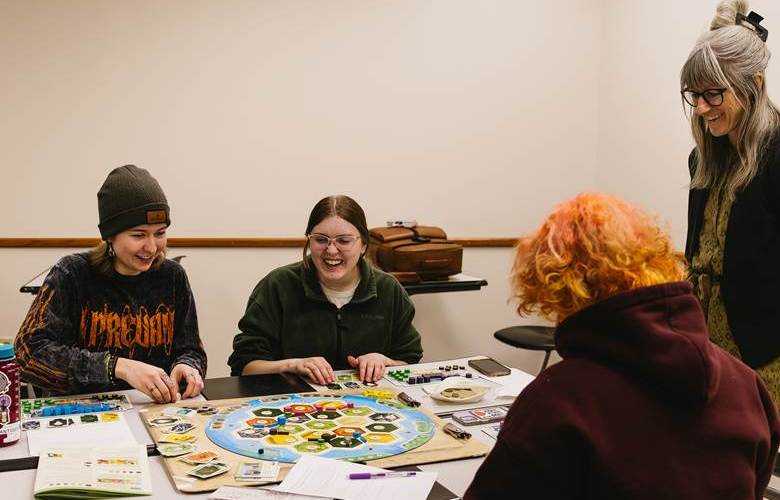
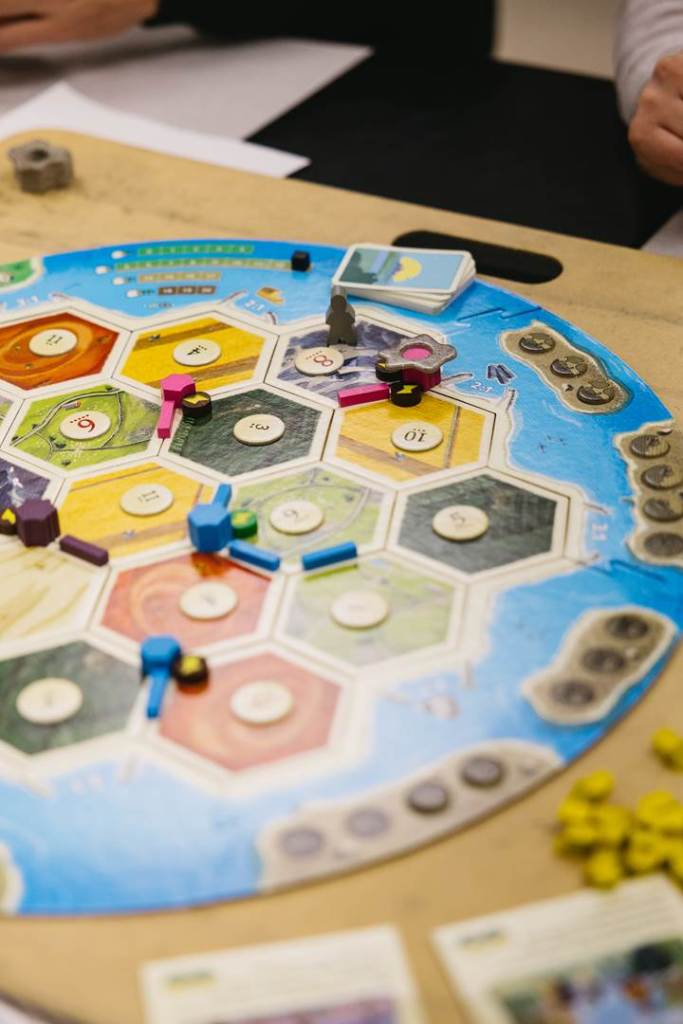
Earlier this semester, students in Environmental Law and Policy (POLS 407) played CATAN – New Energies for the second annual Worldwide Climate Games Day. New Energies is an updated version of CATAN, where players jockey to collect enough resources to build out their society and develop their energy infrastructure. Players can choose to develop cheaper fossil fuels to collect more resources or opt for more expensive renewable energy plants. With more fossil fuel power plants the global footprint climbs higher, which increases the likelihood of triggering a natural disaster or a pollution event.
The game gives players a choice between working collaboratively to bring down their global carbon footprint, or teaming up against each other to build out their fossil fuel energy grids. One group of students played cooperatively by trading resources with each other and exclusively building out renewable energy. Reflecting on this strategy, one student noted that the game helped them recognize the role international cooperation plays in combatting climate change.
Mary Witlacil is Assistant Professor of Political Science.
What’s your area of expertise? What do you primarily research and/or teach? And what drew you to this field?
As a Fine Arts Major during my undergraduate studies, I would find myself getting into impassioned political discussions with my art professor. At some point, he mentioned his love of political science. The next semester, I registered for my first American Politics class, and I was hooked. By the following Fall, I changed majors to Political Science. Then, after working outside of academia, I decided to return to graduate school to study the politics of climate change.
By training, I am an environmental political theorist, and I have broad expertise and interest in environmental politics and policy, critical theory, the politics of climate change, contemporary political theory, and international relations. It might sound peculiar to some, but I am fascinated by the study of politics.
My research draws on contemporary political thought and critical theory to consider how we cope with climate change and environmental injustice. I am curious about what it means for politics and what it means to be human during a moment of massive and catastrophic environmental change.
As a professor at SD Mines, I cover all the political science courses including American Political Issues, Political Ideologies, American Government, and Introduction to International Relations. Next semester I am excited to teach Environmental Law and Policy, and in the Fall of 2024, I look forward to teaching the Politics of Nature and Technology.
What’s one of your favorite courses, topics, or specific texts to teach? Why?
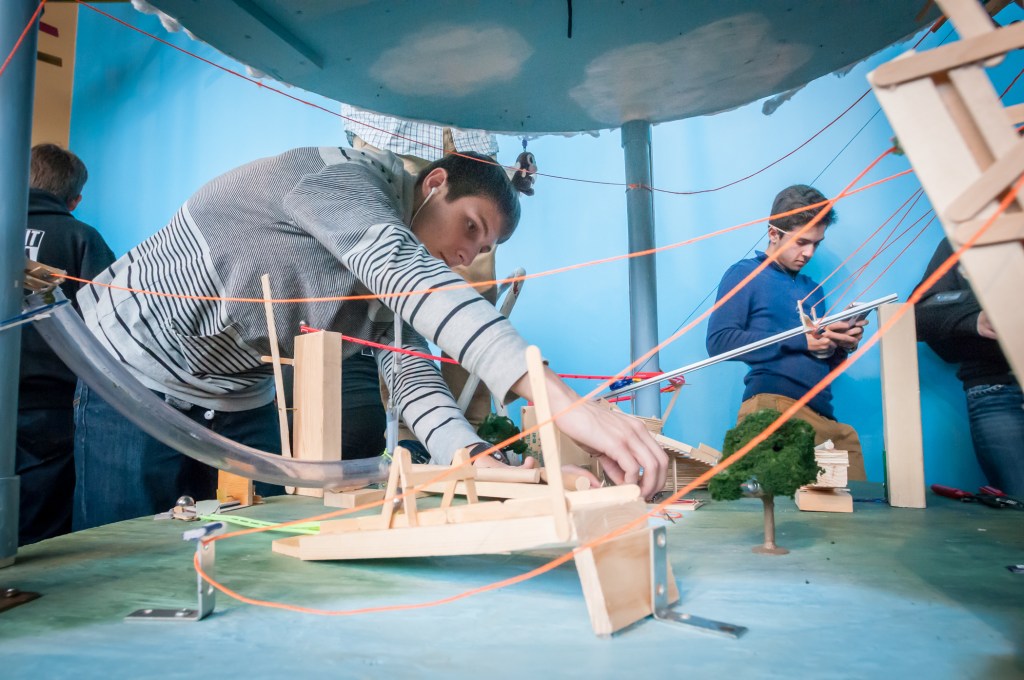
While I do not have a favorite course yet, I love teaching about political ideologies as well as the intersection between politics and the environment. This semester I have enjoyed watching students make connections between the functions (or dysfunctions) of American politics and more local or personal political issues. American politics is like a Rube Goldberg machine—or a chain-reaction machine designed to perform simple tasks in an absurdly indirect manner—where political institutions affect the functioning of the whole in bizarre and surprising ways. Whenever someone proposes or enacts a solution to a political problem, it alters and affects all the intermediary chain reactions, in a way that can be difficult to understand for years or decades. It has been fun to explore this conundrum with students.
31441D, Rube Goldberg contest 2016. Photograph by Mark Lopez (Flickr).
John Dreyer is Associate Professor of Political Science in the Social Sciences department.
What’s your area of expertise? What do you primarily research and/or teach? And what drew you to this field?
I received my PhD in International Relations, and today I focus on strategy and International Security. Most of my research is currently focused on military advisors and how they have operated and what they have done for the last 150 years. It’s fun! My research also fills a niche in the field that is not well covered. My teaching is Foreign Policy/International Relations/Military History with some Political Ideology thrown in for good measure.
I chose Political Science because I liked the idea of theory and the boundaries it pushed. The subfield of International Security also appealed to me. I have taken an interest in military affairs for years and believed I might as well have a go at making it into a degree. I can write and teach about topics that I enjoy and bring that enjoyment to my courses.
What’s one of your favorite courses, topics, or specific texts to teach? Why?
Military history! This is a personal class for me. I’ve been devouring books on all manner of military history since I could read. Every year I choose books that I enjoy and that I believe my students will love as well. My favourite book that I used in 2021 was Ron Chernow’s Grant, which traces the evolution of one of America’s top leaders of all time. Another book I really enjoy using is Odd Arne Westad’s The Global Cold War and the Third World, which talks about small proxy conflicts and small states.