By Christy Tidwell and Erica Haugtvedt
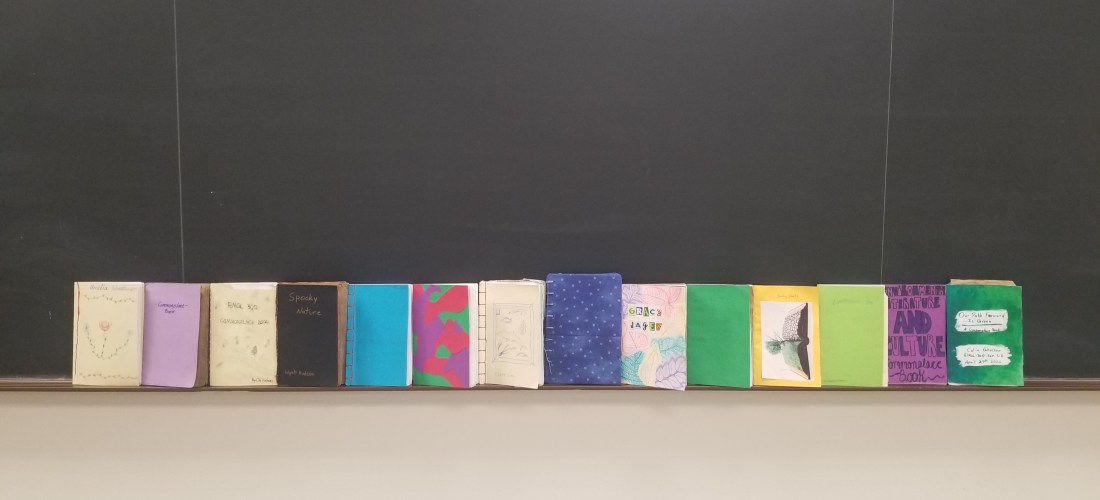
This semester, we both asked students in our classes (Introduction to Humanities and Environmental Literature & Culture) to create commonplace books. We found this to be a successful way to get students thinking about core ideas from class and to encourage creative activity. Read on for more information about commonplace books, how we used them, and how students responded!
What Are Commonplace Books?
Commonplace books have a long history – extending as far back as people have had easy access to paper and writing utensils – and are a way of organizing information for yourself. They can overlap with journals or diaries, but they’re also for classifying and indexing information to find later, and they have taken various shapes over time as they have served different purposes for different groups of people. Religious leaders’ commonplace books in the 17th century, for instance, look and function differently than young ladies’ commonplace books in the 19th. Adam Smyth provides a pretty standard definition of them: “the commonplace book presents a series of thematic headings under which aphorisms are distributed, gathered from reading, or, more rarely, from conversation, and deemed in some way useful or exemplary” (91).
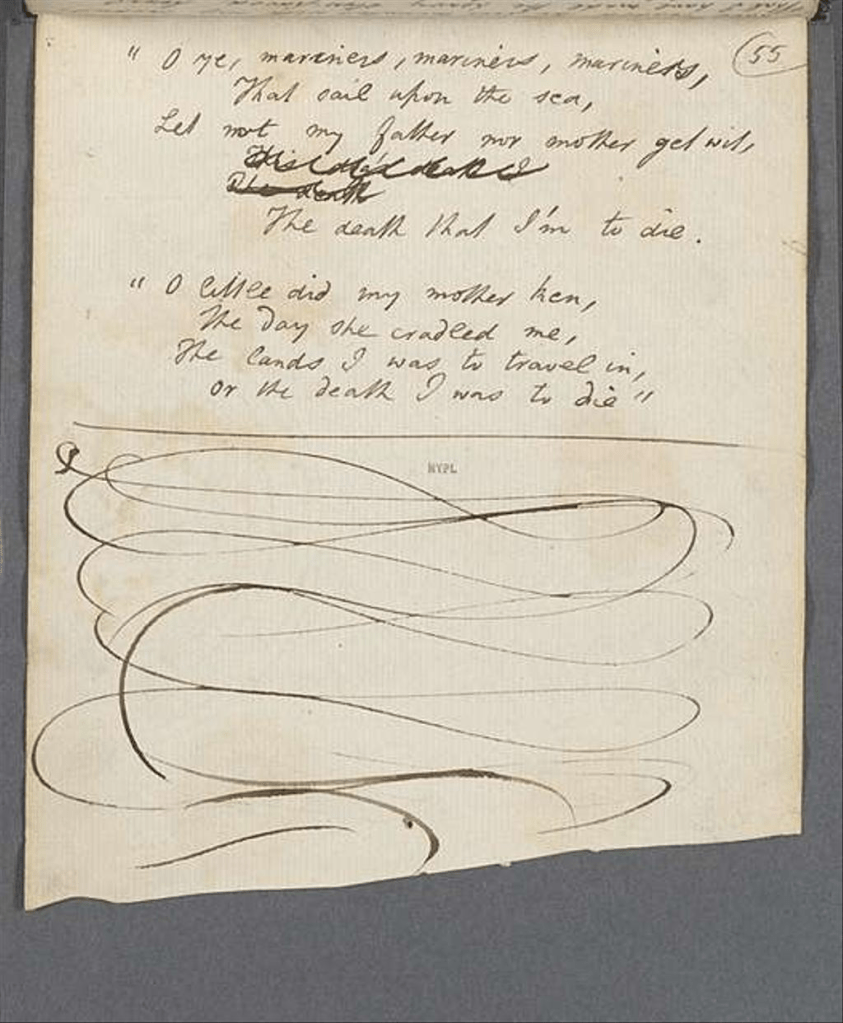
However, Smyth also notes that actual commonplace books only sometimes followed this description. He writes,
The experience of reading manuscript commonplace books is often an experience of baffled delight – delight at pages so crammed with text that annotations spill over the binding and covers; at devotional aphorisms jostling with bawdy epigrams and recipes . . . ; at scraps of printed pages glued into the manuscript; at prose merging with verse merging with financial accounts merging with illustrations; at blank pages, and gaps; at entire printed books bound into the centre of manuscripts; at the construction of a single manuscript out of many different sized pages; at the recycling of old, often medieval texts in the binding of manuscripts; at texts that simultaneously ‘begin’ from various points within their pages and proceed in various directions, so that it becomes meaningless to talk of a front or back, a beginning or an end. (90-91)
Smyth goes on to describe this as an “eclecticism of inclusions” and “rampantly inventive materialism” (91), descriptions which beautifully highlight the flexibility and openness of commonplace books and their inherently physical nature. Both of these elements are closely tied to goals of humanities classrooms that emphasize practicing and learning about a wide range of modes of expression (e.g., film, art, literature, philosophy) and that value creators’ and students’ experiences of the world.

