Commonplace Books in the Classroom: Organizing Ideas and Making Art

art, Classes, Environment, Humanities, STS Faculty

By Christy Tidwell and Erica Haugtvedt

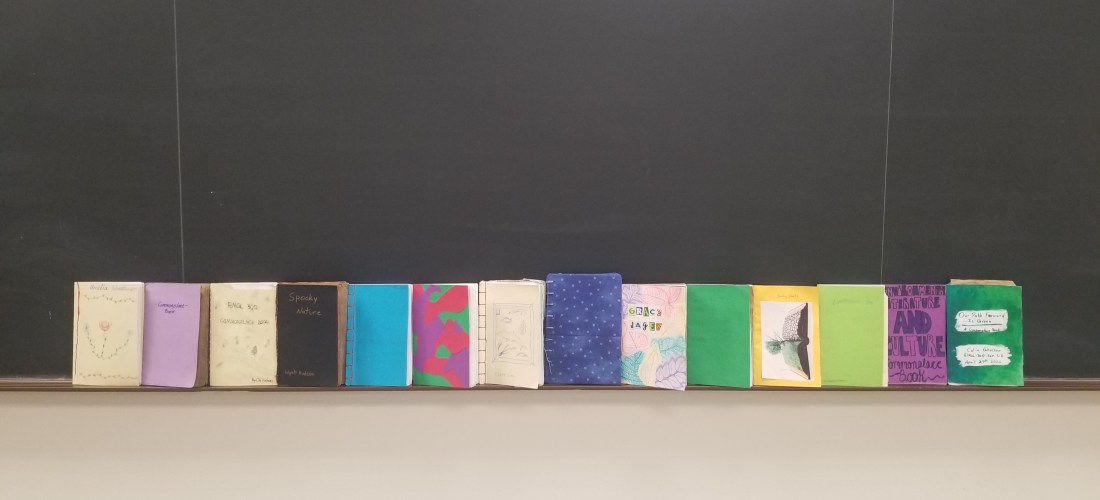
This semester, we both asked students in our classes (Introduction to Humanities and Environmental Literature & Culture) to create commonplace books. We found this to be a successful way to get students thinking about core ideas from class and to encourage creative activity. Read on for more information about commonplace books, how we used them, and how students responded!

What Are Commonplace Books?

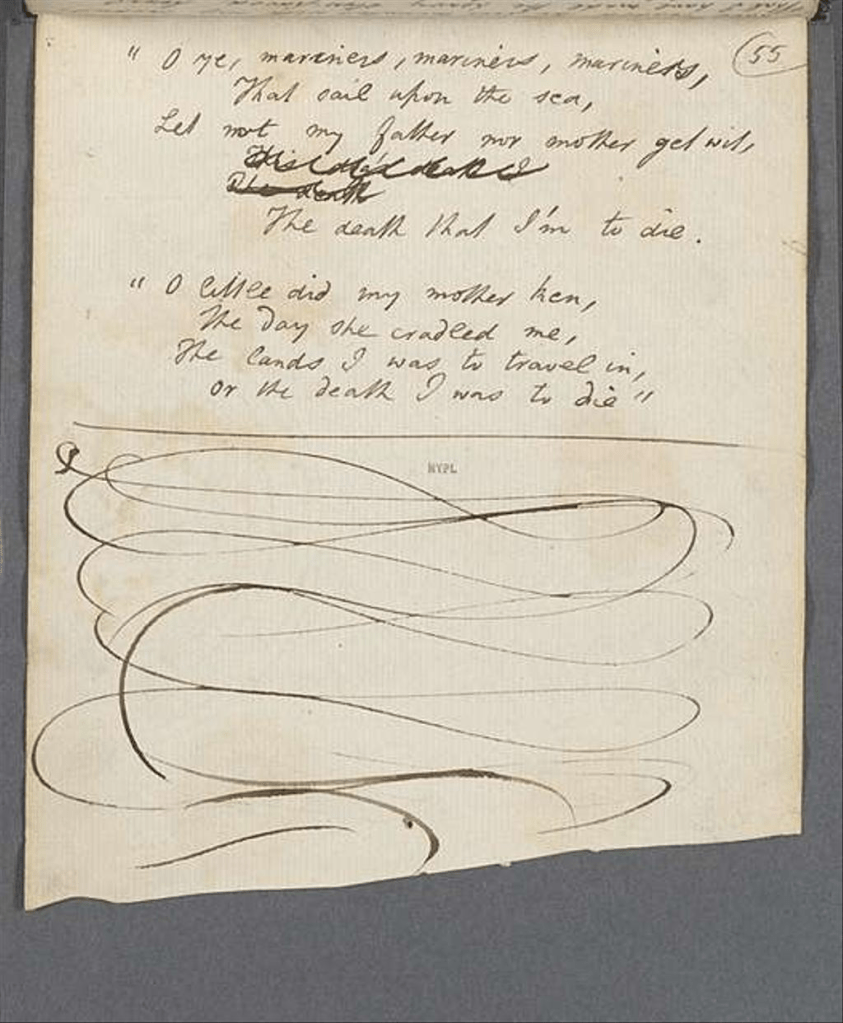
Commonplace books have a long history – extending as far back as people have had easy access to paper and writing utensils – and are a way of organizing information for yourself. They can overlap with journals or diaries, but they’re also for classifying and indexing information to find later, and they have taken various shapes over time as they have served different purposes for different groups of people. Religious leaders’ commonplace books in the 17th century, for instance, look and function differently than young ladies’ commonplace books in the 19th. Adam Smyth provides a pretty standard definition of them: “the commonplace book presents a series of thematic headings under which aphorisms are distributed, gathered from reading, or, more rarely, from conversation, and deemed in some way useful or exemplary” (91).

Page from a commonplace book by author Charles Lamb (1775-1834). Public domain.

However, Smyth also notes that actual commonplace books only sometimes followed this description. He writes,

The experience of reading manuscript commonplace books is often an experience of baffled delight – delight at pages so crammed with text that annotations spill over the binding and covers; at devotional aphorisms jostling with bawdy epigrams and recipes . . . ; at scraps of printed pages glued into the manuscript; at prose merging with verse merging with financial accounts merging with illustrations; at blank pages, and gaps; at entire printed books bound into the centre of manuscripts; at the construction of a single manuscript out of many different sized pages; at the recycling of old, often medieval texts in the binding of manuscripts; at texts that simultaneously ‘begin’ from various points within their pages and    proceed in various directions, so that it becomes meaningless to talk of a front or back, a beginning or an end. (90-91)

Smyth goes on to describe this as an “eclecticism of inclusions” and “rampantly inventive materialism” (91), descriptions which beautifully highlight the flexibility and openness of commonplace books and their inherently physical nature. Both of these elements are closely tied to goals of humanities classrooms that emphasize practicing and learning about a wide range of modes of expression (e.g., film, art, literature, philosophy) and that value creators’ and students’ experiences of the world.

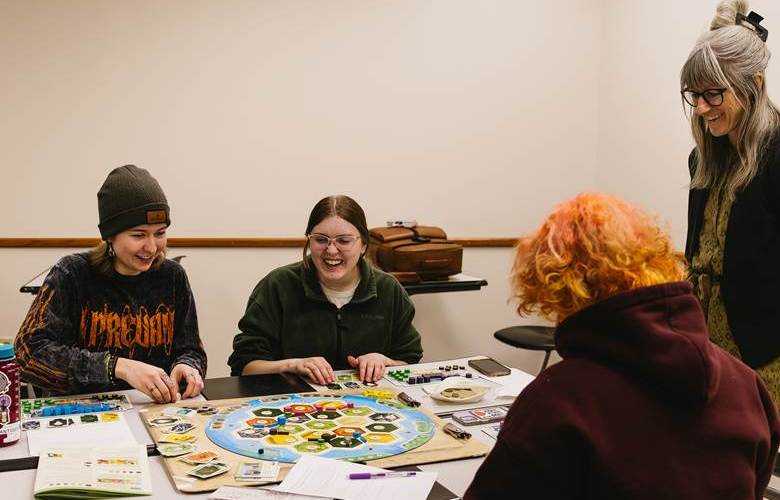
Students sit at a table playing the board game while Dr. Witlacil observes.

What can games teach us about climate change?: Playing CATAN – New Energies for World Climate Games Day

Classes, Environment

By Mary Witlacil

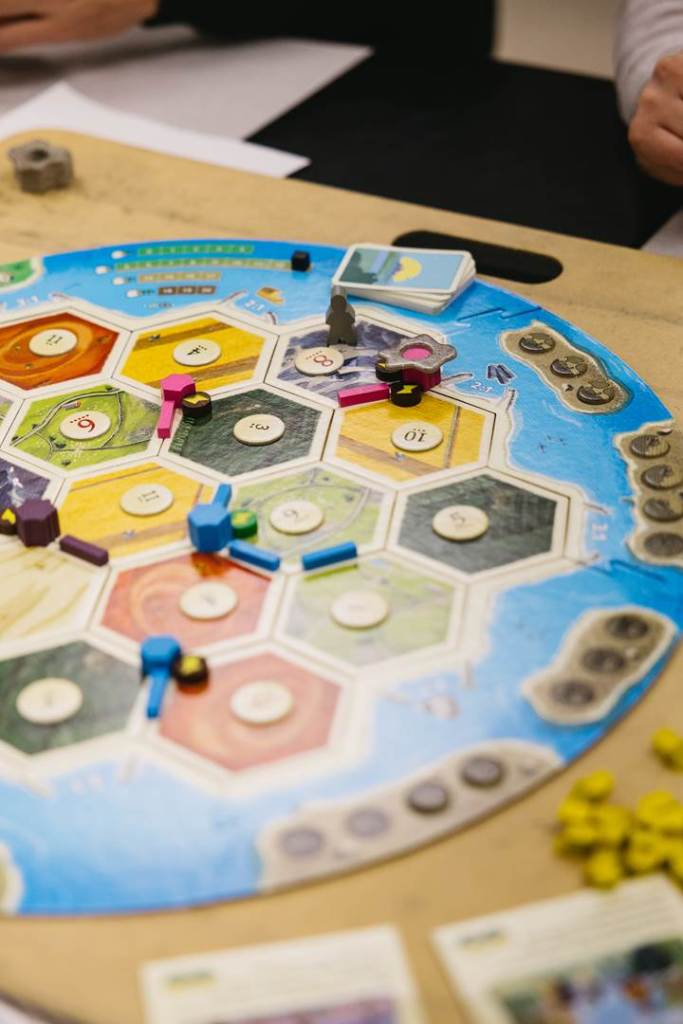
Earlier this semester, students in Environmental Law and Policy (POLS 407) played CATAN – New Energies for the second annual Worldwide Climate Games Day. New Energies is an updated version of CATAN, where players jockey to collect enough resources to build out their society and develop their energy infrastructure. Players can choose to develop cheaper fossil fuels to collect more resources or opt for more expensive renewable energy plants. With more fossil fuel power plants the global footprint climbs higher, which increases the likelihood of triggering a natural disaster or a pollution event.

A Catan game board midway thorugh play, featuring tokens distributed across the game world.

The game gives players a choice between working collaboratively to bring down their global carbon footprint, or teaming up against each other to build out their fossil fuel energy grids. One group of students played cooperatively by trading resources with each other and exclusively building out renewable energy. Reflecting on this strategy, one student noted that the game helped them recognize the role international cooperation plays in combatting climate change.

What Do You Love About Parks?: STS at the Earth Day Expo

Environment, Events

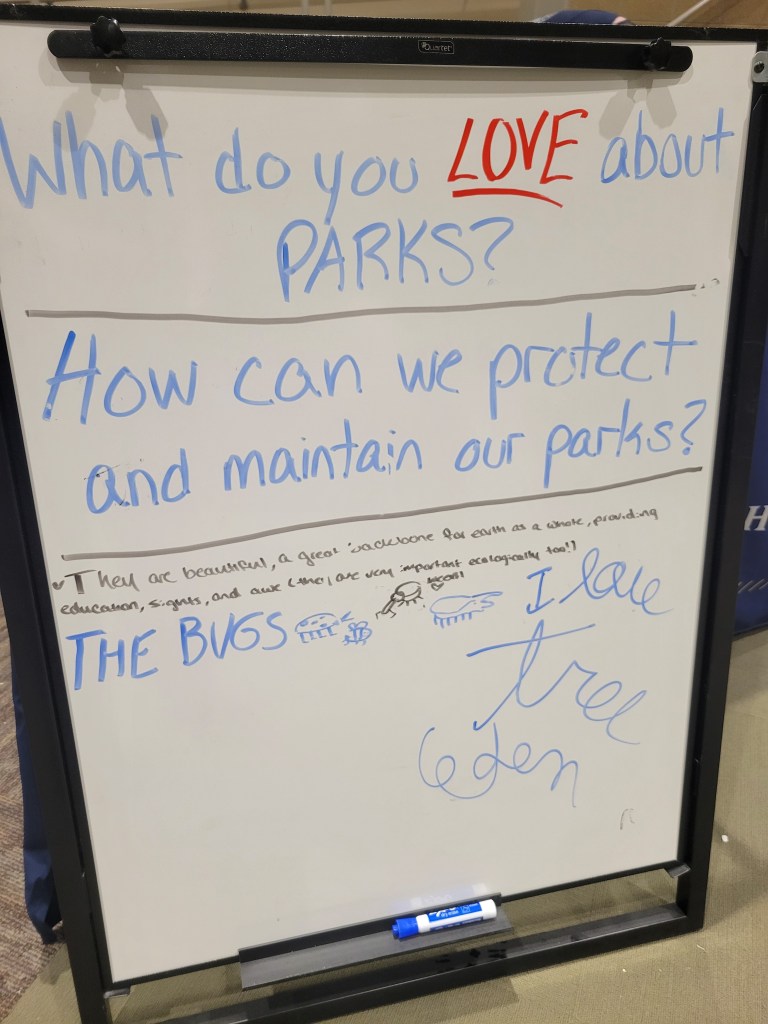
This past weekend, the STS program set up tables at the Earth Day Expo (held on the campus of Western Dakota Tech here in Rapid City) to share information about STS and ask visitors to think about parks as a piece of nature we regularly interact with.

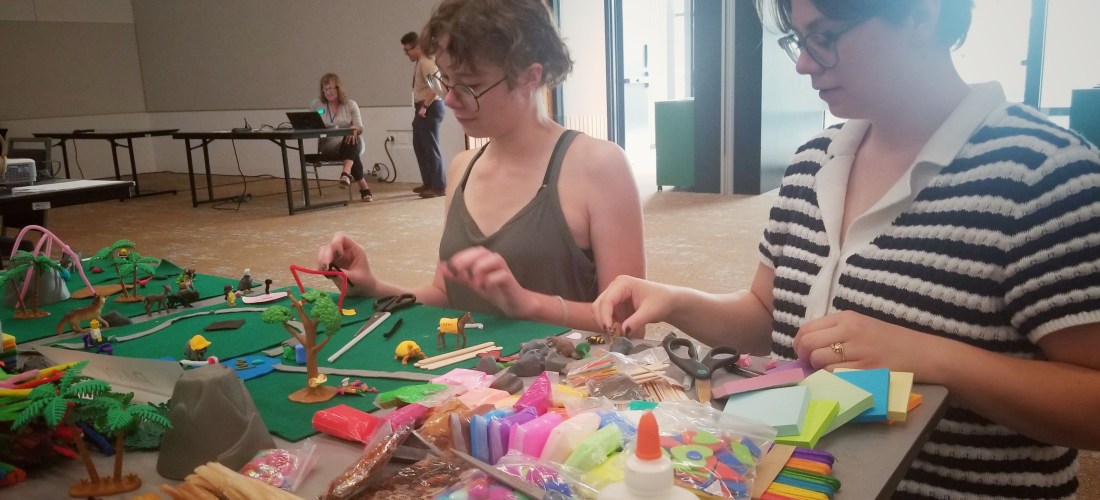
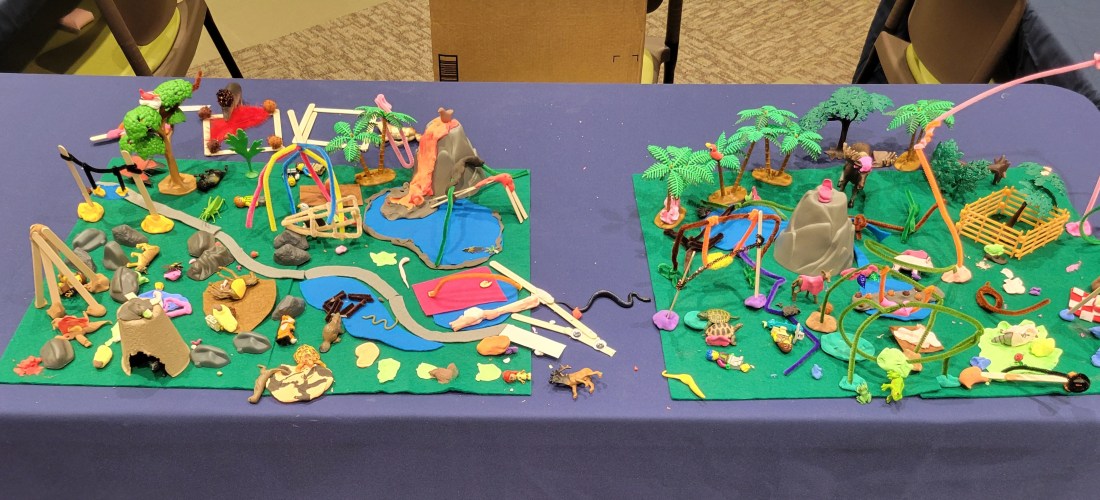
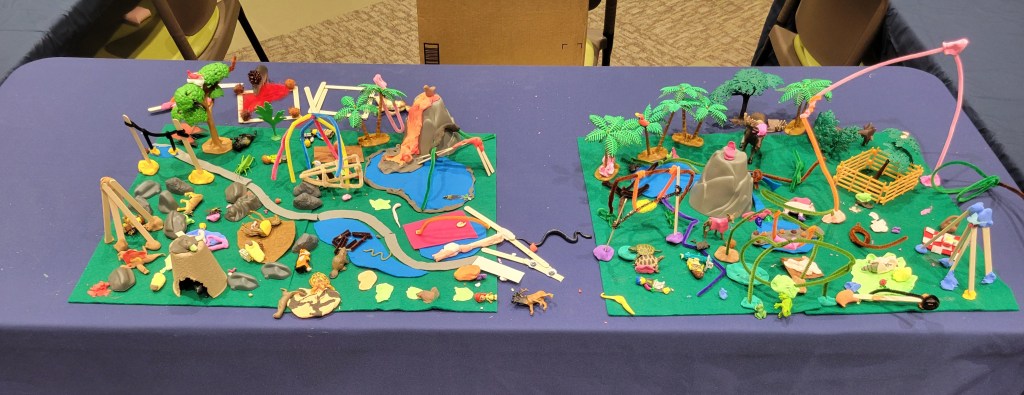
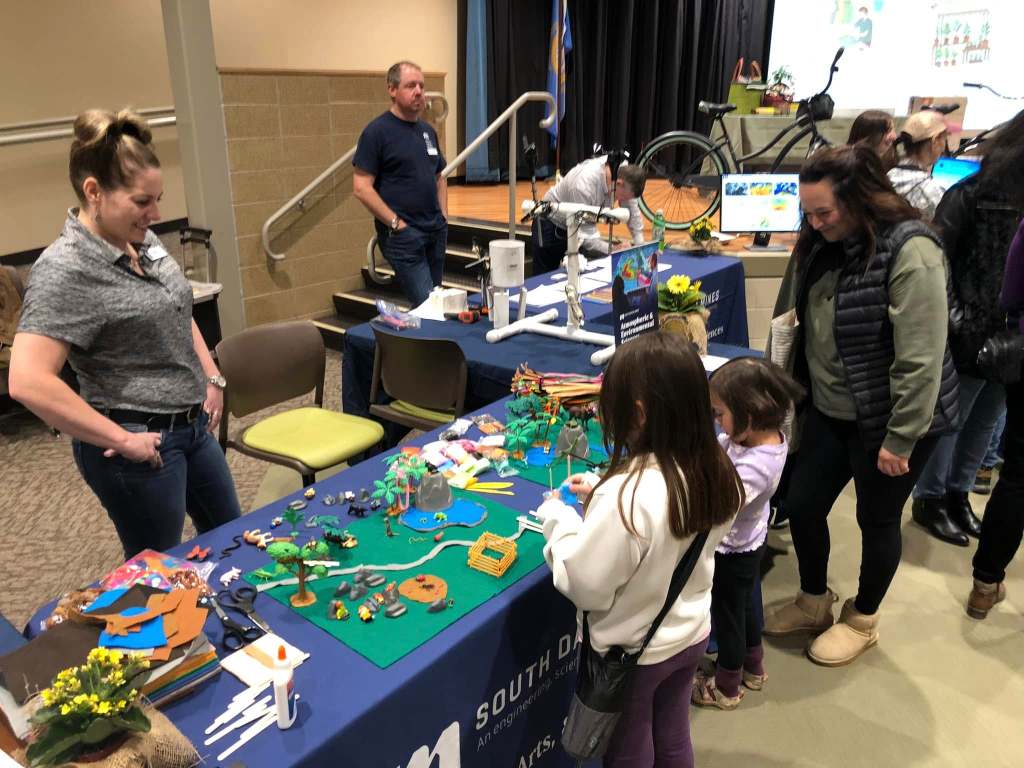
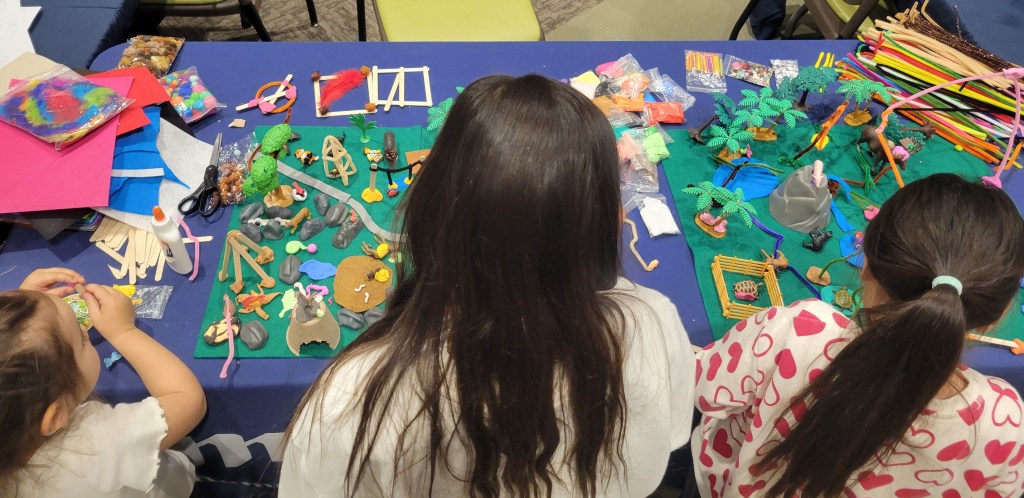
With a whiteboard for sharing ideas in response to the key question – What do you love about parks? – and a table for visitors to build their ideal park, we invited lots of hands-on participation and engagement.

Parks are a great way to practice STS ways of thinking at any age, since they are intersections between natural and social spaces and they are shaped by our technologies as well as our social needs and expectations. Plus, it’s fun to play with toys, felt, and clay!

We hope to be back at the Earth Day Expo again next year!

Whiteboard with the question What do you LOVE about parks? at the top. Answers focus on beauty and education, bugs, and trees.
Some of the answers to our question about what we love about parks.
Two green felt park spaces with trees and paths and ponds and animals, etc.
Some very full park designs!
Dr. Pritchard observes children working on park design elements.
Dr. Kayla Pritchard at the table while kids build parts of a park. (Photo credit: Rapid City Municipal Government.)
A few children - seen from behind - working on park elements.
Kids working on park development.

Upcoming Upper-Level Courses – Fall 2026

Classes

This fall, the Humanities, Arts, and Social Sciences department and STS program are offering upper-level classes covering a range of topics:

  • Topics: Urban/Rural Divide in American (ENGL 392) – MWF at 1 pm
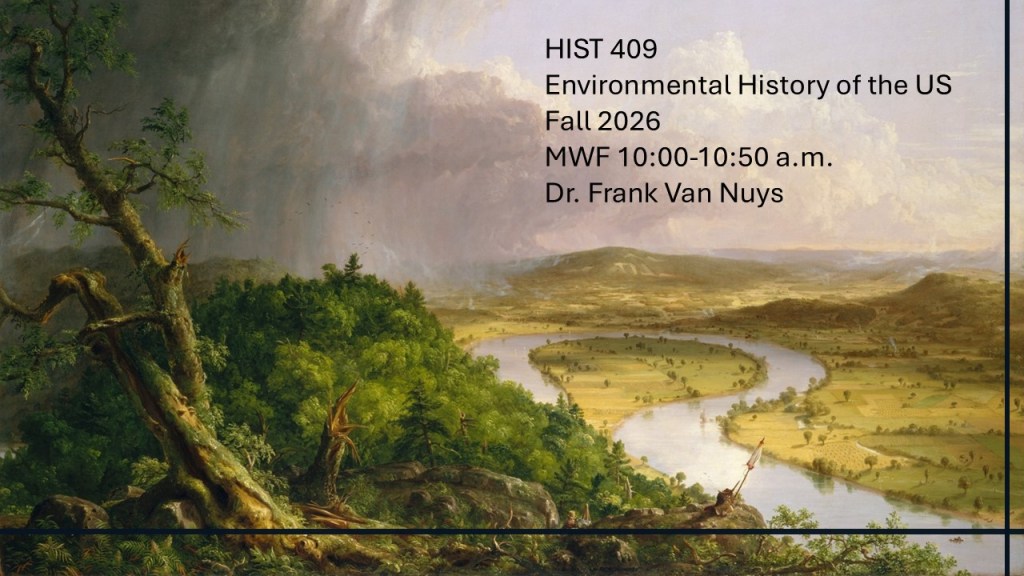
  • Environmental History of the US (HIST 409) – MWF at 10 am
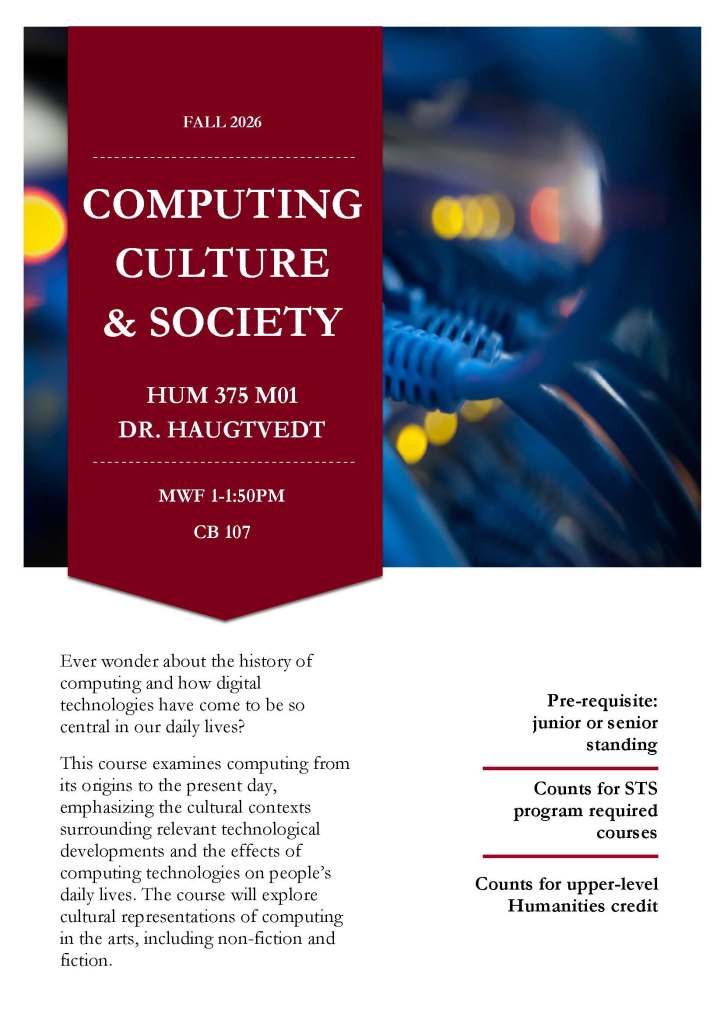
  • Computing, Culture, and Society (HUM 375) – MWF at 2 pm
  • Music in Performance II (MUS 317) – TBD
  • History and Philosophy of Science (PHIL 335) – MWF at 11 am
  • Theories of Personality (PSYC 461) – MWF at noon
  • Criminology (SOC 351) – MWF at 9 am
  • Senior Seminar in STS (STS 401) – 1 pm

Given this range, there’s almost certainly something interesting for everyone to take – and there’s very little conflict in times between them, so imagine the fascinating semester a Mines student could have by taking several!

For a taste of a few of these classes, check out the posters below.

Dinosaur Movies and Climate Change: STS at the SD Mines Student Research Symposium

communication, STS Students

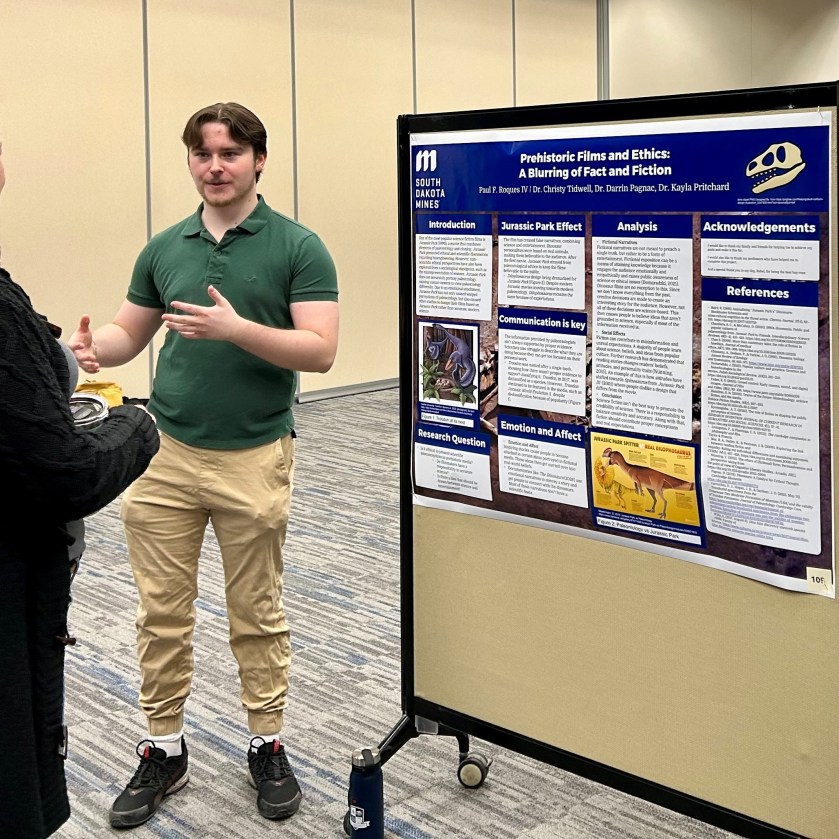
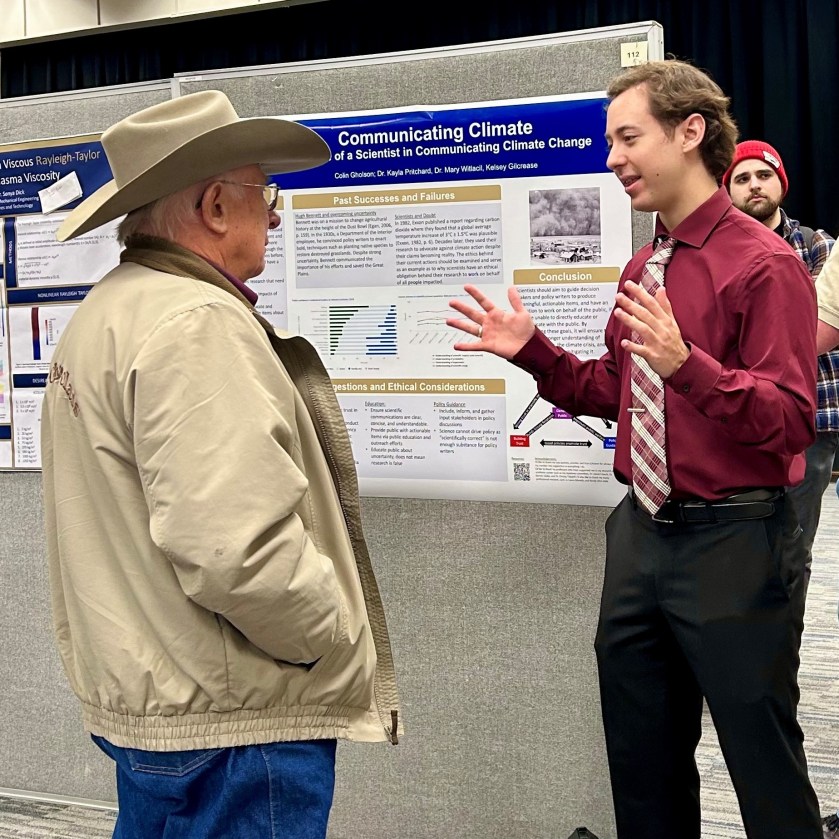
Last week, the 16th Annual Student Research Symposium was held on campus, and two of our STS students presented posters about their senior capstone research. Colin Gholson presented “Communicating Climate: The Role of a Scientist in Communicating Climate Change,” and Paul Roques presented “Prehistoric Films and Ethics: A Blurring of Fact and Fiction.” (Colin also presented his poster the next day at Black Hills State University’s student symposium in Spearfish.)

Paul Roques standing next to his poster, presenting to an audience member.
Paul Roques presenting his poster.
Colin Gholson presenting to an audience member in front of his poster.
Colin Gholson presenting his poster.

Paul’s poster anlyzed media representations of paleontology, including the Jurassic Park franchise and dinosaur documentaries (for more on Paul’s topic, you can read his post about his capstone proposal from last fall), and Colin’s examined real-world examples of climate communication while developing ideas about climate communication-related education and policy. Although their topics may seem at first glance to be quite different, the two posters emphasize what’s at the heart of STS: the relationship between people and science. Whether raising questions about how movies influence our understandings of paleontology or about how we can help people to understand climate change, STS is fundamentally about how people engage with science and technology.

Presenting their research at the symposium allowed them to experience sharing their ideas with a wider audience, receiving feedback and answering questions on their research, and having the opportunity to further refine their ideas before completing their capstone projects later this semester.

Service Learning at Trinity Eco Prayer Park III: Choosing Native Grasses

Classes, communication

Reflections on Service Learning Lessons with Trinity Eco Prayer Park in Dr. Haugtvedt’s Fall 2025 STEM Communication for Public and Technical Audiences Course

Mario Dominguez: Restoring a Prairie, One Volunteer Step at a Time

When our class partnered with Trinity Eco Prayer Park this semester, I expected a simple clean-up project. What I discovered instead was a living example of how small ecological changes can ripple through an entire landscape. One of the most striking lessons came from learning how invasive species, especially Canada thistle, can spread quickly and choke out native grasses. These native plants aren’t just background scenery; they anchor soil, trap moisture, and support insects, birds, and even the microorganisms underground. Removing an invasive patch doesn’t just make the park look nicer, it helps restore the natural cycles that keep the prairie healthy.

Our time in the park also revealed how restoration is as much about people as plants. Every volunteer who pulled weeds or cleared debris added visible progress, but they also became connected to the ecosystem they were helping. Science communication often talks about “ecosystem services,” but seeing the concept firsthand–cleaner soil, healthier growth, and a space that brings peace to visitors–made the science feel personal. Trinity Eco Prayer Park isn’t just a project site; it’s a reminder that anyone can make a meaningful impact when they understand the science behind their actions.

By the end of the semester, our team didn’t just complete a service project, we contributed to a small but powerful example of community-driven ecological restoration. And that’s what I hope others see when they visit the park: a place where science, stewardship, and community come together to revive a prairie one season at a time.

Lucas Geiger

While our team was researching possible alternatives for the Kentucky Bluegrass lawn at Trinity Eco Prayer Park it became clear that the simplest and most sustainable solution could be found right outside of town. We thought that native South Dakota grasses like prairie dropseed, western wheatgrass and buffalo grass are naturally built for the local climate and would be great options for the park’s ideology. In their own ways, they can all handle droughts, bounce back after foot traffic and survive through large temperature swings. Creating a mix of the three seemed like the best option to maximize each species’ strengths and weaknesses. This is contrary to the existing Kentucky Bluegrass which is unable to take care of itself without significant work.

Choosing native grasses for the park isn’t just a design choice, it fits in with the park’s ecological values. These grass species will help improve the existing soil’s health, support the local insect diversity and create a landscape that changes more naturally throughout the year. Our goal for the lawn conversion was to give the park a stronger connection to South Dakota’s natural landscaping by replacing one of the last non-native areas in the park.

Park sign featuring QR code.

Service Learning at Trinity Eco Prayer Park II: Installing QR Codes

Classes, communication

Reflections on Service Learning Lessons with Trinity Eco Prayer Park in Dr. Haugtvedt’s Fall 2025 STEM Communication for Public and Technical Audiences Course

Josiah Gibbs

When I first walked into room 206W in the Classroom Building, I was expecting a typical English class. I was not expecting Professor Haugtvedt to outline our main project for the semester as a real-world research project for Trinity Eco Prayer Park in Rapid City, a nonprofit organization. We would not be assigned a prompt. Instead, we would be forming groups and researching problems the park faced, writing first a project proposal, then a recommendation report, then presenting our findings in person to the Board of Trinity Eco Prayer Park.

English assignment? This was more like a senior design project.

I was suddenly excited. When my team of five chose to research how Trinity Eco could install QR codes in the park, I knew our research would impact the Rapid City community. I also knew that, because this was a real client, the project would prepare me for communicating outside of a college environment. Often, classes are a little too “safe” – isolated from industry – but this class was industry.

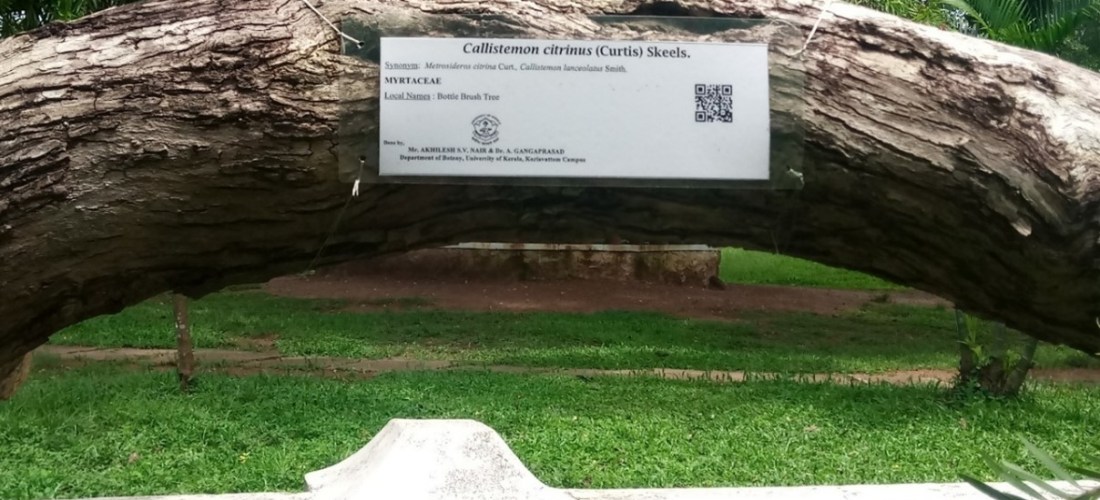
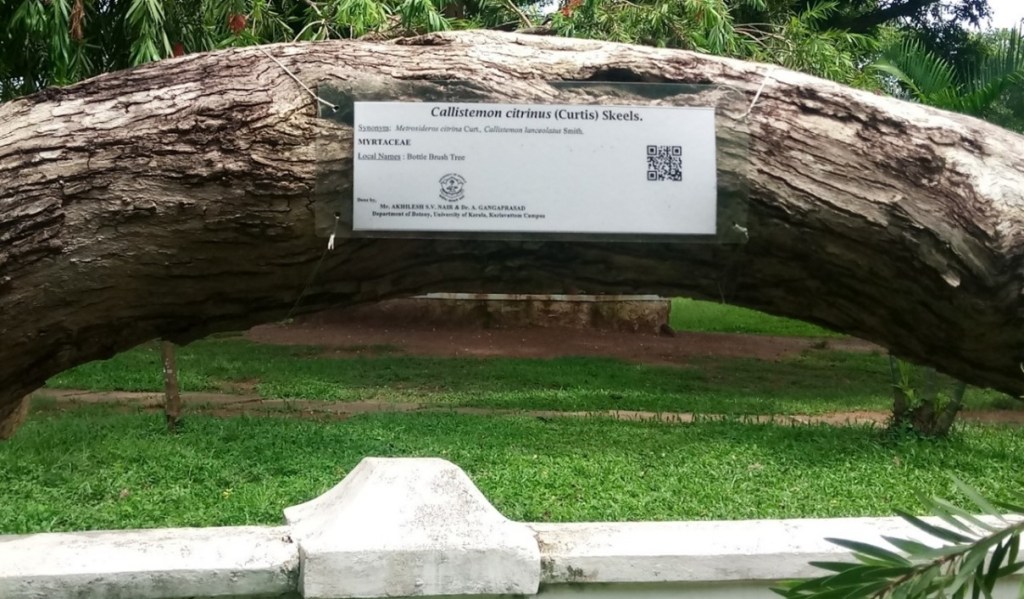
QR Code Used as a Plant Label at Kanakakkunnu Palace. Photo: ASV Nair, CC BY-SA 4.0 <https://creativecommons.org/licenses/by-sa/4.0&gt;, via Wikimedia Commons.

Our team had a picture of Trinity Eco’s future – we wanted to research ways to install QR codes. In a normal project, that would be the end of it, but here we had to communicate with our client and make sure our vision lined up with theirs. Part of my role was to talk to the park’s director, Ken Steinken, to clarify our budget and make sure our plans would match Trinity Eco’s own picture of the park’s future. And, with five team members, we had to communicate among ourselves as well. Everyone needed to know their role and communicate their progress to the group. This was all besides our main communication with Trinity Eco: the proposal and the report we were writing. To make a real impact, we had to be able to share information on multiple fronts. The same will be true in a career. With this project behind me, though, I know I can communicate on that level. When I stood in front of Trinity Eco’s Board with my team, describing our plans for QR code installation, I realized we had succeeded – the Board understood our research, and they resonated with it. I’m taking that confidence with me into the future. After this project, I know I can communicate.

Laptop on the grass in a park

Service Learning at Trinity Eco Prayer Park I: Improving the Website

Classes, communication

Reflections on Service Learning Lessons with Trinity Eco Prayer Park in Dr. Haugtvedt’s Fall 2025 STEM Communication for Public and Technical Audiences Course

Krista Burkman

Service learning is beneficial in many ways, from learning more about a local organization to seeing the impact one person or a group of people can have on a community. The project we completed in Dr. Haugtvedt’s Fall 2025 ENGL 289 does just this. Through working to help the Trinity Eco Prayer Park find potential solutions to one of their problems, I learned how a person or a group of people can have a larger impact on the community than I previously thought.

One of the issues the park is currently facing is finding ways to utilize its website to show off all the park has to offer and recruit donors. I spent time reading articles to learn more about the different audiences the park would like to reach and the content each audience prefers. After compiling all my newfound information, I was able to compose a recommendation for the park board. This included several options for creating strong and effective content for their website, which can also be used on social media platforms if the park were to utilize them.

Even though this may seem like something small, this will help the park improve its website and be more well-rounded when trying to create content to entice viewers. This also helps them gain donors, which then helps the broader Rapid City community. The park may have the funds to continue doing upkeep, general maintenance, and taking on new projects to update or improve the park. The park board’s mission is to bring together people in Rapid City. By maintaining the park and creating a safe environment for residents and visitors of Rapid City, they continue to bring people together and strengthen the community.

2025 SURF Artist in Residence Showcases Interactive Sculptures at Mines APEX Gallery

Apex Gallery, art, Events, Guest Speakers

Last summer, Washington, D.C.-based artist Chris Combs swapped his urban studio at the Otis Street Arts Project for one that required a 10-minute open-cage elevator ride, personal protective equipment, and a brass tag etched with his name, indicating his presence nearly a mile underground.

As the 2025 Artist in Residence (AiR) at the Sanford Underground Research Facility (SURF), Combs brings his unique experience to life through an interactive exhibition at the South Dakota Mines APEX gallery. The exhibition opens with a reception from 4:30 – 6:30 p.m. on Friday, Jan. 23.

Photo credit: Matt Kapust, SURF

The show will feature interactive, time-based sculptures crafted from found objects, metal, wood and other industrial materials—many of them salvaged during Combs’ time at the Sanford Underground Research Facility (SURF) in Lead. By weaving discarded materials into his work, he aims to echo the layered history of the Homestake Mine and its evolution into a world-class underground laboratory, a dual legacy that drew him to apply for the SURF AiR program.

“I wanted to see firsthand the machinery of particle physics, and the human ‘machinery’ that constructs and maintains it nearly a mile underground in a dusty former gold mine with flood-marked walls,” Comb said. “In my art, I think a lot about how technologies have changed our world, and Homestake/SURF is two rounds of that: first, the transformation of a mountain into 370 miles of tunnels and drifts, and then the transformation of that mine into a container for globe-spanning experiments. The idea of astrophysics occurring a mile underground was very intriguing.”

Photo credit: Stephen Kenny, SURF

Combs creates his pieces with the goal of having audience interaction. “I am lucky to get to make interactive artworks, where pushing a button or inserting a metal ball makes something happen,” he said. “At least for me, actively participating helps me remember it later. This extra little conversation between an artwork and its viewer also offers a challenge and a reward: do you dare to touch the thing? If so, here is an unexpected result. I hope that my artworks reward your curiosity.”

We’re Off to See the Blizzard!

Atmospheric Science Students

By Kendall Custer

On March 19th, 2003, residents of the Denver Metropolitan area and the adjacent foothills awoke to a winter wonderland. However, instead of thoughts of stressful work commutes and plans for backyard snowball fights, a sense of cabin fever was settling in. This was the third day of one of the largest snowstorms in Denver’s history. According to the National Oceanic and Atmospheric Administration’s (NOAA) National Regional Climate Center snowfall accumulation database, some residents saw up to thirty inches of snow over four days. As a result, thousands of residents were on lockdown without power and unable to leave their homes.

While the March 2003 blizzard was one of the more memorable snowstorms in the past fifty years, Coloradans are familiar with large blizzards and their inevitable consequences. Other notable Denver storms include the Christmas 1982 blizzard that dropped nearly twenty-four inches of snow, and, more recently, the March 2021 “Pi Day” blizzard that buried the Front Range in twenty-seven inches of snow (data courtesy of the Denver/Boulder National Weather Service [NWS] Weather Forecast Office [WFO]). Large snowstorms like these often result in significant road and travel closures, power outages, and property damage, which are difficult to prepare for and a consequence of inaccurate weather forecasting. Yet, despite what many Coloradans believe, the local meteorologists are not at fault. It is the unfortunate reality of living near large mountain ranges, such as the Rocky Mountains, where radar and satellites struggle to track current weather patterns accurately and topography can change conditions on a dime.

Growing up as a Colorado native who has heard the stories of (and even lived through) these intense blizzards, I developed a passion for mountain meteorology and often wonder: how do we improve weather forecasting for the mountainous terrains that make up our colorful state? What can we as meteorologists do to gather accurate information to help major metropolitan areas mitigate impacts? These questions inspired me to choose the topic of my senior capstone project: investigating the patterns associated with mid-latitude cyclones and how they impact snowfall over Metro Denver and the Foothills.

Mid-Latitude Cyclone Over the Midwestern US as seen from the GOES West Satellite. Photo: NOAA Satellites.

As defined by NOAA’s National Environmental Satellite, Data, and Information Service (NESDIS), a mid-latitude cyclone is a low-pressure system that forms between 30° and 60° latitude, including most of the continental United States, excluding the Gulf Coast and Florida. These pressure systems fall on the “synoptic-scale” (NOAA), meaning their size can range from 620 to 1,500 miles, i.e., the size of one state to multiple at once. If you’ve ever looked at a weather map on the news before, you’ve likely seen a mid-latitude cyclone’s familiar “T-Bone” structure (Schultz & Mass). It consists of a red “L” (for the center of the low-pressure zone), a red line with semi-circles (a warm front), followed by a blue line with triangles (a cold front), and occasionally a purple line with alternating semi-circles and triangles (an occluded front). When looking through the lens of thermodynamics and atmospheric physics, a more complex framework appears, including what is referred to as “conveyor belts”: air bands that vary in temperature, moisture, and density (Lackmann). In a mid-latitude situated over the Midwestern United States, air flows counterclockwise around the low-pressure system. As it does so, warm, moist air is pulled from the Gulf, creating the “warm conveyor belt.” Meanwhile, an east-to-west “cold conveyor belt” of cold, moist air forms ahead of the warm front. When these two belts meet, the warm conveyor belt is quickly forced upward, where the air cools and condenses into clouds before falling as precipitation.

Diagram of air conveyor belt relationship with a low-pressure system. Diagram by Kendall Custer.

In my research, I hypothesize that when a mid-latitude cyclone brings blizzard conditions to Denver, the system’s low-pressure center is most likely positioned over southeastern Colorado. Here, the warm and cold conveyor belts have an easterly flow when they reach the eastern slopes of the Rocky Mountains and encounter upslope forcing, a process where topography redirects wind from horizontal to vertical flow. During this, the air is rapidly cooled, condensing into clouds and producing significant snowfall over Denver and the Foothills.

As mentioned earlier, forecasting these large, heavy snowfall events is challenging in regions like Denver, which is why research like mine focusing on the patterns of meteorological processes is essential. Improving the accuracy and timeliness of numerical weather forecasting can prepare residents (i.e., supply stocking), allow government agencies like the Colorado Department of Transportation to prepare roads by dropping sand/magnesium-chloride to prevent icing, and provide time for energy companies such as Excel to plan for power outages. In the end, these preparations not only keep metropolitan areas like Denver operating during large snowstorms but can save Coloradans’ lives, enforcing the necessity of improved weather forecasting and mountain meteorology research.

References

Denver/Boulder Weather Forecasting Office. (n.d.). Denver’s Fall/Winter/Spring Statistics. National Weather Service. https://www.weather.gov/bou/DenverFallWinterStatistics.

Lackmann, G. (2011). Midlatitude Synoptic Meteorology: Dynamics, Analysis, and Forecasting. American Meteorological Society.

NESDIS. (2018, June 22). Mid-Latitude Cyclone on the First Day of Summer. NOAA. https://www.nesdis.noaa.gov/news/mid-latitude-cyclone-the-first-day-of-summer.

NOAA Satellites. (2019). Powerful Storm System Seen by GOES West [Photograph]. NOAA. https://www.flickr.com/photos/125201706@N06/47380253391.

Schultz, D. M., & Mass, C. F. (1993). The Occlusion Process in a Midlatitude Cyclone over Land. Monthly Weather Review, 121(4), 918-940. https://doi.org/10.1175/1520-0493(1993)121%3C0918:TOPIAM%3E2.0.CO;2.

Synoptic Meteorology. (2023, May 16). NOAA. https://www.noaa.gov/jetstream/synoptic.


I am a Senior Atmospheric and Environmental Science Major with a Meteorology Specialization and a minor in Mathematics. The question of when I first became interested in the weather is greatly debated in my household, ranging from me searching our yard every day for fallen weather balloons after a local TV meteorologist visited my elementary school to when I would beg my dad to pull over so I could take a photo of a cool cloud. Regardless, every childhood fascination with something weather-related led me to today, where I have developed a passion for synoptic-scale meteorology, cyclogenesis, mountain meteorology, severe weather, and investigating the unknown. After graduation, I plan to continue my education by earning my master’s degree, ideally internationally (fingers crossed!), and eventually working in my dream career as an atmospheric researcher. When my head is not in the clouds or my textbooks, I enjoy a range of hobbies, including creative writing, arts/crafts, paddleboarding/hiking with my dog Hershey, and powerlifting.