By Christy Tidwell
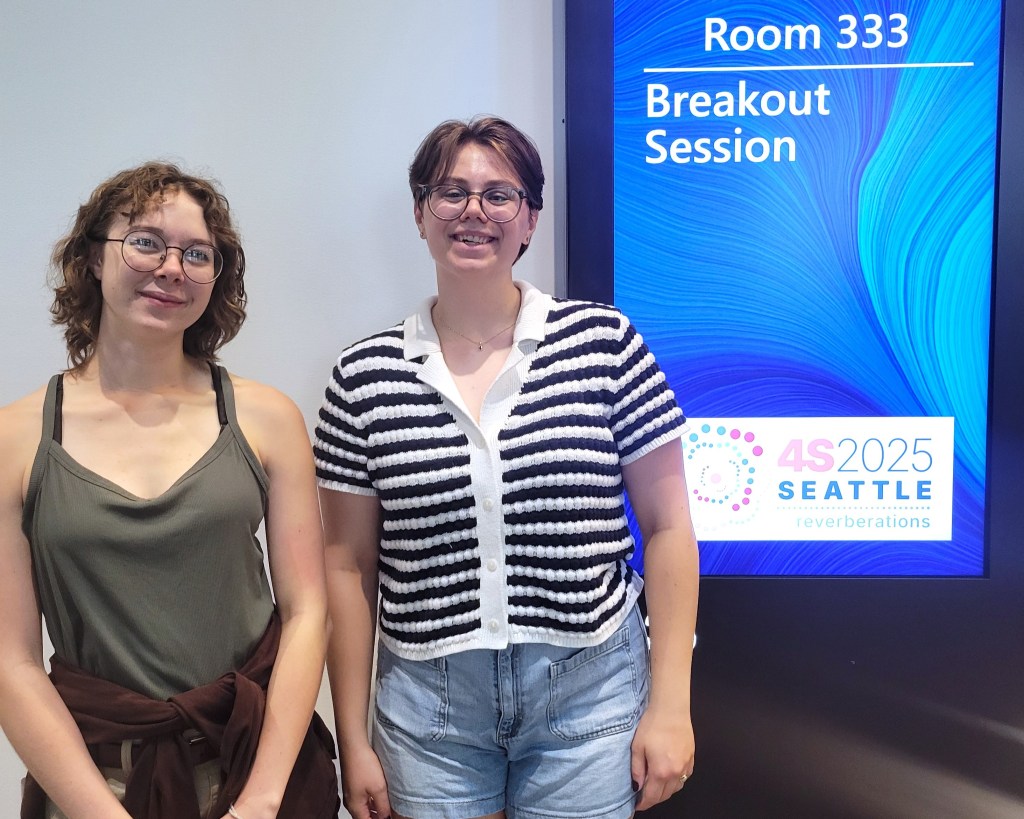
At the beginning of this academic year, the Science, Technology, and Society program sent three faculty members (Erica Haugtvedt, Kayla Pritchard, and myself) and two STS students (Claire Linn and Parker Smith) to the Society for Social Studies of Science (4S) conference in Seattle. (Thank you to the Raising for Rockers donors whose generosity made it possible for the students to attend!)
Faculty members took part in the conference as well as attending panels and learning about the work done by other STS scholars from around the world. This was the first academic conference the students had attended, so they got to learn about STS as a field but also about how conferences work. 4S is a large conference, so it provided a wide range of opportunities for all of us to explore, and both faculty and student experiences helped illustrate key elements of STS as a field.
Faculty Presentations
Erica Haugtvedt presented a paper in a cluster of panels themed around computing beyond the digital. She describes her paper and its focus as expanding how people think about computers and computing: “My paper was on how modern computing descends from Charles Babbage’s application of the detailed division of labor in factories to the work of calculation, first by humans and later by (steam-powered) machines, and the human implications of this reorganization of work in the nineteenth century.” Her work on the history of computing highlights the emphasis within STS as a field on the ways that technologies rely on human labor. As she says, “The other presenters on the panel and the audience seemed glad to be reminded of the historical roots of computing in factories and readily granted that computing today is still fundamentally a re-distribution of work between humans and machines. When I have presented this work to other audiences, I spend a lot of time establishing the relationship between computing and the detailed division of labor, so it was notable that STS scholars were ready to grant this connection easily.”
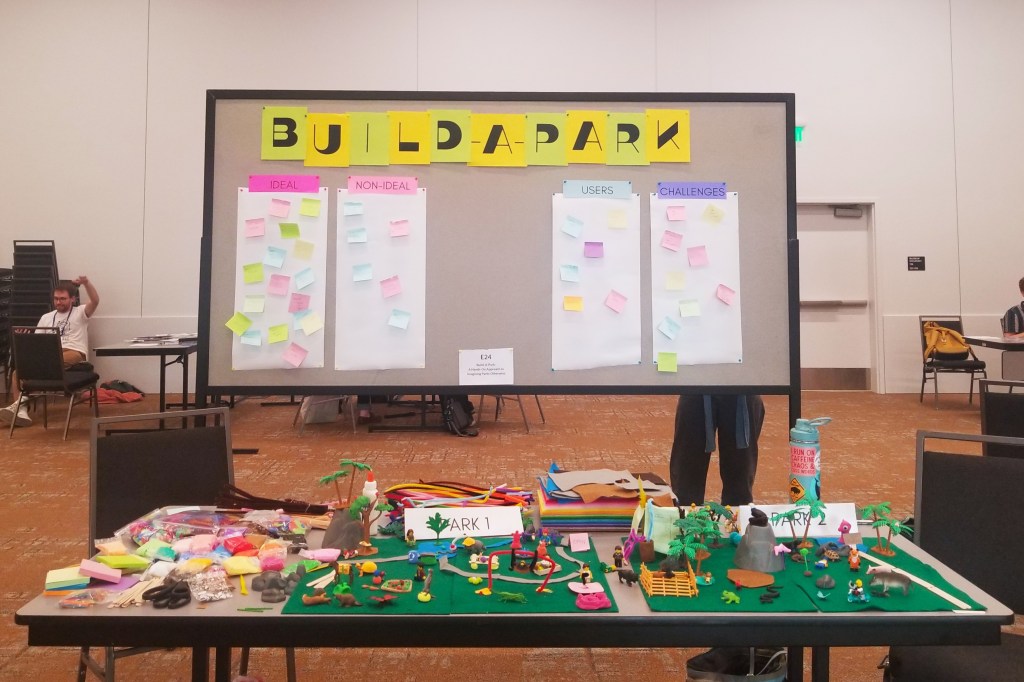
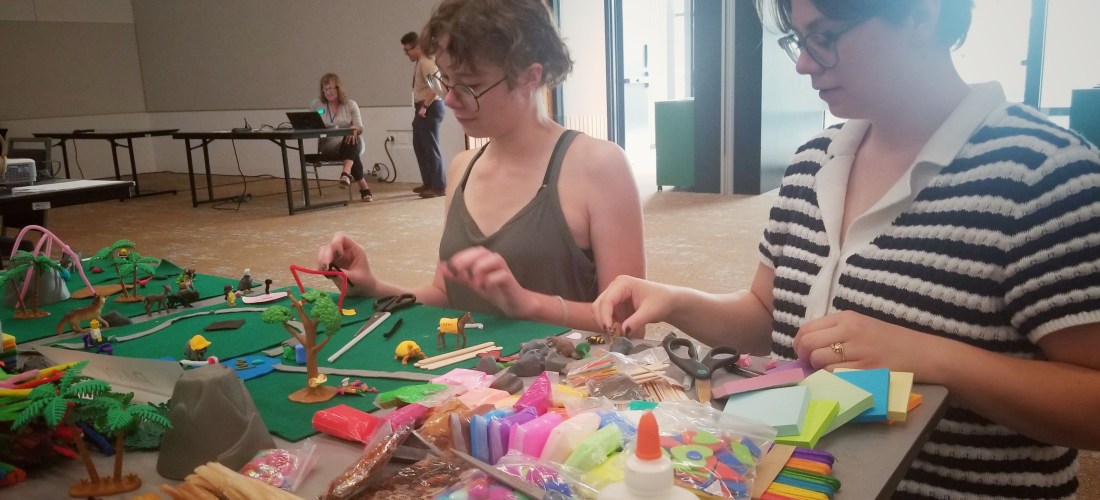
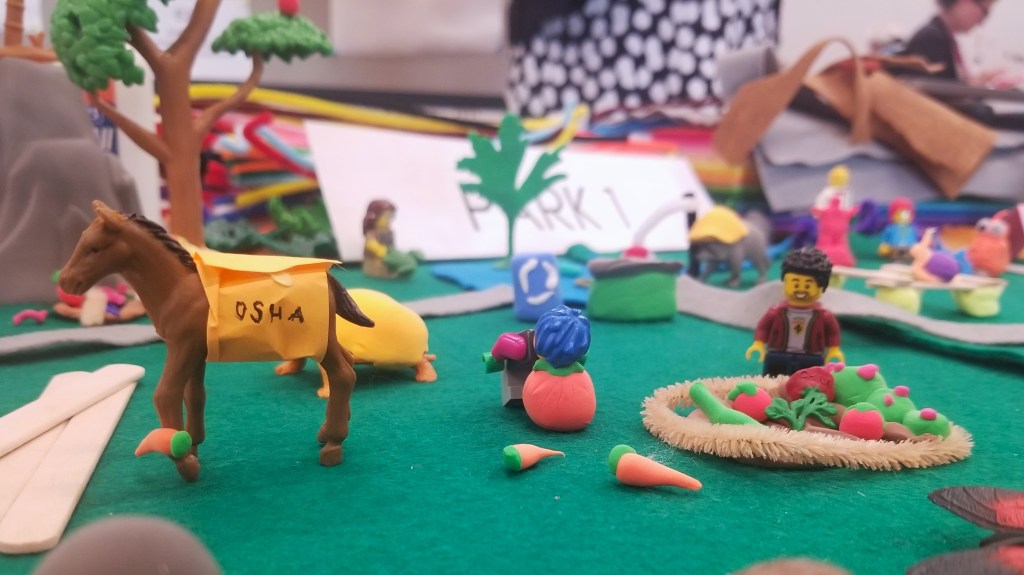
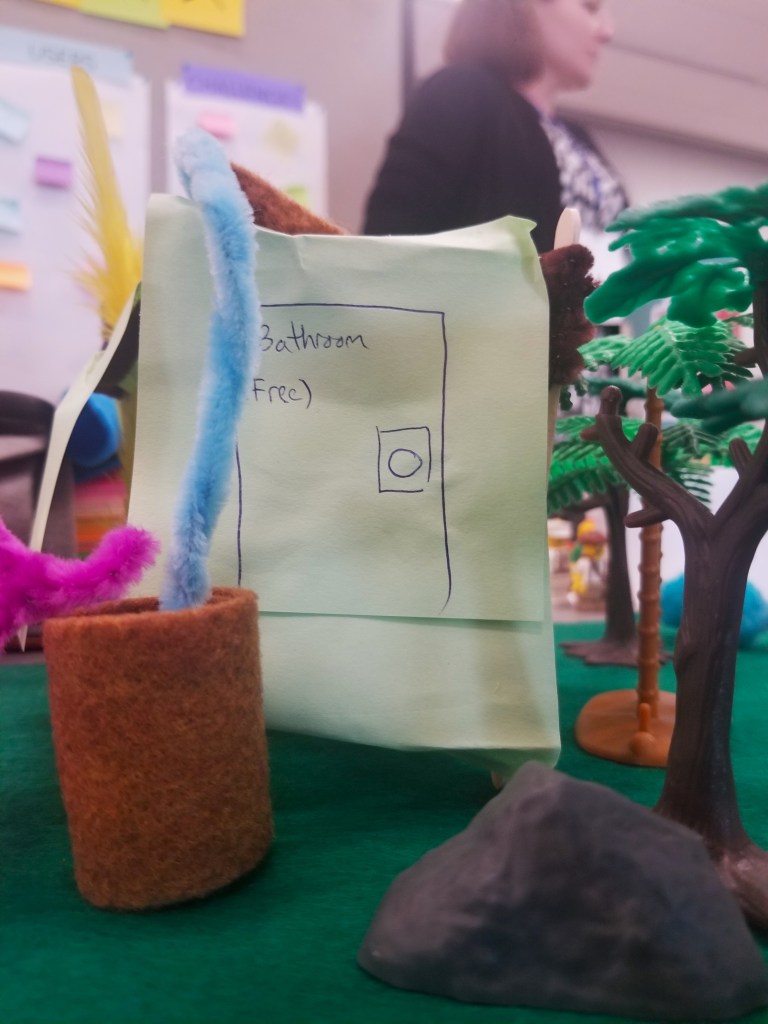
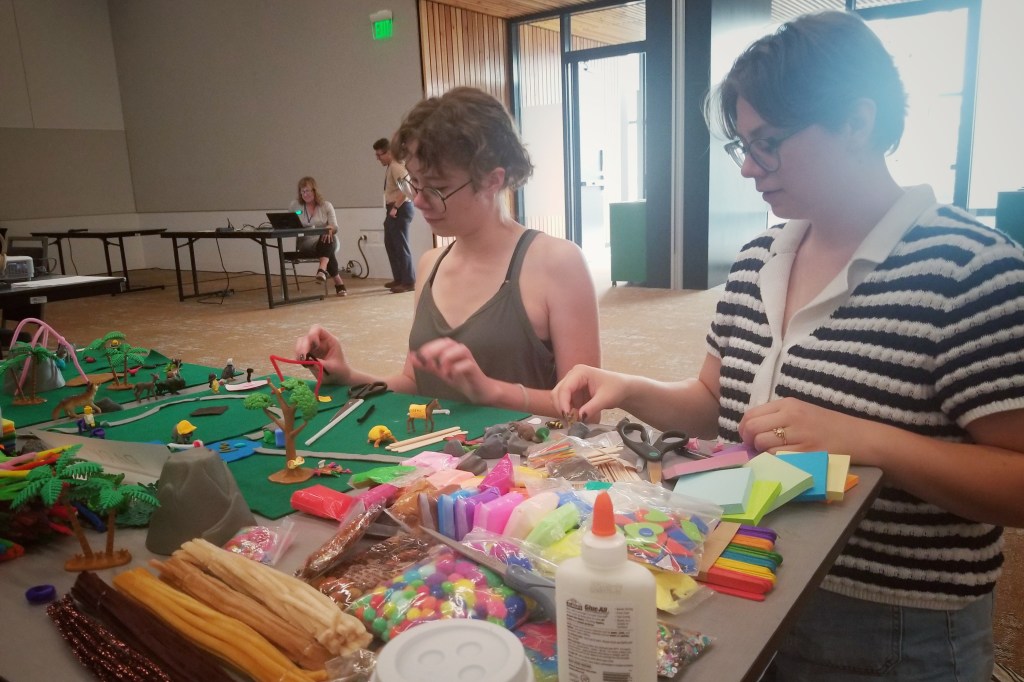
Kayla Pritchard and I took part in the Making and Doing session, where we shared our work related to the social construction of parks in an interactive presentation we called Build-A-Park. Making and Doing sessions are theoretically grounded but more experimental than traditional presentations, often including artistic or hands-on components. Our Build-A-Park table featured arts and crafts materials for participants to use as they contributed to building various versions of parks. Over the course of the day, new visitors combined their ideas of what makes a good park with those of others who attended and participated throughout the day. People built bathrooms (free to the public!), added animals, and constructed playgrounds, benches, and gardens. As people explored others’ contributions and made their own, we talked with them about the assumptions and values underlying their choices and asked people to also contribute ideas to the board behind us. On the board, we had four categories (elements of an ideal park, elements of a non-ideal park, users of parks, and challenges facing parks) where we could add sticky notes showing the range of ideas our participants came up with for them. Our Making and Doing session emphasized connections between daily life and STS history and theory, and we had some great conversations with others about the ways that park technologies and infrastructures shape and are shaped by people’s park experiences and expectations.
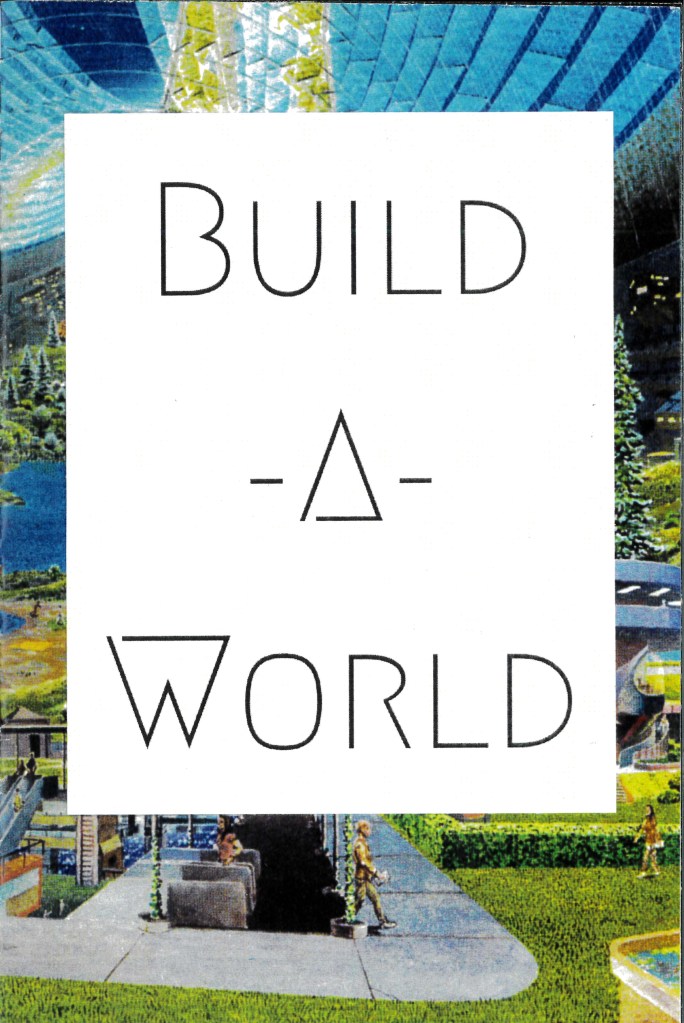
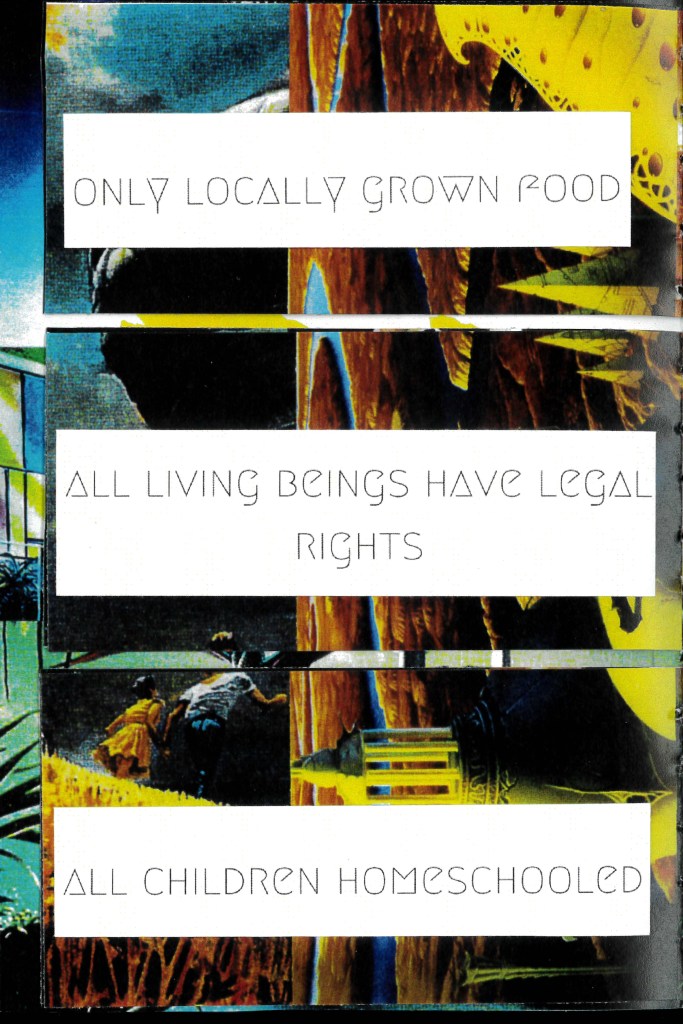
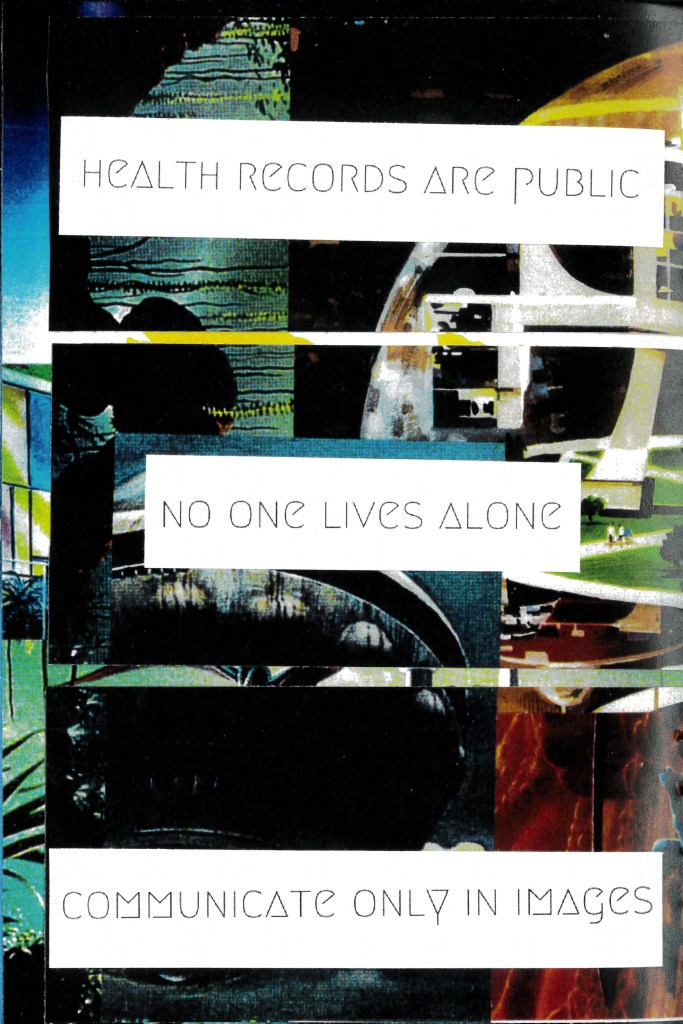
I also submitted a zine to the conference, which was shared as part of a zine display. My zine was called “Build-A-World” (echoing our Build-A-Park Making and Doing session title) and was inspired by teaching science fiction and having students do worldbuilding exercises as a way of thinking about how possible futures are shaped by new technologies and/or infrastructural changes. Constructed as a half-page booklet style zine with flip-flap folding on the interior to allow readers to mix-and-match science fictional worldbuilding elements inspired by Marina Zurkow’s Investing in Futures card game, my worldbuilding zine drew on ideas about zines themselves as “practices of ‘poetic world-making'” (Allen 23) and about STS as a a space for thinking about the the ways we build worlds.
The Student Experience
The two STS students who attended 4S were not presenting; their goal was to observe and to learn more about the field. They attended the plenary session with us, many panel sessions (including Erica Haugtvedt’s panel), the Making and Doing session (where they helped contruct some interesting park elements – see OSHA horse above), and the zine display. They also regularly met with us for meals, where we were able to share ideas from the conference and talk about what we were all learning.
Upon our return, I asked students to write about their experiences, including what they learned about STS and what stood out at the conference. They both enjoyed the conference and felt they got a better sense of the field as a whole. Claire Linn said, “The 4S conference provided a unique experience for me to observe the reaches of STS in a myriad of fields. I can’t imagine a better way to enlighten myself than to be surrounded by professionals discussing the relations between their field (from geology to neuroscience) and social studies.” And Parker Smith said, “”I loved the 4S conference! What really grabbed my attention about it was the various ways people were using STS for research and education.”
They also shared specific panels or presentations that spoke to them. Parker noted a presentation about Y2K that “argued that the panic surrounding Y2K was systematically created by computer scientists to get large companies and the government to take action and change how computer stored dates” and Claire noted one called “The Ethics of Refusal,” which discussed intersections between archaeology and modern Indigenous culture and “how communication is conducted when artifacts are not available to ‘western’ archaeologists due to cultural values.” These two topics are quite different from each other on the surface, but they each helped students see the way that STS works and make connections between scholars in the field and what they’ve been learning in STS classes at Mines.
Both Claire and Parker commented on how attending the conference helped them understand STS more fully. As Claire noted, STS is a broad field, and one challenge can be figuring out how to turn this field of study into a career after graduation. She wrote that an important part of figuring that out “is awareness of how this major can be applied across the many fields of science. The 4S conference, more than anything, took some of my rudimentary scientific interests and allowed me to really dive into critical thought about those disciplines.” Ultimately, she says that the conference helped her narrow down some possible directions that she might want to take her STS degree.
Attending 4S was a productive experience for Parker and Claire. They study what STS is here on campus, but seeing it in action with far more scholars doing such a wide range of things with it vividly demonstrates its potential. Parker left the conference with an understanding of STS as “being about connections,” about “”thinking deeper about subjects and “acting as a liaison between science and humanities.” Similarly, Claire described STS as “bridg[ing] the gap between the scientific world we want to uncover and the social world all scientists are bound to.”
It’s wonderful to see that the conference continues – months later – to impact the students and their sense of STS. Asked very recently to think back to the conference and what they took from it, Parker noted that the impact was broad, not limited to a specific topic. They said, “it shifted my outlook by how I perceive topics or examples, not by showing me different connections but through the analysis.” Claire reported continuing to think about the “Ethics of Refusal” panel she attended, saying she made connections between it and two classes she took this year: Marine Ecology and Environmental Literature & Culture. But more broadly, she says that the conference was a good reminder for her of the value of her major:
Like anyone, I have doubts that I’ve chosen the right major, but when I remember the multitude of diverse panels that I got the pleasure of seeing in Seattle I’m reminded that STS is what I’m most passionate about, and there is a place for those who want to pursue that major.
Works Cited
Allen, Gwen, “Artists’ Zines: The Fanzine as an Artistic Medium,” Copy Machine Manifestos: Artists Who Make Zines, ed. Branden W. Joseph and Drew Sawyer, Brooklyn Museum, 2023, pp. 16-23.

