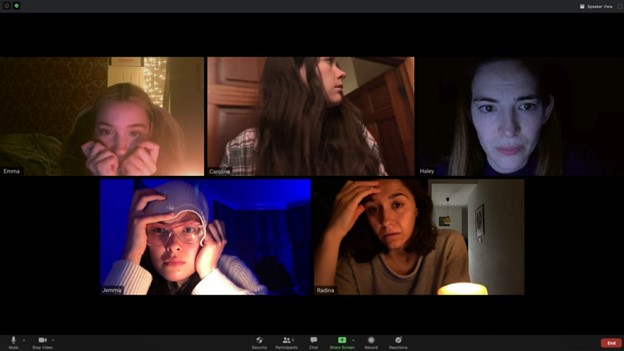
The 2020 film Host (dir. Rob Savage) was recently crowned the scariest horror movie according to a scientific study that measured the heart rates of 250 viewers watching 40 different films. As someone who watches a lot of horror and is usually not affected by it, I had to turn on all the lights in my house after watching it alone on a tablet. Why is it so scary? It’s all in the technology.
Host (2020)
The film is about a séance held by five friends and a medium, all in different locations and connected to each other not only through the medium leading them or their shared concentration but also through Zoom, a program we’ve all come to rely on to make us feel connected to each other. As the trailer asks, what if it connects us with something else?
There’s just a week and a half left before Halloween, but there’s still time for more spooky movies! This week’s classic and contemporary movie recommendations prominently feature scientists and scientific research, highlighting the risks of scientific experimentation and exploration (especially when done outside the bounds of formal research contexts) as well as the limits of scientific knowledge.
Classic Movie #4: The Fly
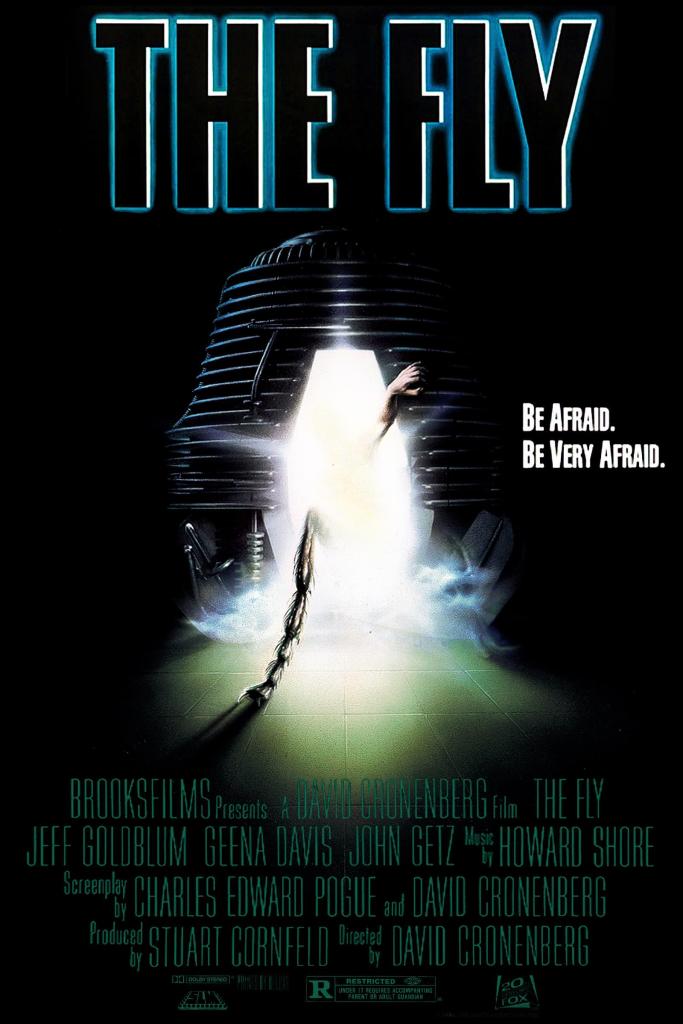
David Cronenberg’s 1986 remake of The Fly is a classic of body horror. Its central premise is that a human (Seth Brundle, played by Jeff Goldblum) merges with a fly and becomes a horrifying human-fly mutant: Brundlefly. This transformation emphasizes bodily mutation through both the intimate horror of things like losing fingernails (as gruesomely shown in the bathroom scene) and the ultimate form of Brundlefly, so dramatically changed that it no longer has a recognizably human face.
The Fly is also another horror film about mad science (following in the footsteps of Frankenstein, recommended during Week 1). It’s not just that a human merges with a fly, after all, but that a scientist conducts experiments on himself that go very wrong. The film dramatizes what can happen when scientists abandon the norms and regulations of scientific practice. If you can’t get funding through traditional means, how far are you willing to go for your research? Are you willing to experiment on yourself? Although historically there have been quite a few scientists willing to do this, The Fly serves as a cautionary tale indicating that this will not always work out. Some renegade scientists might get to be Humphry Davy (who experimented with nitrous oxide and discovered its use as an anesthetic – without killing himself!), but others are Seth Brundle/Brundlefly.
Poster for The Fly (1986)
Contemporary Movie #4: Annihilation
Alex Garland’s Annihilation (2018, an adaptation of Jeff VanderMeer’s 2014 novel of the same name) also follows a scientist, a biologist (Natalie Portman). She is on an expedition with an anthropologist, a psychologist, a surveyor, and a linguist (all women) into a mysterious environmental disaster zone known as the Shimmer. The Shimmer doesn’t follow the familiar rules of nature and ever stranger things happen to and around the group of explorers. Without giving too much away (since the movie is still relatively recent), I can say that Annihilation centers both scientific exploration and environmental issues, which connects it nicely to the STS degree.
Where The Fly endorses traditional science by showing the awful consequences of going outside its boundaries, Annihilation takes a different approach, illustrating the limits of scientific knowledge. The team of women in Annihilation are overwhelmed by the world within the Shimmer, ultimately unable to study it objectively and changed by it instead. In both films, scientists are unable to remain completely separate from what they study.
Trailer for Annihilation (2018)
For more recommendations, check out earlier entries in this series: Week 1, Week 2, and Week 3!
On Tuesday, October 19, from 6-7 pm (Mountain time), Erica Haugtvedt (Assistant Professor of Humanities) and Duana Abata (Professor of Mechanical Engineering) will present as part of the STEAM Café series. This free presentation will take place at Hay Camp Brewing Company in downtown Rapid City (601 Kansas City St.) and will also be available to watch via livestream on Zoom. The talk will also be posted to the SD Mines YouTube channel and the SD Mines Facebook page after the event.
Long before today’s pervasive digital computers, the first computer programmer was arguably Augusta Ada King, Countess of Lovelace (daughter of the famous poet Lord Byron). An exceptional mathematician, she captured the essence of Charles Babbage’s Analytical Engine, which was conceptualized by Babbage but was not constructed in his lifetime. In 1843, she wrote an algorithm to accompany Babbage’s Engine. Her contribution to calculate Bernoulli numbers with the Analytical Engine has since been successfully translated, with minor changes, to the C++ programming language. Dr. Erica Haugtvedt and Dr. Duane Abata will discuss how this extraordinary Victorian woman achieved her insights through translating between languages, people, disciplines, and between the imaginary and the real.
Watercolor portrait of Ada Lovelace by Alfred Edward Chalon (ca. 1838)
This week’s recommendations stick with the emphasis on ecohorror introduced last week. Instead of presenting monsters like Godzilla or crocodiles, though, these two films find both wonder and horror in exploring the agency of the nonhuman world. How do other species communicate? How do they act upon us and shape our actions?
I often teach a general education Humanities course (HUM 200, officially titled Connections: Humanities and Technology) on the topic of “Automatic Art.” As a Humanities class, we study representative elements from the entire range of arts and letters:
we study the Hockney-Falco hypothesis that primitive optical cameras were used in the paintings of the Dutch Golden Age;
Those are representative examples of the coursework – but what is “Automatic Art”? The term doesn’t actually have much reality outside of my course. (Frustrated students will often turn to the surrealist technique of Automatic Writing, which does exist, but has little bearing on the collection of objects we study.) I like to tell students that “automatic art” is equivalent to “taking the human out of art,” but what does that actually mean?
In any case, monsters demonstrate something about both the world we live in and what we fear. In the 1950s, people feared nuclear war; now, we fear climate change. The two horror movies I’m recommending for this week directly address those fears, presenting viewers with monsters that embody the harm of nuclear warfare/testing in one case and that are the direct result of climate change’s superstorms and unpredictable weather patterns in the other.
My Introduction to Science, Technology, & Society class recently discussed “space ethics,” and part of that conversation involved weighing the costs and benefits of prioritizing space exploration over other alternatives – most notably, ocean exploration.
For part of our discussion, I grouped my students into two different teams and gave them a task: one team had to decide how to convince the public to support funding space exploration, while the other team needed to convince the public that it was better to support ocean exploration.
John Dreyer is Associate Professor of Political Science in the Social Sciences department.
What’s your area of expertise? What do you primarily research and/or teach? And what drew you to this field?
I received my PhD in International Relations, and today I focus on strategy and International Security. Most of my research is currently focused on military advisors and how they have operated and what they have done for the last 150 years. It’s fun! My research also fills a niche in the field that is not well covered. My teaching is Foreign Policy/International Relations/Military History with some Political Ideology thrown in for good measure.
I chose Political Science because I liked the idea of theory and the boundaries it pushed. The subfield of International Security also appealed to me. I have taken an interest in military affairs for years and believed I might as well have a go at making it into a degree. I can write and teach about topics that I enjoy and bring that enjoyment to my courses.
What’s one of your favorite courses, topics, or specific texts to teach? Why?
Military history! This is a personal class for me. I’ve been devouring books on all manner of military history since I could read. Every year I choose books that I enjoy and that I believe my students will love as well. My favourite book that I used in 2021 was Ron Chernow’s Grant, which traces the evolution of one of America’s top leaders of all time. Another book I really enjoy using is Odd Arne Westad’s The Global Cold War and the Third World, which talks about small proxy conflicts and small states.
October means cooler temperatures, cozy sweaters, falling leaves – and scary movies. Horror might not be where you turn for your STS-related entertainment, but the genre frequently addresses science, technology, and humanity’s relationship to both. In Knowing Fear: Science, Knowledge and the Development of the Horror Genre, Jason Colavito writes that “horror cannot survive without the anxieties created by the changing role of human knowledge and science in our society” (4). These anxieties are also a big part of what we study in STS (Science, Technology, and Society), and they can shape the kinds of technologies we embrace or reject, both as individuals and as a culture.
In the spirit of Halloween, then, this is the first post in a series where I will recommend horror movies that address STEM topics, broadly defined. Each week until Halloween, I’ll suggest one classic and one contemporary horror movie that provide opportunities both to think more deeply about the relationships we as humans have with science/technology and also to have a little fun.
National Hispanic Heritage Month spans September 15 to October 15 and is a time to, as the official Library of Congress website says, celebrate “the histories, cultures and contributions of American citizens whose ancestors came from Spain, Mexico, the Caribbean and Central and South America.” This includes important historical and contemporary contributions to STEM fields, despite the ongoing underrepresentation of Hispanic people within those fields.
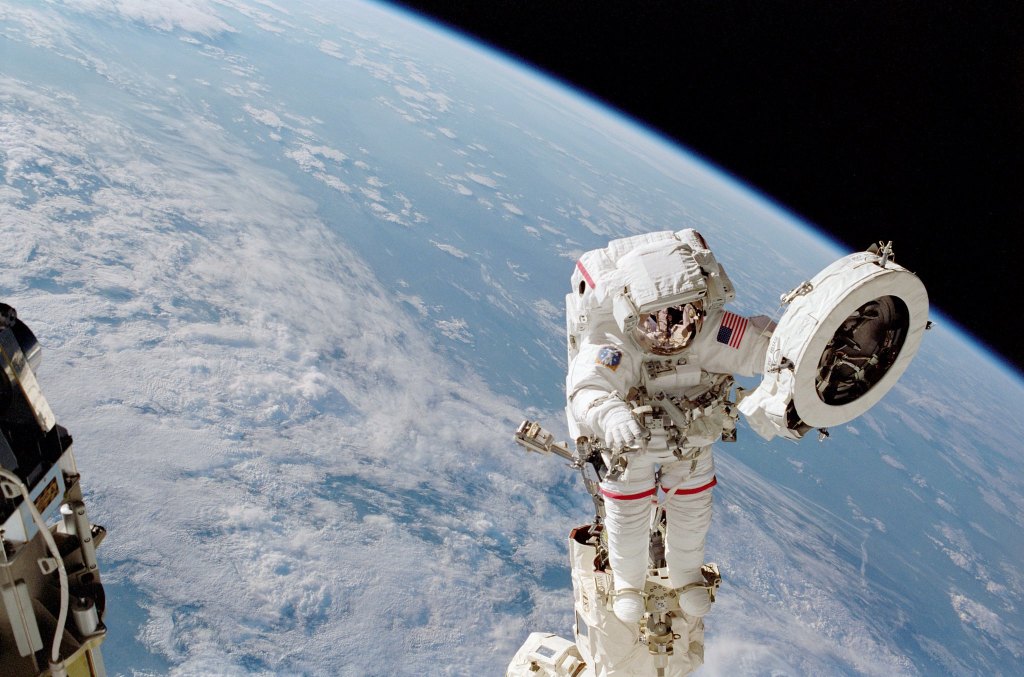
Franklin R. Chang-Diaz, a Costa Rican American astronaut, conducting work on the International Space Station (ISS). Photo credit: NASA via Flickr.
Is it Hispanic or Latino or…?
The language used to refer to people “whose ancestors came from Spain, Mexico, the Caribbean and Central and South America” is complicated. Not all people included in this list would call themselves Hispanic, despite the name given to the month. Some prefer Latinx (or Latino/a or Latine), some prefer Chicano (or Chicana or Chicanx), and some prefer a more specific reference to their families’ nationality (e.g., Mexican American, Cuban American). And none of this addresses the question of indigeneity and the distinctions between histories of Indigenous peoples and colonizers in these regions. Nevertheless, given the lack of a consistent umbrella term and the name of the month, I will use the term Hispanic generally and will use other terms for individuals if they identify themselves in another way. (For more on this issue, see Vanessa Romo’s NPR piece “Yes, We’re Calling It Hispanic Heritage Month And We Know It Makes Some of You Cringe.”)
Running the Numbers
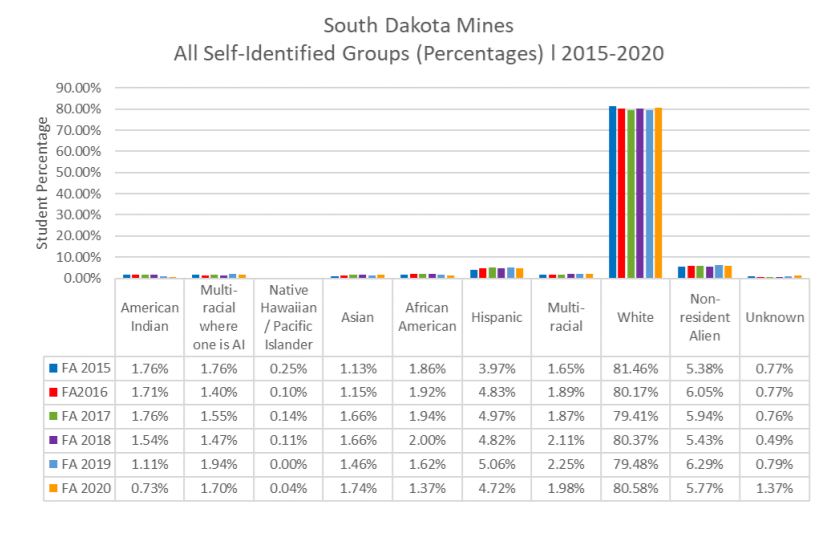
South Dakota Mines’ Hispanic student population has hovered around 5% of the total student population for the last 5 years, meaning that there have been approximately 120-140 Hispanic students enrolled in each of those years. This is not a high proportion of the overall student body, but Hispanic students still represent the largest group of students of color at Mines. (If you are a Hispanic student at Mines or if you’re interested in supporting Hispanic students at Mines, you can check out the Mines chapter of Society of Hispanic Professional Engineers (SHPE).)





 The Novum
