Zinefest: World-Making, Creativity, & Technology

Apex Gallery, Arts, Classes, communication, Events, Humanities

By Christy Tidwell

“[Zines] are practices of ‘poetic world-making’—poetic not in the sense of a poem on the page (although they can be this too),
but in the sense of poesis: the process of creating something that did not exist before.” 
– Gwen Allen

The classes I teach create communities. Students get to know each other as they learn the course material, and they share ideas and work with each other. This is a form of world-making, even if temporary, and I love this about my classes. But I don’t want the connections and sharing to stop at the classroom door or to be forgotten when the semester ends. The goal is for my students to connect what they’re learning in class with the rest of the world, to share what they’ve learned with others, to hear what others have learned, and to join and build other communities.

Finding ways to do this can be challenging, but it’s not impossible.

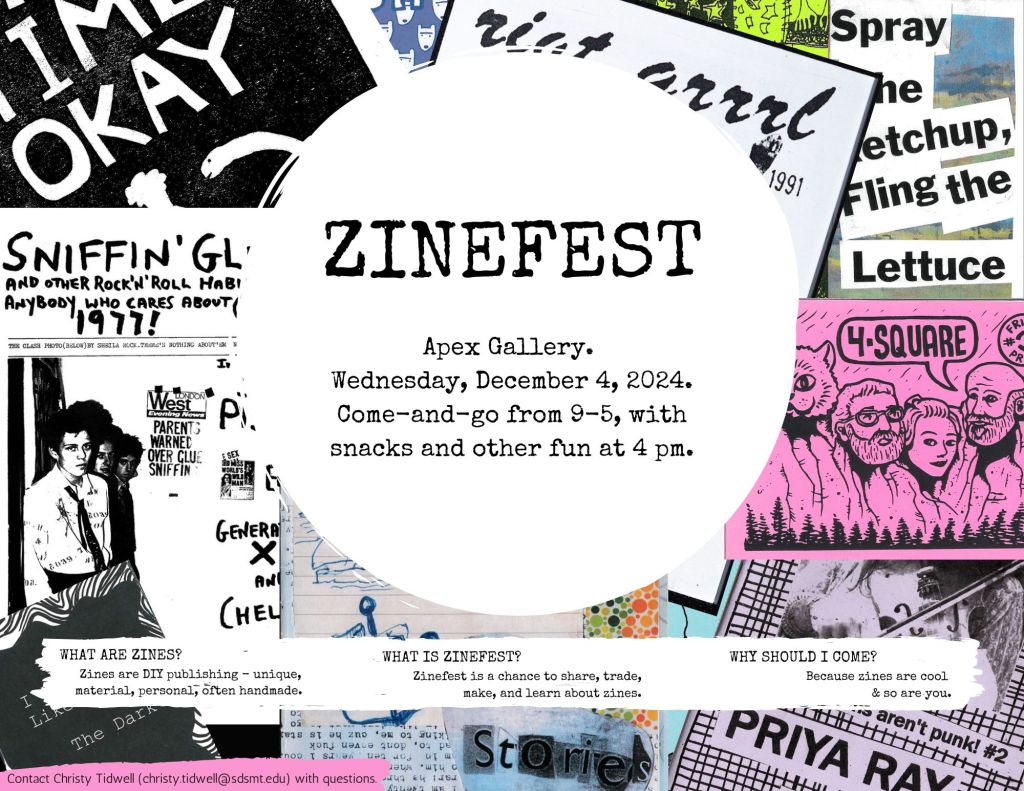
This semester, as a way for students to connect across classes and share work with broader audiences, a few of us in the Humanities, Arts, and Social Sciences department (myself, Matt Whitehead, Evan Thomas, Erica Haugtvedt, and Mary Witlacil) put on a series of zinemaking events that culminated in a Zinefest in the Apex Gallery on December 4th. Zinefest was an all-day come-and-go event that displayed the zines students made in classes (and, in a few cases, just for fun!), provided some examples of interesting zines made by others, and gave visitors a chance to make their own zines. (If you missed it this year, watch out for another event next year!)
This event let students share some of what they have learned this semester, giving them a broader audience, and it also connected them to students in other classes and to the audiences who came to Zinefest. While I did not count the number of visitors during Zinefest, the gallery filled several times and was rarely empty. Some people walked through relatively quickly and took in only a few zines; others stayed for quite a while, standing and reading multiple zines before finally deciding on some they wanted to keep. One student – who will remain nameless for obvious reasons – wrote in a reflection afterward, “I spent almost 2 hours there and accidentally missed class, so I would say I had a good time.” Although I would (of course) never encourage a student to miss class, this indicates that Zinefest offered this student something meaningful.

Because most students were asked to bring multiple copies of their zines, visitors could take a copy of one if they were particularly interested in its ideas or really loved it. Hopefully, they will re-read any zines they took, remember the event, and maybe even be inspired to make their own! Leaving with a material artifact helps the experience and community created through this event extend past Zinefest itself.

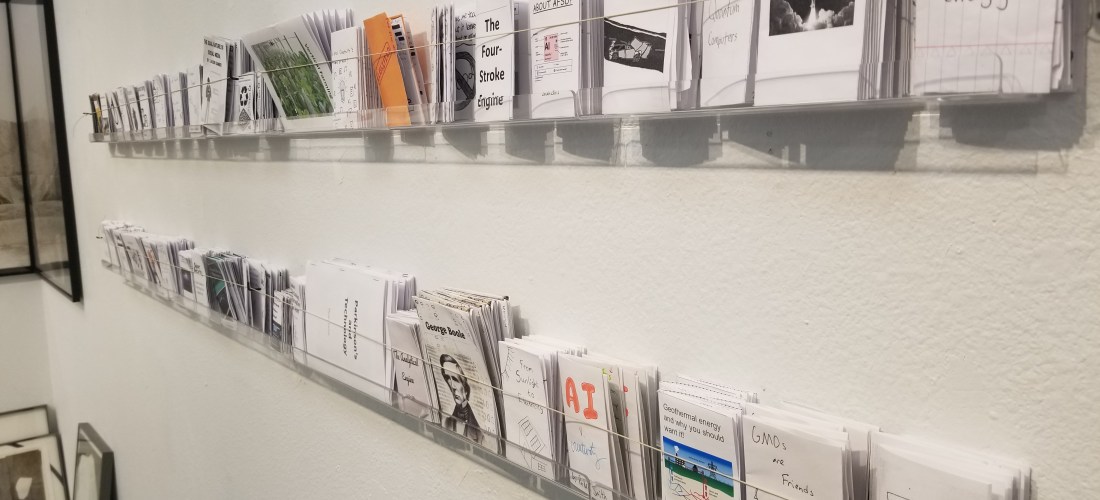
Two rows of zines displayed on the wall, with a handwritten sign above them: See a zine you like? Feel free to take it. Just don't take the last one! Thanks for stopping by.
Student zines on display with an invitation to take a zine.

As an event, Zinefest promoted connections and community; as a practice, making zines (even without an event like Zinefest) provides us all with an opportunity to create something new – to engage in world-making – and to share that something with others, without requiring elaborate technology or infrastructure, refined skills, or many resources. Anyone can make a zine, and that’s what’s so beautiful about them.

Printing in the Classroom: Hands-On Creation & History of Technology

art, Classes, Humanities, teaching, Technology

By Christy Tidwell

This semester, I am teaching a section of Connections: Humanities & Technology (HUM 200), which is one of our core STS courses as well as a general education course that students from across the university take to fulfill their humanities requirement. There are many ways to teach this course to get students to think more critically and more deeply about the relationships between the humanities and various technologies, and this particular semester’s class begins with a few weeks exploring printing technologies.

What better way to understand printing technologies than to try them out?

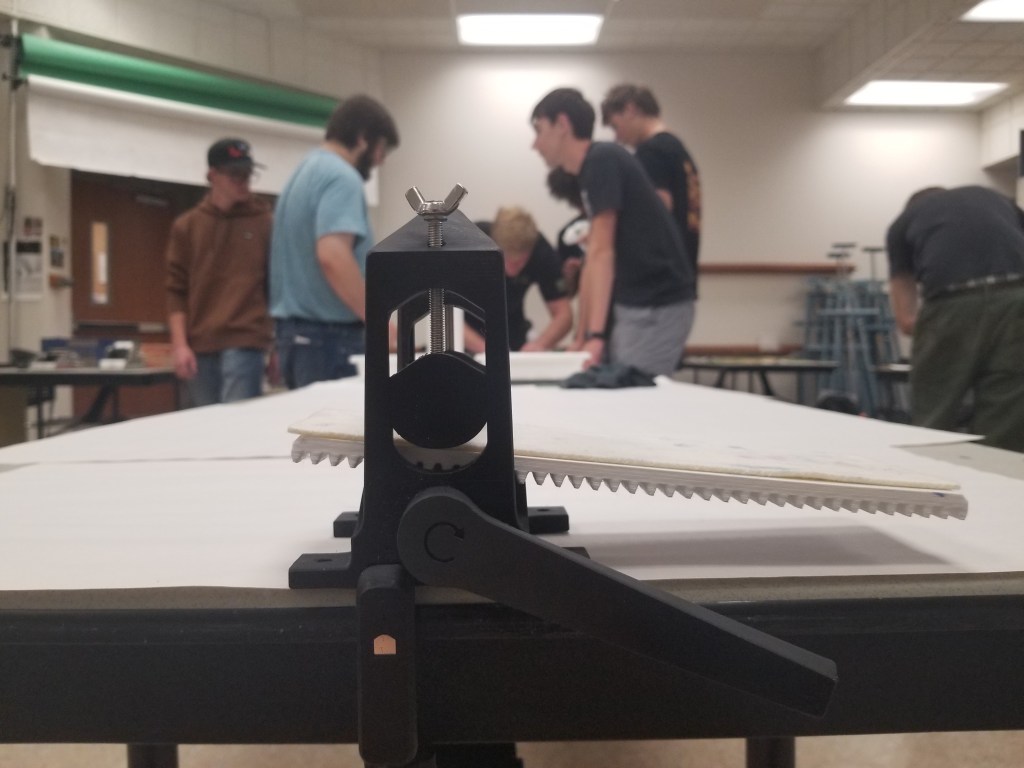
To incorporate a hands-on approach to printing in the class, I worked with our art professor, Matt Whitehead, to prepare an activity for students in the art room. We wanted to give students a chance to work with printing presses in a couple of different ways, to try using a typewriter and a Leroy lettering set, and to check out some old toy moveable type presses. These toy presses date from the 1940s and are no longer totally functional, so they were more on display than for use, but they still allowed students to get a better sense of what a moveable type printing press is like on a small scale.

Photo of a mini printing press ready for use.
A mini printing press from the Open Press Project, with students working in the background.

After a brief introduction to some basic printing techniques and explanation of what was available, students were given the freedom to explore these technologies in whatever order they wished. Some made an effort to try everything and even combined elements (the printing press with text from the typewriter or lettering set, for instance); some really focused in on one technology or technique and tried it multiple times or in multiple ways.

Writing on Demand vs. Writing on Purpose

computers, teaching, Technology, writing

By Evan Thomas

What does it sound like to sound educated yet know nothing? In a 17th-century comedy by Molière, Le Bourgeois Gentilhomme (“The Middle-Class Aristocrat”), a rich cloth merchant tries to imitate aristocratic education and speech. He takes philosophy classes and learns that his normal expressions “require a little lengthening” – he must learn how to stretch heartfelt statements (“your lovely eyes make me die of love”) into aristocratic contortions (“Of love to die make me, beautiful marchioness, your beautiful eyes”; “Your lovely eyes, of love make me, beautiful marchioness, die”; “Die, your lovely eyes, beautiful marchioness, of love make me”; “Me make your lovely eyes die, beautiful marchioness, of love”). The joke is on him, as his rhetoric tutor cruelly exploits his easy admiration for excessive, voluminous, amplitudinous, prolix, verbose, copious speech.

The example of the Bourgeois Gentilhomme is echoed in a new development in AI. Recently, OpenAI released ChatGPT, a large-language model (“LLM”) AI that appears to have tremendous facility at composing passable long-form texts. As an educator in higher ed, I don’t think that writing pedagogies are remotely ready yet for the instructional challenges posed by this technology. The main concerns that academics have had about AI and collegiate writing have to do with academic integrity. These are important concerns and addressing them will probably have massive relevance in the years to come.

Headline: Schools Ban ChatGPT Amid Fears of Artificial Intelligence-Assisted Cheating
Headline: Teachers Fear ChatGPT Will Make Cheating Easier Than Ever

However, not all academics are especially concerned by the threat posed by AI language models. First, some academics express confidence that their domain-specific knowledge is too inscrutable for a machine to understand. Second, others suggest that the strength of their bonds with their students would make it impossible for their students to make an unnoticed switch to a different voice. Whether the first or second case is true, whether some content or character is indelible, there are finer, more constructive applications of LLMs to writing in higher ed.

Other Interesting Technologies: STS Faculty Reflect

STS Faculty, Technology

This final entry in the series on interesting moments in science and technology features reflections from Paul Showler, Gerrit Scheepers, and Christy Tidwell on a wide range of topics: emotion detection technology, a method to provide easier access to clean water, and a scheme to farm hippos in the US. (For more thoughts on interesting science and technology from STS faculty, see previous posts on technologies of communication and technologies of destruction.)

Technologies of Destruction: STS Faculty Reflect

STS Faculty, Technology

In this second entry in our series asking STS faculty to reflect on moments in science and technology that they find particularly interesting or meaningful (read the first entry here), Lilias Jones Jarding, Joshua Houy, and Frank Van Nuys address technologies of destruction and violence. Some – like nuclear weapons – are directed at humans; others – like coyote-getters – at nonhumans. All, however, have their limits.

Technologies of Communication: STS Faculty Reflect

communication, Technology

This is the beginning of a short series in which several STS faculty share elements of science and technology that they find intriguing or meaningful. This opening post features reflections from Evan Thomas, Erica Haugtvedt, and Olivia Burgess on communication technologies. Their choices highlight both the ways we connect with each other and the role that technology plays in that connection.

Food in … SPACE!

history, Technology

By John Dreyer

When I was in my early teens I bought Mr. Scott’s Guide to the Enterprise. This book was just a technical manual for Star Trek and, as a young fan, I was pretty happy. One aspect the authors addressed was eating on board a future starship using a replicator. Essentially a 3D food printer, the replicator could make anything you desired. The author even included a menu of choice dishes. This book is only one place where food in science fiction is addressed. From the cornbread in Aliens to the generic-looking dinner in 2001: A Space Odyssey that David Bowmen grabs while it’s still too hot, food has had a place in storytelling.

But what about real space exploration? Do astronauts get Yankee Pot Roast? Space food has had a long developmental arc, often supplemented by industry, that seeks to put nutritious and tasty food at the fingertips of astronauts and, later, consumers.

Partial menu listing, including a list of Terran foods, Vulcan foods, and Andorian foods.
Food available from the Enterprise’s replicator. (Source: Mr. Scott’s Guide to the Enterprise)

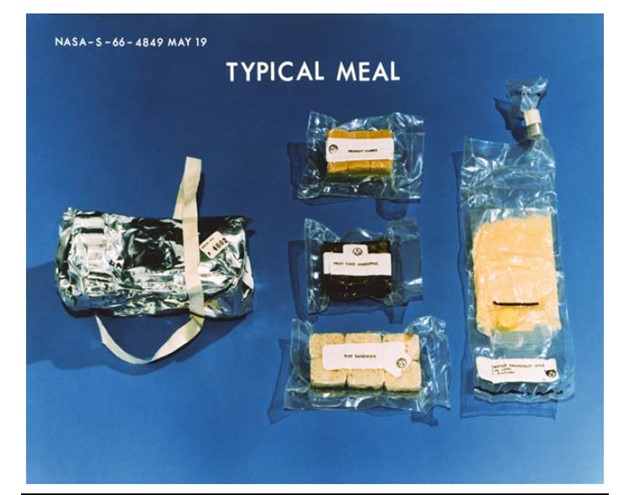
The first food in space was carried by Yuri Gagarin. His meal was two tubes of pureed meat and a tube of chocolate sauce. For the designers of the meal, there was a question if he could actually eat and digest in zero gravity. In his first American orbital flight, John Glenn consumed a tube of applesauce, which he claimed to have enjoyed. Tube foods are not exactly appetizing, and nutrition in space was still in its infancy. There were also questions of taste and texture. As NASA began to work towards Apollo and the moon landing, it was realized that better food was necessary.

Kissing Robots: Can Technology Help Us Love?

design, Technology

By Christy Tidwell

On Valentine’s Day, talk of love and romance is everywhere. Some people celebrate it and some avoid it. Still others would like to celebrate but are separated from their loved ones. Long-distance relationships are hard, after all, so what if technology could help diminish that distance? Sure, we have phone calls, FaceTime, even emails or letters (if you’re particularly old-fashioned). But these methods of connection don’t include touch.

Lovotics, a multidisciplinary research project proposed by Dr. Hooman Samani of the University of Plymouth (UK), proposes to change this. It includes several applications:

  • Kissenger, a pair of robots designed to transfer a kiss over distance. Here, “the system takes the form of an artificial mouth that provides the convincing properties of the real kiss.”
  • Mini-Surrogate, a project to use miniature robots “as small cute, believable and acceptable surrogates of humans for telecommunication.” They are meant to “foster the illusion of presence.”
  • XOXO, a system that builds on Kissenger but also includes a “wearable hug reproducing jacket.”

It sounds like a potentially nice idea to help with long-distance relationships. When I raised this with students in my Humanities & Technology class last semester, however, they found it more disturbing than promising. Check out the video for the Kissenger for more detail.

Video demonstrating the Kissenger application.

For me, these ideas come with more questions than answers. How important is physical proximity for a meaningful relationship? What elements of touch are most important? Can those elements be replicated by something other-than-human? Even – what new relationships between human and nonhuman might be possible in the future?

I don’t have answers to these questions; in fact, I don’t think there is one right answer to them. But we should probably be asking them before we start creating technological solutions to problems that we don’t fully understand. Will having kissing robots lead to serious harm? Probably not. Will they help? We won’t know unless we ask questions about human emotions and psychology, bringing humanities and social sciences knowledge to bear on technological possibility.

Kissenger application. Photo credit: Ars Electronica.

Roger Boisjoly and the Challenger Disaster

The Double-Edged Sword

By Olivia Burgess
The Double-Edged Sword

I recently gave a Brown Bag talk on the Challenger space shuttle disaster, the events surrounding it, and its use as a case study for engineering education and communication. There was so much to cover that I couldn’t go into much detail on one of the most remembered and revered figures of the case study: engineer-turned-whistleblower Roger Boisjoly. To fill in those gaps, I’m dedicating this blog to Boisjoly.

About 73 seconds after the space shuttle Challenger launched on January 28, 1986, it exploded, killing all seven astronauts inside while viewers across the country–including school age children watching in their classrooms–witnessed the disaster on live TV. 

Welcome to the SuperHuman Sports League

The Double-Edged Sword

By Olivia Burgess
The Double-Edged Sword

What if athletes could voluntarily replace their limbs with prosthetics to make them faster and stronger?

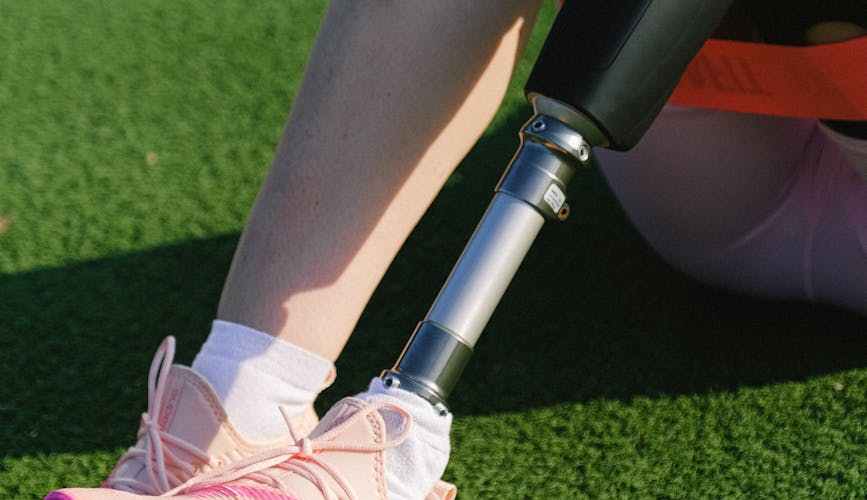
This question was raised by Otutoa Afu, an STS major in my Intro to STS course. The class has been discussing what it means to be human in a world where technology can radically transform both the human body and the human experience. Some of these advancements have been tremendously positive, such as the blade runner prosthetic that allows amputees to compete in athletic events, but Otutoa’s question highlights the potential complexities that may arise if technological enhancements become more widespread.