Last week, Matt Whitehead and I gave a presentation about the relationship between poetry and science for National Poetry Month as part of the STEAM Cafe series at Hay Camp Brewing. If you were not able to attend, this is a brief version of what we presented.
As members of the Humanities, Arts, and Social Sciences department, Matt and I (as Art and English faculty, respectively) spend a lot of time thinking about how to get students thinking creatively and engaging in creative projects. Given our work with the Science, Technology, & Society degree, we also work with connections between humanities/arts and science/technology, and we encourage our students to see creativity as something that they don’t do only in our classes but that is a part of their scientific and engineering work, too.
Our core question grows out of this work: What does poetry have to do with science?
The two might seem fundamentally dissimilar, belonging to different realms, but both offer opportunities to look carefully, communicate observations, make connections, and understand the world more fully – piece by piece, experience by experience.
“[Zines] are practices of ‘poetic world-making’—poetic not in the sense of a poem on the page (although they can be this too), but in the sense of poesis: the process of creating something that did not exist before.” – Gwen Allen
The classes I teach create communities. Students get to know each other as they learn the course material, and they share ideas and work with each other. This is a form of world-making, even if temporary, and I love this about my classes. But I don’t want the connections and sharing to stop at the classroom door or to be forgotten when the semester ends. The goal is for my students to connect what they’re learning in class with the rest of the world, to share what they’ve learned with others, to hear what others have learned, and to join and build other communities.
Finding ways to do this can be challenging, but it’s not impossible.
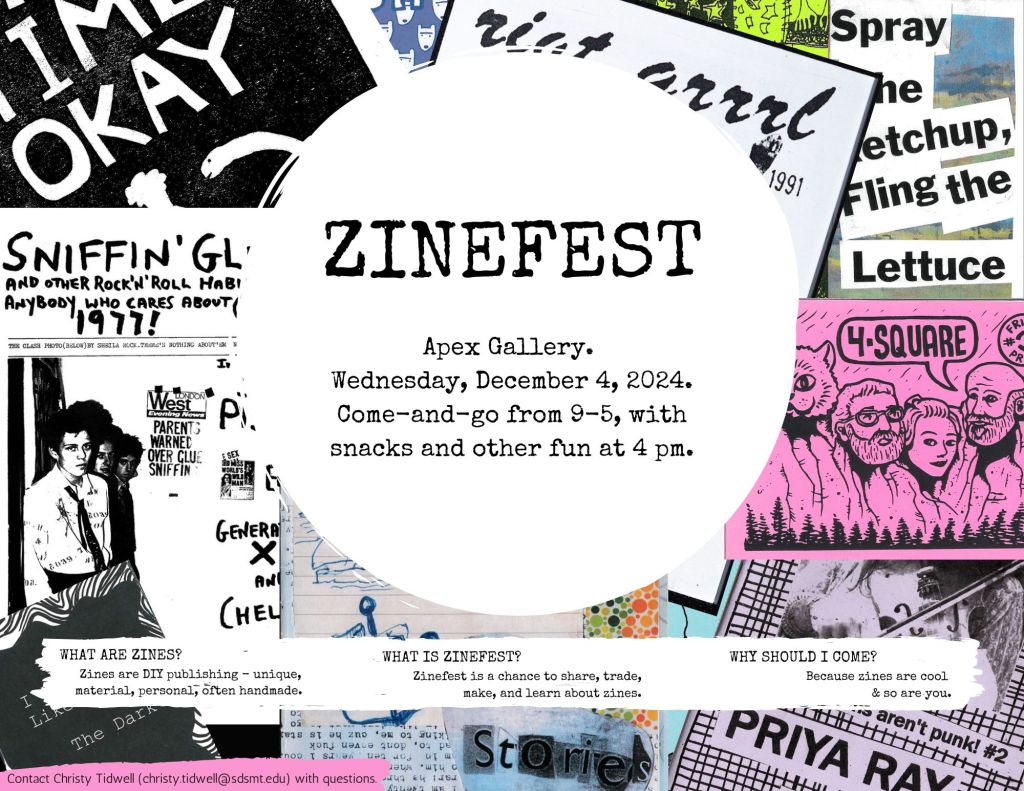
This semester, as a way for students to connect across classes and share work with broader audiences, a few of us in the Humanities, Arts, and Social Sciences department (myself, Matt Whitehead, Evan Thomas, Erica Haugtvedt, and Mary Witlacil) put on a series of zinemaking events that culminated in a Zinefest in the Apex Gallery on December 4th. Zinefest was an all-day come-and-go event that displayed the zines students made in classes (and, in a few cases, just for fun!), provided some examples of interesting zines made by others, and gave visitors a chance to make their own zines. (If you missed it this year, watch out for another event next year!)
This event let students share some of what they have learned this semester, giving them a broader audience, and it also connected them to students in other classes and to the audiences who came to Zinefest. While I did not count the number of visitors during Zinefest, the gallery filled several times and was rarely empty. Some people walked through relatively quickly and took in only a few zines; others stayed for quite a while, standing and reading multiple zines before finally deciding on some they wanted to keep. One student – who will remain nameless for obvious reasons – wrote in a reflection afterward, “I spent almost 2 hours there and accidentally missed class, so I would say I had a good time.” Although I would (of course) never encourage a student to miss class, this indicates that Zinefest offered this student something meaningful.
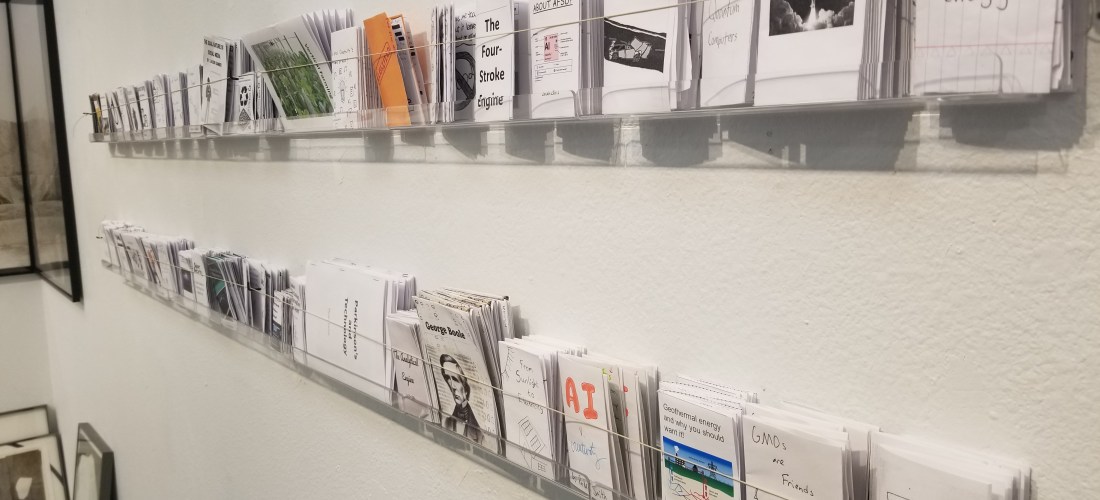
Because most students were asked to bring multiple copies of their zines, visitors could take a copy of one if they were particularly interested in its ideas or really loved it. Hopefully, they will re-read any zines they took, remember the event, and maybe even be inspired to make their own! Leaving with a material artifact helps the experience and community created through this event extend past Zinefest itself.
Student zines on display with an invitation to take a zine.
As an event, Zinefest promoted connections and community; as a practice, making zines (even without an event like Zinefest) provides us all with an opportunity to create something new – to engage in world-making – and to share that something with others, without requiring elaborate technology or infrastructure, refined skills, or many resources. Anyone can make a zine, and that’s what’s so beautiful about them.
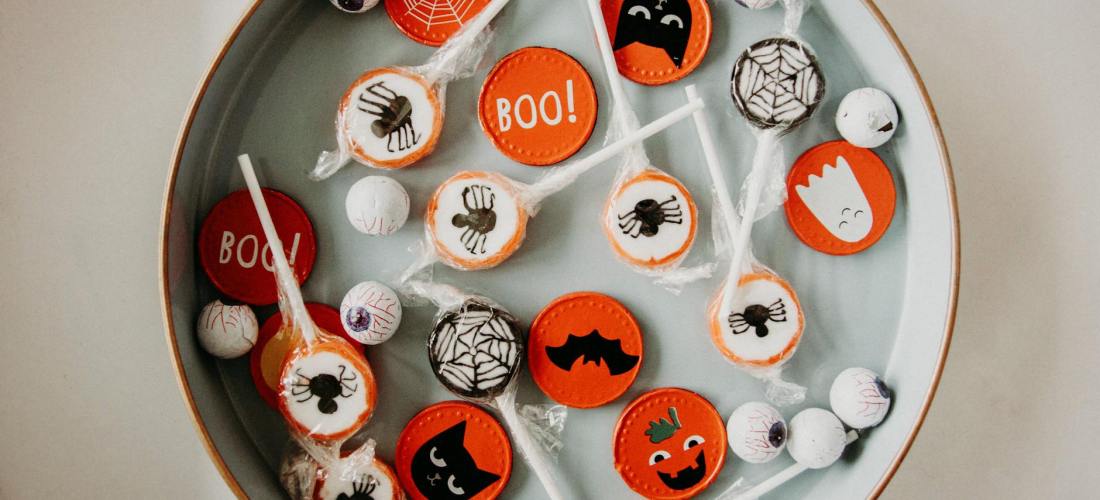
It’s nearly Halloween, so we wanted to share some information about this year’s Halloween costume contest and some spooky content from years past.
Last year, we got some great costume contest entries (see the winners here!), and we’re looking forward to more excellent costumes this year. Open to all SD Mines students, faculty, and staff, the costume contest is simple to enter and offers prizes for winners! If you love dressing up for Halloween, enter by sharing a picture and description of your costume on Instagram and tagging us (@sts_sdmines) or by emailing Dr. Christy Tidwell your entry (christy.tidwell@sdsmt.edu). We really hope to see some STS-related costumes, but all costumes are welcome!
We also wanted to highlight some past posts about scary movies to check out if you missed them the first time around: a series of posts called Spooky Science at the Movies (part 1, part 2, part 3, part 4, and part 5), as well as a post about the Science of Scare project, which measures the so-called scariest movie of the year each year. This year, the Science of Scare named Oddity the scariest movie – watch it for yourself and see what you think!
This semester, I am teaching a section of Connections: Humanities & Technology (HUM 200), which is one of our core STS courses as well as a general education course that students from across the university take to fulfill their humanities requirement. There are many ways to teach this course to get students to think more critically and more deeply about the relationships between the humanities and various technologies, and this particular semester’s class begins with a few weeks exploring printing technologies.
What better way to understand printing technologies than to try them out?
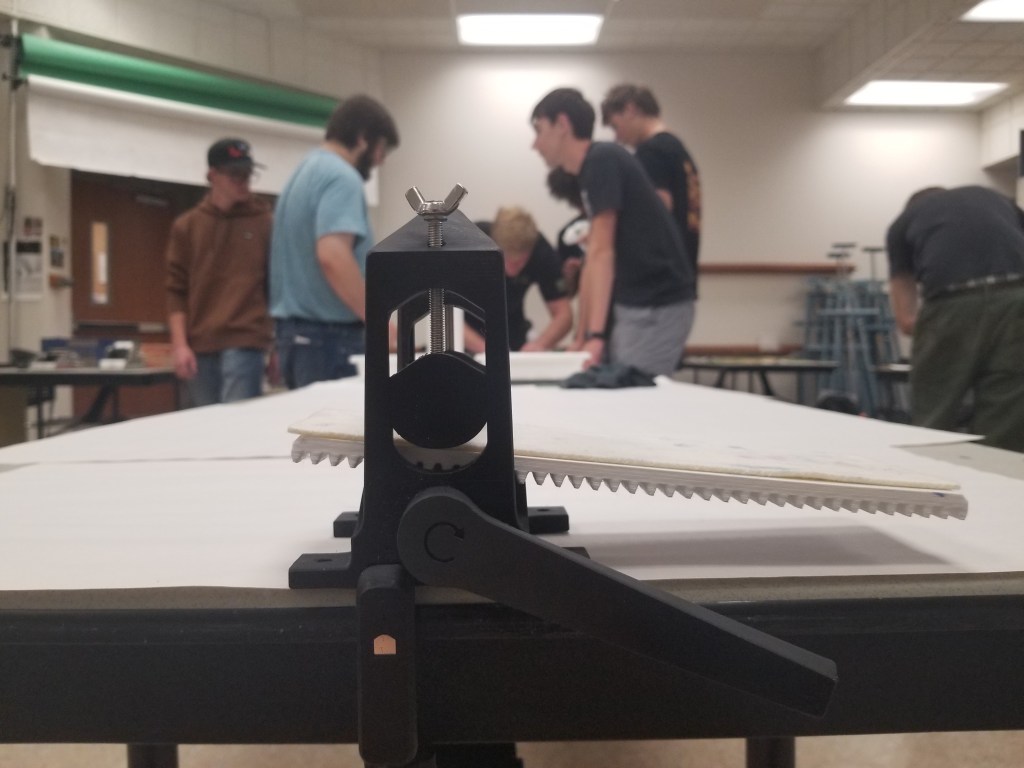
To incorporate a hands-on approach to printing in the class, I worked with our art professor, Matt Whitehead, to prepare an activity for students in the art room. We wanted to give students a chance to work with printing presses in a couple of different ways, to try using a typewriter and a Leroy lettering set, and to check out some old toy moveable type presses. These toy presses date from the 1940s and are no longer totally functional, so they were more on display than for use, but they still allowed students to get a better sense of what a moveable type printing press is like on a small scale.
A mini printing press from the Open Press Project, with students working in the background.
After a brief introduction to some basic printing techniques and explanation of what was available, students were given the freedom to explore these technologies in whatever order they wished. Some made an effort to try everything and even combined elements (the printing press with text from the typewriter or lettering set, for instance); some really focused in on one technology or technique and tried it multiple times or in multiple ways.
The Exorcist. Hereditary. The Ring. Texas Chain Saw Massacre. These are often named some of the scariest movies out there. They’re also among the most popular horror movies, ones that are watched and re-watched, considered classics. Horror movie fans want to be scared, after all.
But what makes these movies – and others like them – so scary? And which is really the scariest?
Since 2020, the Science of Scare Project has run an experiment to try to answer the second of these questions. The project asks a panel of 250 people to watch horror movies while measuring their physiological responses to them and then ranks the scariest movies based on those responses. In past years, they have relied simply on heart rates, but – after some criticisms from horror fans that this emphasizes only one sudden type of fear – they have updated this for 2023. Now their study includes not only heart rate as way to measure excitement and fear but also heart rate variance, arguing that “the lower the heart rate variance the more stressed our audience members became, a good indicator of slow burn fear and dread.”
Frey speaking about his piece “Minesweeper World Map” (2018).
While here, Frey also visited Matt Whitehead’s Drawing class and worked with students on a poster creation project. In preparation for his visit, the class toured his show in the Apex Gallery and discussed the work and how it fit within the class’s idea of “the grid.” For the workshop, Frey started by discussing his take on the grid, which he sees as being all around us. He shared images that he took in his hotel that morning to help illustrate this. In his artwork he examines various ideas but is often looking for ways to challenge our understanding of the grid, while still working within it.
Asked to design posters for invented events and issues (using Nathaniel Russell’s fake flyer assignment described here), students invented lost animal posters with a twist, public service announcements about wearing sunscreen, warnings about birds, and much more. Many posters used similar design techniques even when their content was wildly different, illustrating how specific kinds of media (like informational posters) come with formal expectations that shape their content and presentation and connecting to Frey’s work in its focus on the idea of disrupting the social grid.
This final entry in the series on interesting moments in science and technology features reflections from Paul Showler, Gerrit Scheepers, and Christy Tidwell on a wide range of topics: emotion detection technology, a method to provide easier access to clean water, and a scheme to farm hippos in the US. (For more thoughts on interesting science and technology from STS faculty, see previous posts on technologies of communication and technologies of destruction.)
My Environmental Ethics & STEM class asks big questions about knowledge, values, justice, and responsibility – both individual and systemic – related to environmental issues. Although I try to situate these conversations in specific, real-world examples, they can still sometimes seem abstract or beyond the scale of my students’ reach. They may wonder what they can do to address climate change, for instance, or to change corporate policy.
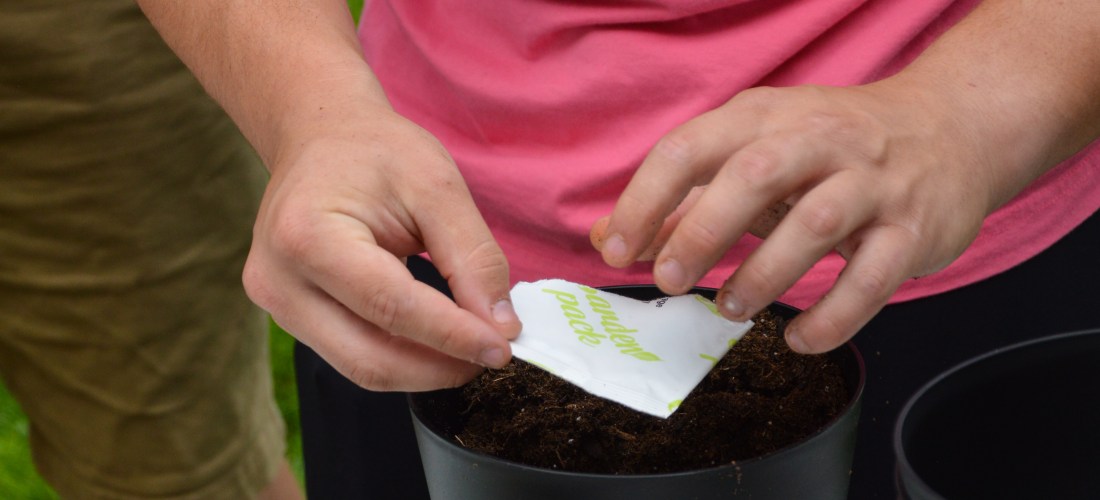
But they can, of course, make a difference, and we look for ways to identify the actions they can take (again, not just individually but within larger contexts). In the meantime, to help connect us more fully to the environment, this semester I asked my students to plant seeds and to do their best to grow them and keep them alive. It’s my hope that working to protect and nurture one small plant will give the class a personal connection that issues of pollution, plastics, or water rights may not always have.
Christy Tidwell is Associate Professor of English & Humanities. You can learn more about her research and teaching at her website.
What’s your area of expertise? What do you primarily research and/or teach? And what drew you to this field?
I typically research and write about speculative fiction, environment, and gender. My dissertation was about feminist science fiction and feminist science, for instance, and since then I’ve co-edited and written for two books on speculative fiction and the environment: Gender and Environment in Science Fiction and Fear and Nature: Ecohorror Studies in the Anthropocene. I have an ongoing interest in dinosaurs in popular culture, especially as dinosaur stories relate to ideas about extinction, and I also sometimes write about Black film/media and disability.
In my work on science fiction – whether related to environmental issues, gender, race, or disability – I look at how we respond to the problems in the present and how we might imagine different possibilities in the future. In my work on horror – again, no matter which of these issues I’m addressing – I look at how our fears (for instance, fears of the natural world or fears for the natural world) shape our lives.
On Valentine’s Day, talk of love and romance is everywhere. Some people celebrate it and some avoid it. Still others would like to celebrate but are separated from their loved ones. Long-distance relationships are hard, after all, so what if technology could help diminish that distance? Sure, we have phone calls, FaceTime, even emails or letters (if you’re particularly old-fashioned). But these methods of connection don’t include touch.
Kissenger, a pair of robots designed to transfer a kiss over distance. Here, “the system takes the form of an artificial mouth that provides the convincing properties of the real kiss.”
Mini-Surrogate, a project to use miniature robots “as small cute, believable and acceptable surrogates of humans for telecommunication.” They are meant to “foster the illusion of presence.”
XOXO, a system that builds on Kissenger but also includes a “wearable hug reproducing jacket.”
It sounds like a potentially nice idea to help with long-distance relationships. When I raised this with students in my Humanities & Technology class last semester, however, they found it more disturbing than promising. Check out the video for the Kissenger for more detail.
Video demonstrating the Kissenger application.
For me, these ideas come with more questions than answers. How important is physical proximity for a meaningful relationship? What elements of touch are most important? Can those elements be replicated by something other-than-human? Even – what new relationships between human and nonhuman might be possible in the future?
I don’t have answers to these questions; in fact, I don’t think there is one right answer to them. But we should probably be asking them before we start creating technological solutions to problems that we don’t fully understand. Will having kissing robots lead to serious harm? Probably not. Will they help? We won’t know unless we ask questions about human emotions and psychology, bringing humanities and social sciences knowledge to bear on technological possibility.







 The Novum