By Emily Novak
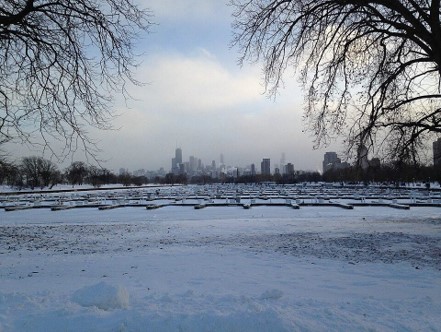
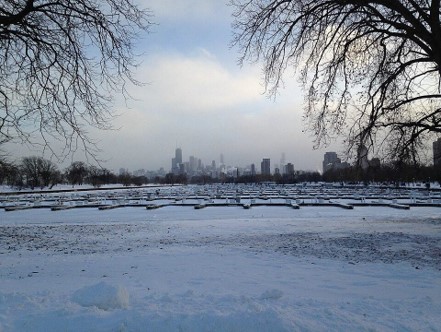
You may have heard of the polar vortex before on TV or in a news article, most likely when there is an extreme polar air outbreak. Some notable polar vortex events in the past years have been in 2014, 2019, and 2021. Maybe you remember school being cancelled or going outside to feel a biting cold the second you stepped out the door. I was one of the curious kids who wanted to go outside and found my eyelashes trying to freeze shut. I’ve always loved winter weather, but I know how detrimental it can be for people who aren’t prepared. This interest in extreme cold and its dangers, along with guidance from my supervisor, is what led me to the polar vortex.
The question I will be exploring for my capstone project is this: Is the Arctic stratospheric polar vortex weakening? The polar vortex is a circulation of strong winds that contains cold air and happens every winter in the poles (Lindsey, 2021). The Arctic/North Pole vortex is stronger and varies more than that in the Antarctic/South Pole, so I chose to focus on the Arctic polar vortex for my research. There is both a tropospheric and stratospheric polar vortex. What’s the difference? Stratosphere refers to the second layer of the atmosphere, and the stratospheric polar vortex happens 10-30 miles above Earth’s surface! “Arctic stratospheric polar vortex” is a bit of a mouthful, so it is more simply referred to as “the polar vortex” if you live in the northern hemisphere. There is also a tropospheric (the troposphere is the layer of the atmosphere we live in and where we experience most of our weather) polar vortex often called the polar jet stream. Unlike the stratospheric one, this vortex exists year-round, not just in the winter months, and occurs 5-9 miles above the surface. The tropospheric polar vortex has short-term effects on our day-to-day weather, while the stratospheric polar vortex influences the Arctic’s entire season (Lindsey, 2021).
The stratosphere can experience sudden warming events called SSWs (sudden stratospheric warming) that weaken the polar vortex. SSWs have been happening an average of every other year in the last two decades (Kumar et al., 2025), which makes the stratospheric polar vortex so variable and unpredictable. When these warming events occur, it destabilizes the polar vortex. Why does this matter? Well, a stable/strong polar vortex keeps the cold air tightly contained around the Arctic, helping to keep sea ice and slow its warming. When the polar vortex is unstable/weak, this cold air spills out into lower latitudes where many people live. The Arctic will also experience more sea ice loss and warming during weak events. The image below shows a graphic of this.
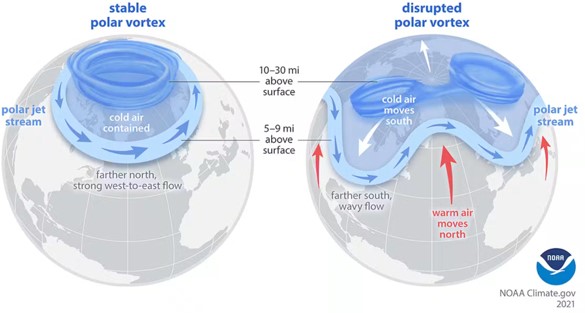
Rather than a “crown” over the arctic, there is a “blob” covering more of the northern hemisphere. It seems counterintuitive at first, but a weak polar vortex actually causes colder temperatures in lower latitudes. Weak polar vortex events can cause extreme cold outbreaks, increasing risk of frostbite and hypothermia for anyone outside, and causing power outages. When a city’s power grid is not equipped to handle extreme cold (like areas in the southern US) thousands or even millions of people can be left without power. This can be especially bad for people with medical equipment, leaving them to rely on generators. A recent and major example of this is the Texas power grid failure of February 2021, which I did a group project on earlier in my coursework.
Disasters like this are preventable with the right precautions and warnings, which is why it is so important to study and understand the weather/climate patterns that cause them.
References:
Kumar, A., K. Karami, and C. Jacobi, 2025: A 45-Year Climatological Study of Arctic Stratospheric Polar Vortex Dynamics and Morphology using ERA5 Data (1979-2023). Research Square, https://doi.org/10.21203/rs.3.rs-7472791/v1.
Lindsey, R., 2021: Understanding the Arctic polar vortex. NOAA Climate.gov. Accessed October 7, 2026. https://www.climate.gov/news-features/understanding-climate/understanding-arctic-polar-vortex.
Bio:
I am an Atmospheric Science student with a minor in Sustainable Engineering. I grew up in Foley, a small town in central Minnesota, with my family and many pets. Weather has always been a topic of interest for me, especially winter weather and anything to do with climate change. I remember seeing someone on the Weather Channel with the title “Arctic Climate Scientist” and decided that was my dream job at 12 years old. After graduation, I will ideally be continuing with a Master’s while working a full-time job in meteorology or something related. I would love to do research in Arctic climate change, but I am open to really anything happening in the atmosphere. Outside of school, I have quite the jumble of hobbies. If it seems fun, I’m willing to try anything. My favorite will always be martial arts. I grew up doing taekwondo and kickboxing, and added jiu jitsu into the mix in college. Others include anything outside (hiking, camping, mountain biking, kayaking, snowmobiling, etc.), weightlifting, listening to and playing music, crocheting, and spending time with friends, family, or animals.


