STS Faculty Profile: Kayla Pritchard

STS Faculty Profile

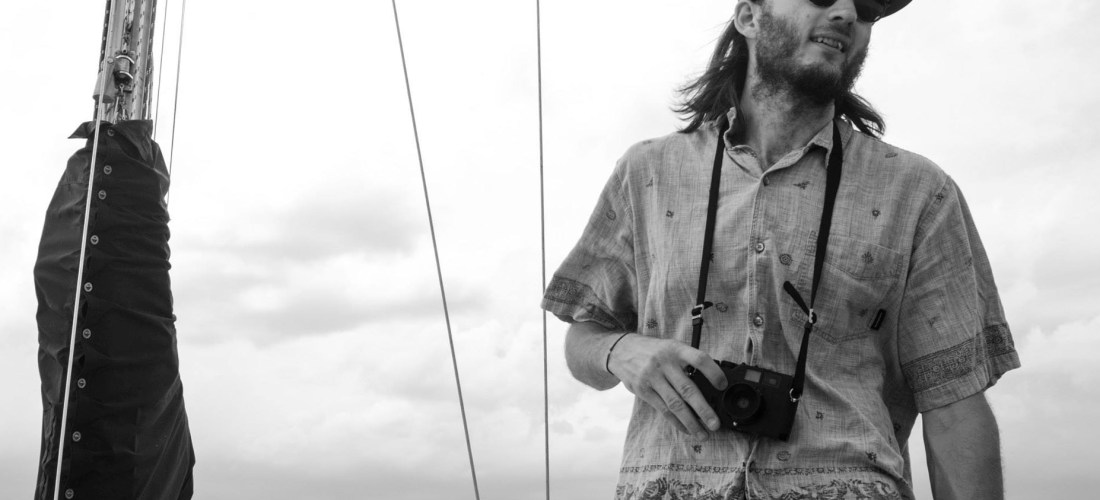
Kayla Pritchard is Associate Professor of Sociology. You can read more from her in last semester’s post: “‘The Oldest Profession’: Sex Work Through the Lenses of History, Feminism, and Sociology.”

What’s your area of expertise? What do you primarily research and/or teach? And what drew you to this field?

I am a sociologist, which means I focus on the context around individuals to understand why they do what they do. This means examining the historical, cultural, and social context that influences our identities, behaviors, opportunities, interactions, and experiences. Within sociology, my expertise centers around 1) family and 2) sex, gender, and sexuality. Both of these exist at the structural level (macro guiding beliefs, ideologies, and assumptions) and at the individual level through identities, experiences, and behaviors. I find the intersection of the structural and the individual fascinating, and it allows me to study and bring in historical processes to better understand society today.

Roger Boisjoly and the Challenger Disaster

The Double-Edged Sword

By Olivia Burgess
The Double-Edged Sword

I recently gave a Brown Bag talk on the Challenger space shuttle disaster, the events surrounding it, and its use as a case study for engineering education and communication. There was so much to cover that I couldn’t go into much detail on one of the most remembered and revered figures of the case study: engineer-turned-whistleblower Roger Boisjoly. To fill in those gaps, I’m dedicating this blog to Boisjoly.

About 73 seconds after the space shuttle Challenger launched on January 28, 1986, it exploded, killing all seven astronauts inside while viewers across the country–including school age children watching in their classrooms–witnessed the disaster on live TV. 

Where Science Happens: Dr. Kathleen Shepherd on Science & Sociability in Egyptology

Guest Speakers

By Olivia Burgess

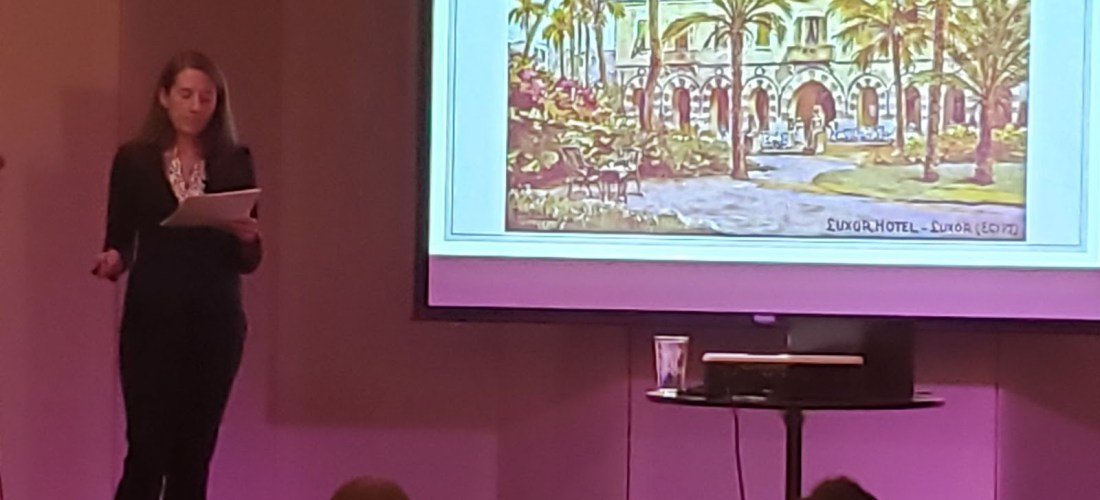
When you think about the development of science, you might envision a laboratory, but you probably don’t think of a bar, a hotel lobby, or a boat. However, our recent guest speaker, Dr. Kathleen Sheppard, argues that the informal spaces where scientists meet to discuss their work, network, and simply relax are just as important if not more important than formal sites like labs, museums, and universities. 

Dr. Sheppard is an Egyptologist and historian of science who specializes in late 19th-century and early 20th-century British and American Egyptology. During her visit from Nov 15th-16th, 2021, she met with the students in STS 201: Introduction to Science, Society, & Society, gave a Brown Bag presentation, and topped off her visit with a STEAM Café talk.  

STS Faculty Profile: Frank Van Nuys

STS Faculty Profile

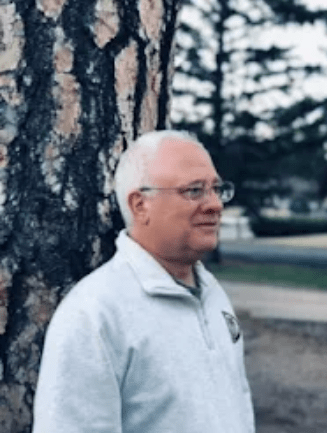
Frank Van Nuys is Professor of History and will be the interim Department Head for Humanities & Social Sciences in Spring 2022.

What’s your area of expertise? What do you primarily research and/or teach? And what drew you to this field?

I would say that I am a generalist in the history of the American West and not particularly comfortable claiming expertise in any area within that field. I am more confident saying that I am conversant in a variety of areas, including the West, of course, but also environmental history. The nature of my job here at Mines accommodates being both a generalist and having some latitude to develop and teach courses that interest me. Of late, in addition to the surveys in American history and Western Civilization, I have been teaching Westward Expansion of the U.S. and Environmental History of the U.S.

My focus earlier in my academic career was on race and immigration, so, for instance, I did my Master’s thesis on so-called alien land laws in California, which were designed to prevent Japanese immigrants from owning or leasing agricultural land in the early 20th century. My first book, Americanizing the West: Race, Immigrants, and Citizenship, 1890-1930, looked at the Western part of the nation as an important driver in immigration restriction and the Americanization programs of the 1910s and 1920s.

After that, my fascination with wildlife issues and the attraction of a deeper engagement with environmental history shifted my focus. Controversies over mountain lions re-populating the Black Hills about fifteen years ago provided the impetus for my second book, Varmints and Victims: Predator Control in the American West, which was published in 2015.

Native Science: Interconnection, Local Knowledge, & Memory

Native American, science

By Christy Tidwell

November is National Native American Heritage Month, a chance to acknowledge the history and living culture of Native American peoples. As a science, technology, and society program, this seems a good opportunity to discuss Native science, also called Indigenous science or Traditional Ecological Knowledge (TEK). As the varied names for this indicate, it’s not one monolithic entity but incorporates ideas from many perspectives. It is both traditional, building on Native peoples’ long histories of learning about and sharing knowledge, and contemporary, an ongoing part of living in and with the world.

Photo by Ponciana via Pixabay

What is Native Science?

Gregory Cajete (Santa Clara Pueblo) coined the term, and he describes Native science as “a metaphor for a wide range of tribal processes of perceiving, thinking, acting, and coming to know that have evolved through human experiences with the natural world.” Cajete says, “Native science is born of a lived and storied participation with the natural landscape. It is the collective heritage of human experience with the natural world” (2). In other words, Native science combines human and nonhuman and describes what humans know by relating to, communicating with, and experiencing the world. It is not a science based on laboratory experiments or anonymous review.

This contrasts with Western ideas of science by emphasizing connection rather than separation, relationships rather than objective distance. Native science sees people as part of the world they’re learning about, not outside it, and therefore people cannot be removed from scientific work. If you’ve been trained to think of science as necessarily objective and tainted by any hint of subjectivity or bias, this may sound unscientific. However, as Leila McNeill points out in a Lady Science interview, “It really just means that it’s grounded in this specific experience of this specific group of people in this specific place, which can actually give us better results than if we were looking at something that is looking at large, broad questions that they’re trying to apply to everything that just kind of obscures the particular.”

Agrarian Protest: Spring 2022 Course

Classes

by Bryce Tellmann

“Agrarian” is a loaded term. Literature scholar M. Thomas Inge notes that it is most commonly associated with independence and self-sufficiency, as well as long-running tensions between tradition and industry, community, and agriculture as a “positive spiritual good” (xiv). Americans are likely to associate it with Thomas Jefferson’s oft-quoted line from Notes on the State of Virginia: “Those who labor in the earth are the chosen people of God, if ever he had a chosen people, whose breasts he has made his peculiar deposit for substantial and genuine virtue.”

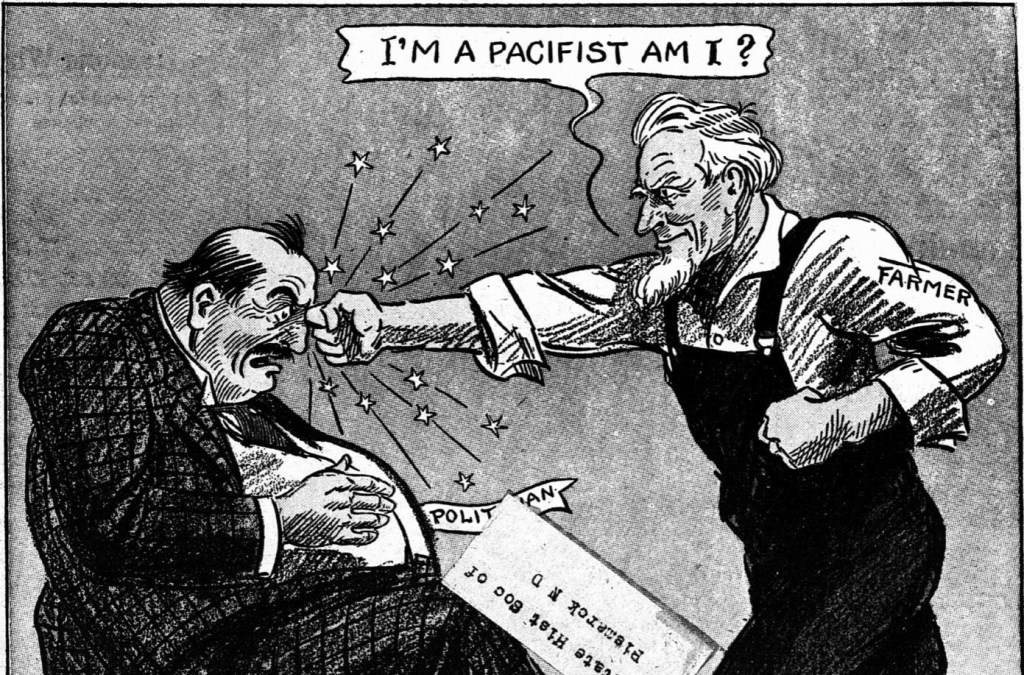
But the history of agrarianism isn’t all community and virtue. From the Whiskey Rebellion of the 1790s to the Tractorcades of the 1970s, farmers in the United States have drawn on agrarian rhetoric to protest commodity prices, foreclosures, corporate control, and more. This line of protest is seen around the world as well, from multiple movements for migrant worker rights to the ongoing farmer protests in India.

Black and white cartoon drawing of a man labeled farmer punching a man labeled politician while saying, "I'm a pacifist am I?"
Image courtesy of the North Dakota Historical Society

In Spring 2022, I am teaching a topics class on Agrarian Protest (ENGL 392) that will examine a broad swath of these protests. Since I’m a rhetorician, we’ll pay particular attention to the communicative and persuasive discourse of these movements, through examination of both primary and secondary sources. Ultimately, I expect that students will be surprised by the sheer diversity of voices in the last century-and-a-half of agrarian protest. It is easy to assume that farmers’ political interests are simple, unified, and consistent across time. The truth is far more complex and – dare I say – radical.

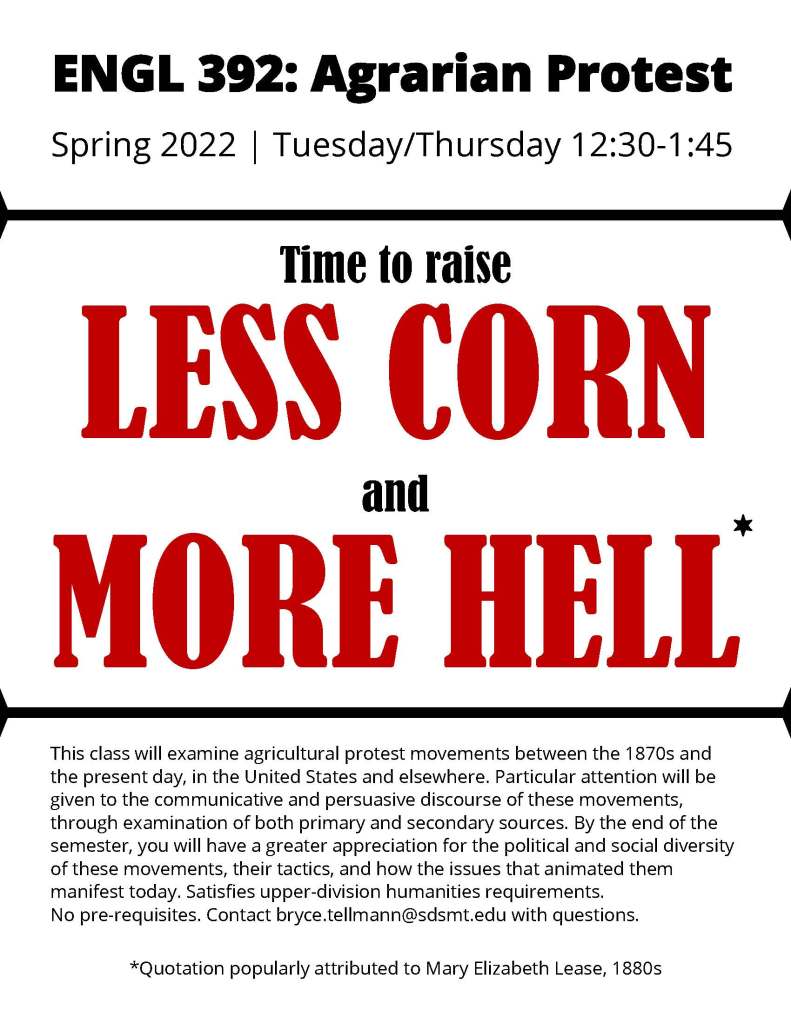
So in the (apocryphal) words of 1880s reformer Mary Elizabeth Lease, “it’s time to raise less corn, and more hell!”

Poster advertising the course. 

ENGL 392: Agrarian Protest, Spring 2022, Tuesday/Thursday 12:30-1:45.

Features the text: Time to raise less corn and more hell.

Environmental Literature & Culture: Spring 2022 Course

Classes

By Christy Tidwell

What is nature? What do you imagine when you think of nature? What are the qualities of nature (better yet, of Nature with a capital N)? 

Pause now and think about that for a minute. 

Seriously. 

What is the image of Nature you hold in your mind? Picture it.

Photo by James Wheeler on Pexels.com

Did you imagine something like that? Maybe not that exact image, but something similar? If so, consider this response more fully. What are the qualities of this representation of nature? It’s beautiful. It has lots of elements of the natural world (I know, that seems circular, but stick with me), like trees, mountains, a lake. It’s pure and untouched. It’s wild. Notably, there are no humans in this image. 

Welcome to the SuperHuman Sports League

The Double-Edged Sword

By Olivia Burgess
The Double-Edged Sword

What if athletes could voluntarily replace their limbs with prosthetics to make them faster and stronger?

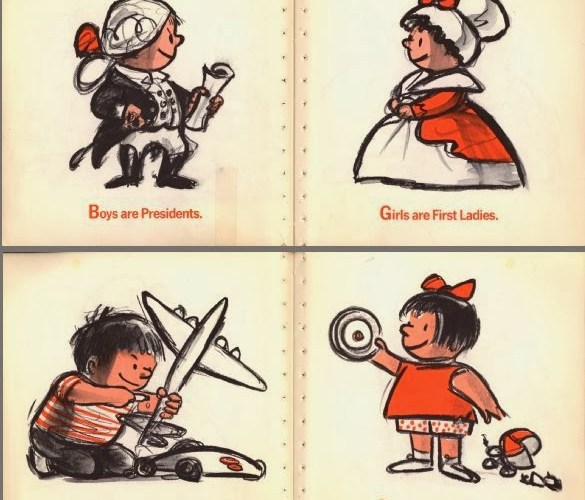
This question was raised by Otutoa Afu, an STS major in my Intro to STS course. The class has been discussing what it means to be human in a world where technology can radically transform both the human body and the human experience. Some of these advancements have been tremendously positive, such as the blade runner prosthetic that allows amputees to compete in athletic events, but Otutoa’s question highlights the potential complexities that may arise if technological enhancements become more widespread.

STS Faculty Profile: Matthew Whitehead

STS Faculty Profile

Matthew Whitehead is the Director of the Apex Gallery and a Lecturer who teaches Art and Art History classes in the Humanities department.

What’s your area of expertise? What do you primarily research and/or teach? And what drew you to this field?

I am an artist. I appropriate images and visual experiences from my surroundings and use them as inspiration for abstractions, mostly drawings, paintings, and collages. I work intuitively, paying close attention to composition and craft. My interest in the arts and the effect it has had on my life pushed me to pursue a career in education. I have taught painting, drawing, photography, illustration, design, graphic design, ceramics, stained glass, sculpture, art history, and foundational arts to students of all ages.

The arts have always been an important part of my life. I come from a family of artists and creatives. On my mother’s side, my grandfather was a renowned potter, painter, and art professor, and my grandmother was a social worker who now spends her time making traditional braided rugs and hand stitching quilts. My mother is a costume designer and art educator by trade but is also an actress and choir singer. My uncle is a potter, and my aunts are also artists of one kind or another. My grandmother on my Dad’s side was a trained aerial performer and painter. My dad was an actor, then a lawyer, and now he’s back to acting again. Given our family background, my siblings and I had no choice but to go into creative fields. My oldest brother is an actor, director, producer, filmmaker, and a professor of acting while my sister is an artist and landscape architect. Becoming an artist always felt like a natural fit.

Spooky Science at the Movies!: Week 5

Film, horror

By Christy Tidwell

This weekend is Halloween! To celebrate, I have two final movie recommendations to share. One is an all-time favorite of mine and probably no surprise to those who know me. The other is one of the scarier recent movies I’ve seen. Their premises are quite different, but both have science and technology at their core.

Classic Movie #5: Jurassic Park

Of course it’s Jurassic Park! Jurassic Park (1993, directed by Steven Spielberg) is an adventure movie featuring dinosaurs, a horror movie with terrifying monster attacks, and a science fiction movie that asks, “What if we could bring a creature back from extinction?” Jurassic Park is such a well-known part of US popular culture that it is a common reference point in discussions of scientific overreach and a familiar critique of the role of money in scientific research. “Spared no expense,” John Hammond (Richard Attenborough) repeats throughout – but the project still fails.

Jurassic Park is a reworking of Frankenstein with dinosaurs, and it is one of the best movies out there for raising important questions about scientific ethics while also being extraordinarily entertaining. If you haven’t seen it, now is the time! If you have already seen it, well, it’s always a good time to watch Jurassic Park again.

Official trailer for Jurassic Park (1993)

Contemporary Movie #5: Host

As Laura Kremmel noted in her recent post “High-Tech Spirits and Ghost Tours,” Host (2020, dir. Rob Savage) has been named as the scariest horror movie. It’s short (only 57 minutes!) and fun, but it definitely gets your heart pounding in that short running time. Host spends less time raising big issues about science than Jurassic Park and focuses more on scaring the audience, but the way it achieves its scares is worth noting from an STS perspective. Those scares are only possible through the technology of Zoom, and the audience’s ability to be scared by spirits via technology is a) definitely not new (as Laura Kremmel points out) and b) perhaps an indication of how mysterious the inner workings of these technologies are to most of us.

Official trailer for Host (2020)

Collected Movie Lists

This is the final entry in the series of STS-related horror movies for this season, so I’ll end by combining all the movies recommended and linking to the earlier posts.

Classic movies:

  1. Frankenstein (1931)
  2. Godzilla (1954)
  3. Phase IV (1974)
  4. The Fly (1986)
  5. Jurassic Park (1993)

Contemporary movies:

  1. Saint Maud (2019)
  2. Crawl (2019)
  3. In the Earth (2020)
  4. Annihilation (2018)
  5. Host (2020)

Happy Halloween, and happy viewing!