The Impact of Being a Firefighter on Mental Health 

STS Students

By Otutoa Afu

Otutoa Afu is majoring in Science, Technology, and Society. He plans to pursue a career in the fire service once done with school. 

After completing the fire academy in 2018, I was fortunate enough to get hired as a full time firefighter at the El Medio Fire Department out of South Oroville, California. At that time I was just a 19-year-old growing boy who never knew his life was going to change due to the fire service. Working as a firefighter, people have always thought about the cool things you get to do, from playing with the “jaws of life” to going to elementary school and playing hero for the young ones. But nobody ever told us about the bad things that came with being a firefighter. 
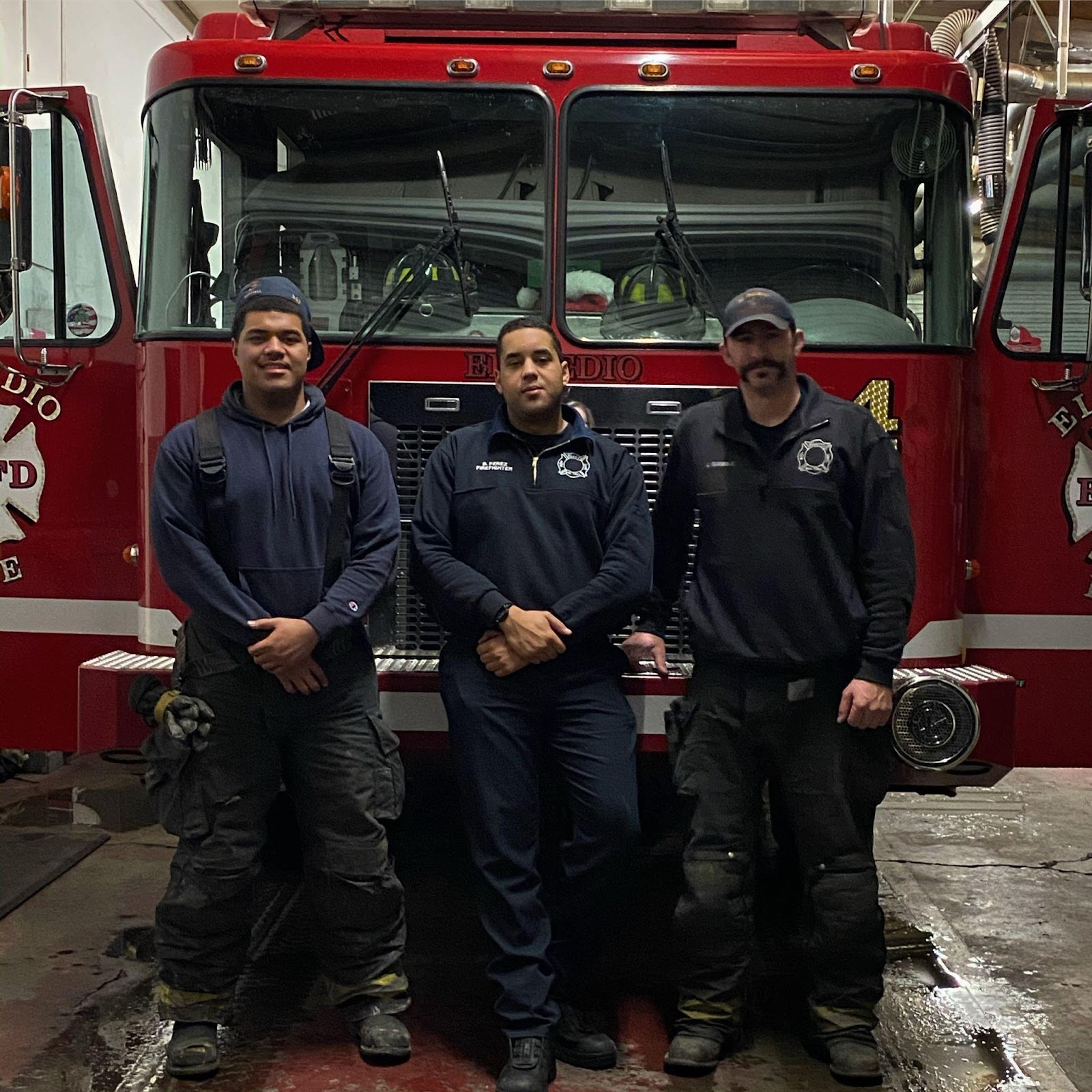
Three firefighters standing in front of a fire truck.

(Left to right) Otutoa Afu, Senior Firefighter Shawn Perez, Captain Jeffery Gamble.

After accepting my football scholarship here at South Dakota Mines, I left my job in California and joined the Rapid Valley Fire Department student resident program here in South Dakota. The student resident program is where you get to live at the fire station and run calls. You also need to be enrolled as a full time student and maintain a certain GPA. 

Because of my strong interest in firefighting, it was a good fit to explore firefighter mental health for my capstone project. The stress faced by firefighters throughout the course of their careers can be hard on mental health and well-being. This stress can be caused by incidents involving children, violence, inherent dangers of firefighting, and other traumatic events. For instance, you might roll up on a head-to-head traffic collision involving two vehicles, a family of five vs. drunk driver that leaves the parents dead. Later in the same shift, you can get called out for a suicidal patient to walk in on the patient hanging themselves. Some may say firefighters know what they are getting into, but that does not make them immune to developing mental health issues.

For my capstone project, I want to explore how firefighters are affected by their job and how fire departments address mental health. I will approach these topics by analyzing journals, scientific papers on mental health, and other reliable sources from those that are in the field or have been in the field. Hopefully this can help me summarize what the best coping tools or even shift schedules can be best for firefighters and their well-being and share with fire departments around the nation, maybe even internationally. All in all, firefighters are always there when called, and we should be there to help them, too. 

Is Driving in the Snow Really that Dangerous?

STS Students

By Jake Lindblom

Jake Lindblom is majoring in Atmospheric and Environmental Sciences with a minor in Geospatial Technology. He plans to study atmospheric science in graduate school after earning his bachelor’s degree.

As most Rapid City residents know, snow can be quite a pain to drive in. The roads are treacherous, it’s hard to see, and it just feels dangerous. As a driver, you may presume that more snow on the road equates to more hazardous driving conditions, but does this mean more crashes actually occur? Might you, as a driver, try to avoid those hazardous conditions and choose to stay at home? Furthermore, while you may think you can handle driving in small, frequent snow events, could this be a false confidence?

These are some of the questions I’m trying to answer in my research project. As a student in the Atmospheric and Environmental Sciences Program, I’m interested in operations research, or how to apply what we know about the atmosphere to the “real world” for the benefit of the community. 

But I’m also a snow fanatic, or someone who is irrationally excited about frozen water falling from the sky. Hailing from Olympia, Washington, snow was a rarity, but occasionally we received a good dumping. The largest of these dumps occurred in February 2019, when I measured 22 inches of snow in my backyard!

Snowy scene, with a pond and snow-covered trees.

A pond covered in snow near my house in western Washington during the February 2019 snowstorm. Snowfall totals ranged widely across the area, but my house measured 22 inches… the most I had ever seen in the Puget Sound lowland (photo credit: Jake Lindblom).

This event completely shut down the city. Nobody moved (in fact, my family couldn’t get out of our driveway for a couple days). In a scenario like this, driving would certainly be dangerous, if not impossible. But there are undoubtedly fewer drivers on the road as well. So, should first responders, city officials, and emergency managers expect greater or fewer crashes overall?

In a place like Rapid City, which averages much more snow than Olympia (about 48 inches, actually), the question of how snowfall impacts car crashes is much more pertinent. 

Photo of cars parked with deep snow surrounding them, covering part of the hood on the nearest car.

The November 2019 snowstorm on the South Dakota Mines campus. Snowdrifts were several feet high, as seen here. The storm set a record for the snowiest November in Rapid City (photo credit: Jake Lindblom).

This question seemed like the perfect project for me. It deals with one of my favorite things about the atmosphere (snow) and applies it to a good cause: helping the community understand how snow affects car crash counts. In this capstone project, I hope to identify a causal relationship (if any) between snowfall measurements and vehicle crash counts. I hypothesize that relatively small snowfall events (less than 3 inches measured) may contribute to more crashes than major events (6 inches or more). People may have more confidence in their driving abilities when “only” a few inches of snow cover the ground and may continue on with their daily errands versus when a major snowstorm discourages them from leaving home. If I have time, I’d like to develop a car crash “forecaster” based on expected snowfall and possibly other meteorological variables (like temperature or visibility). But for now, I think I have my plate full!

STS Faculty Profile: Gerrit Scheepers

STS Faculty Profile

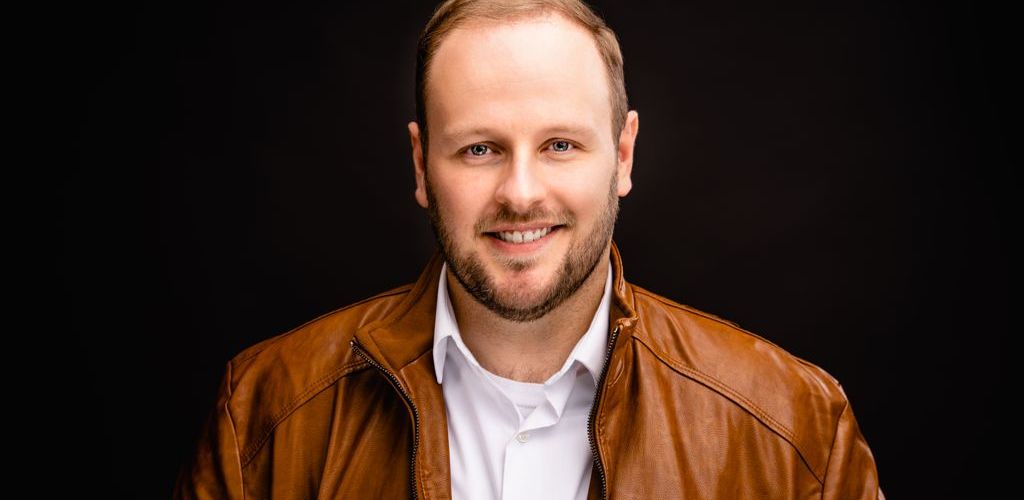
Gerrit Scheepers is Assistant Professor of Music and Director of Choirs.

What’s your area of expertise? What do you primarily research and/or teach? And what drew you to this field?

My terminal degree is in music performance with specialization in choral conducting. I mainly teach choir, and when the opportunity arises I teach the art of conducting as well as choral literature.

It has been an interesting journey to my current career field. I have always known since high school that I want to have a job that interacts with many people but also puts good out into the world. I wasn’t quite sure what exactly I wanted to do after graduating high school, so I started out as Bachelor of Medical Science student but also sang in the prestigious University of Pretoria (TUKS) Camarata choir. The turning point was during my sophomore year when the conductor resigned just prior to a scheduled Christmas concert and none of the seniors in the choir was available to conduct the choir. So, I was sort of obligated to conduct the performance by default. It went really well, so much so that several colleagues came up to me afterwards, asking if I am planning to pursue a career in conducting. The rest is history.

What’s one of your favorite courses, topics, or specific texts to teach? Why?

One of my favorite courses to teach is choral conducting, as well as choral literature. I really feel a sense of accomplishment when I see students grasping conducting concepts in the moment. Conducting equals moving, and moving in front of other people can be daunting. It requires a deep sense of vulnerability from the person moving (in this case conducting). Here at SDSMT I don’t get to teach conducting, but I can apply almost everything I have taught in the past to the choirs I am teaching every day.

What’s something you’ve done that you’re really proud of?

I am really proud of the legacy I left behind at Missouri State University. I was the very first South African to study for a Master of Music at MSU. Since my graduation in 2016, another four South African students have gone on to pursue a Master of Music degree at MSU. Three of them already graduated and the newest one just started this fall. I also had the opportunity to leave a mark there by starting the Scheepers Memorial fund in honor of my late parents in 2019. This endowment fund, for which I was just this past month awarded the Rick & Dee Uebel Award for “outstanding support and advocacy of the Missouri State University Choral Program,” was specifically created to give other international students the opportunities I had to fulfill their dreams via the MSU choral studies program. That fund will change the lives of future conductors from across the globe (and already has).

What is a book, movie, or another work of art or media you’ve enjoyed recently that you would like to recommend?

A musical artist I am currently obsessed with is Gregory Alan Isakov. We have some connection in terms of our country of birth. He was also born in South Africa but moved to the United States at an early age. His music combines indie and folk genres. His music reminds me of Leonard Cohen, who is another favorite of mine. The first time I encountered Isakov’s music was in 2017, while studying in Seattle for my DMA. My favorite album of his is This Empty Northern Hemisphere. He is just a master with words. One of my favorite lyrics perhaps is from his song “Big Black Car.”

Tell us something about yourself outside of work. What do you enjoy doing? What’s a detail about you that your students might not already know?

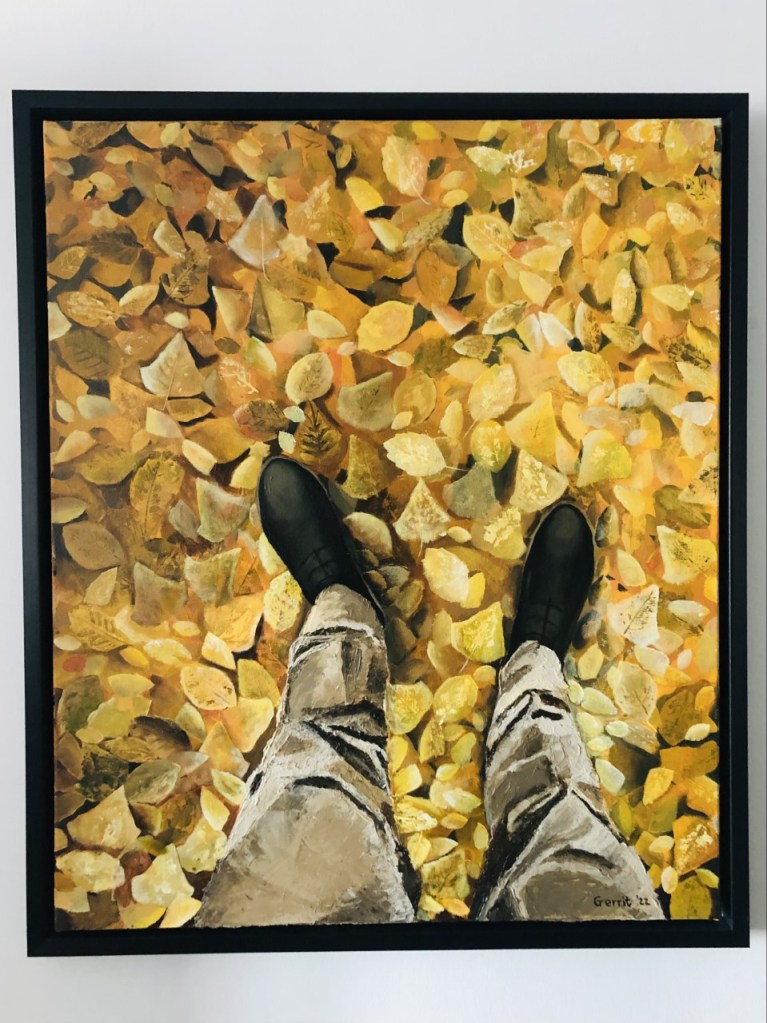
I am an avid and prolific painter, and I love to make pencil sketches as well. I have done art since an early age. In 2020 – after almost a 10-year hiatus – I dusted off my pencils and started sketching again. However, my favorite medium to work in is acrylic on canvas. I finished probably eight paintings in the first 6 months of 2022. I do not have a specific genre I paint in – portrait, still life, landscapes – I’ll paint it all. My current favorite painting I call “Autumn from a different perspective,” pictured below.

A painting depicting yellow autumn leaves on the ground, viewed from above, with legs and feet standing on the leaves.
Photo of Dr. Scheepers working on a painting.

STS Faculty Profile: Bryce Tellmann

STS Faculty Profile

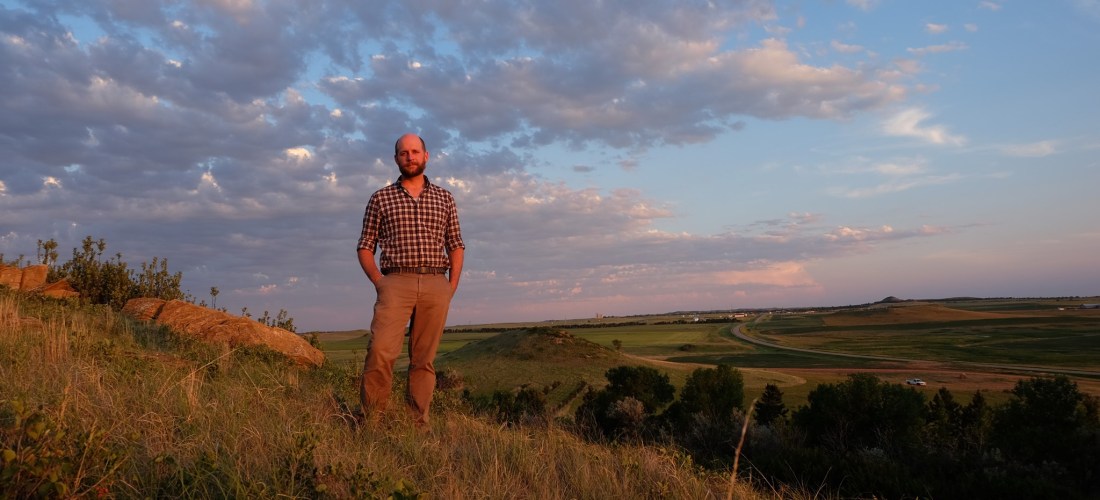
Bryce Tellmann is Instructor of English.

What’s your area of expertise? What do you primarily research and/or teach? And what drew you to this field?

My field is rhetoric, by which I mean the study of how we use discourse (usually words, but not always) to make stuff happen. I’m mainly interested in rhetoric and space/place, especially at the regional level. A lot of my research comes back again and again to the Great Plains, maybe because it’s my home, but also because it perennially faces difficult questions about what it means to consider a place a region and how that regional identity is leveraged in civic life. These themes of place and community almost always worm their way into every course I teach.

Like a lot of communication scholars, I think I wound up in the field by accident. The nice thing about rhetoric is that you can use it as an excuse to study just about anything. My initial dissertation proposal was on ancient Irish rhetoric, but some of those same themes led me yet again to studying the Great Plains.

What’s one of your favorite courses, topics, or specific texts to teach? Why?

Over the past couple of semesters I’ve realized that I cherish teaching Introduction to Humanities. Part of it is the flexibility of the course—“Introduction to Humanities” is a broad mandate, so it gives both my students and me the opportunity to play with ideas and explore possibilities. I use the idea of “place” as a central theme of the course. We read historians, geographers, communication scholars, poets, and more, but we use the place as a locus to see how different approaches ask different questions and yield different results. All of my students have something to say about place, so it’s a great tool to make connections between fields, including STEM fields. And, of course, because it’s so broad, if I read something interesting and want to talk about it in class, it’s pretty easy to find an opportunity to make it relevant!

What’s something you’ve done that you’re really proud of?

An article I published a couple years ago was cited in a book that was just published this month. The author, a geographer, called my a piece “a thoughtful analysis,” which is about as high a compliment as I can ask for.

Book cover of Famine Pots, featuring an image of a mortar and pestle by a window.

What is a book, movie, or another work of art or media you’ve enjoyed recently that you would like to recommend?

I’m just finishing a book titled Famine Pots: The Choctaw-Irish gift exchange, 1847-present. It is a series of essays, poems, and meditations on one of the most profound gifts in history: in 1847, members of the Choctaw Nation took up a collection to send to Ireland to provide relief during the Irish Famine. They ultimately sent $172 (some sources say $721), or about $5,000 today. This happened just a few years after the Choctaw were forcibly relocated to Oklahoma from their homelands in the south-eastern US, an act of ethnic cleansing commonly called “The Trail of Tears.” It’s a haunting read and raises a host of interesting questions about what connects people and places.

Tell us something about yourself outside of work. What do you enjoy doing? What’s a detail about you that your students might not already know?

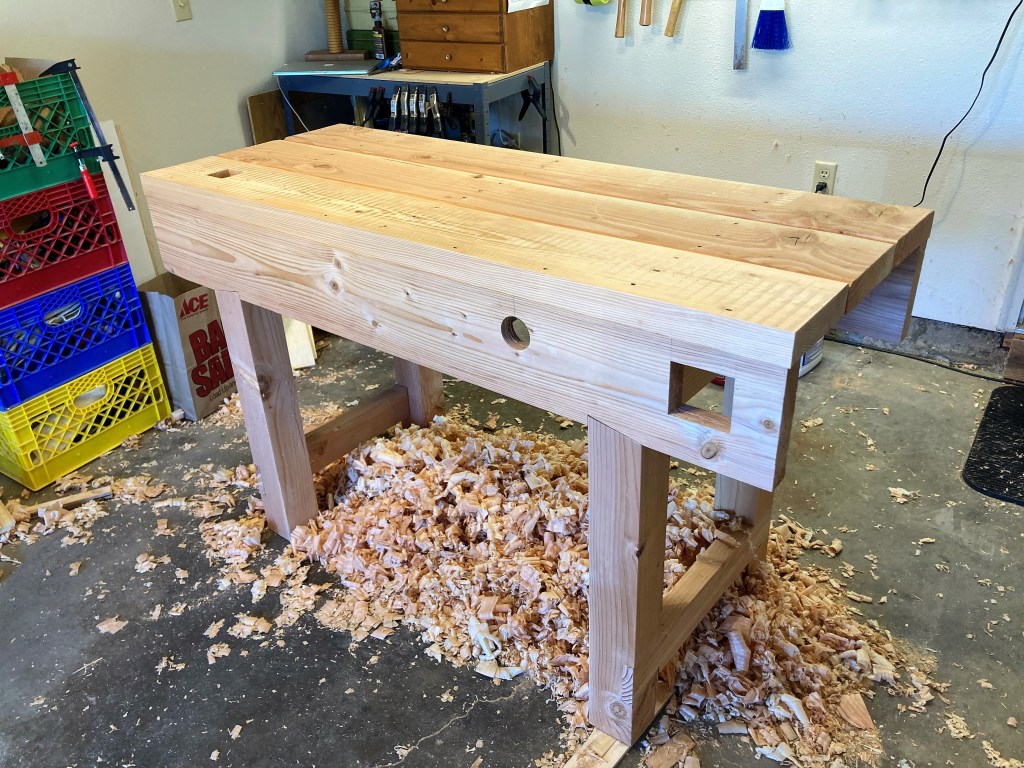
Over the past year or so, I’ve taken up woodworking, using almost exclusively hand tools. Since January I’ve been working on a traditional English-style woodworking bench, which I’ll hopefully complete by the end of this semester. It has been a good reminder that the first step to being good at something is to be quite bad at it for some time.

A wood bench in progress, with a pile of wood shavings beneath it.
Woodworking bench in progress.

Other Interesting Technologies: STS Faculty Reflect

STS Faculty, Technology

This final entry in the series on interesting moments in science and technology features reflections from Paul Showler, Gerrit Scheepers, and Christy Tidwell on a wide range of topics: emotion detection technology, a method to provide easier access to clean water, and a scheme to farm hippos in the US. (For more thoughts on interesting science and technology from STS faculty, see previous posts on technologies of communication and technologies of destruction.)

Technologies of Destruction: STS Faculty Reflect

STS Faculty, Technology

In this second entry in our series asking STS faculty to reflect on moments in science and technology that they find particularly interesting or meaningful (read the first entry here), Lilias Jones Jarding, Joshua Houy, and Frank Van Nuys address technologies of destruction and violence. Some – like nuclear weapons – are directed at humans; others – like coyote-getters – at nonhumans. All, however, have their limits.

Technologies of Communication: STS Faculty Reflect

communication, Technology

This is the beginning of a short series in which several STS faculty share elements of science and technology that they find intriguing or meaningful. This opening post features reflections from Evan Thomas, Erica Haugtvedt, and Olivia Burgess on communication technologies. Their choices highlight both the ways we connect with each other and the role that technology plays in that connection.

STS Faculty Profile: Kyle Knight

STS Faculty Profile

Kyle Knight is Department Head and Professor of Sociology.

What’s your area of expertise? What do you primarily research and/or teach? And what drew you to this field?

I’m an environmental sociologist. I primarily research the human dimensions of environmental change, which includes the social causes, consequences, and responses to environmental problems. Besides introductory, statistics, and methods courses in sociology, I’ve also taught courses on environmental sociology, environmental justice, and society and climate change. My research has lately focused on social patterns in climate change public opinion. For example, my most recent publication examined how outdoor recreation, such as hiking and birdwatching, might foster greater concern for climate change. My initial interest in sociology was motivated by questioning the centrality of materialism and consumerism in our society, and that blossomed into a drive to understand how we might achieve a more sustainable and equitable future.

Photo by Josh Willink on Pexels.com

What’s one of your favorite courses, topics, or specific texts to teach? Why?

One book I’ve used in my classes for a while now is Andrew Szasz’s Shopping Our Way to Safety, which I think provides an excellent illustration of how treating systemic social problems as individual-level issues to be solved by consumers not only doesn’t solve these problems but actually makes them worse. One of the biggest challenges in teaching environmental sociology is to get across the point that environmental problems are, at their root, social problems, and this book usually does the trick.

What’s something you’ve done that you’re really proud of?

While working on my Ph.D. at Washington State University, I co-authored and published an article with a fellow sociology graduate student and we received a departmental award for it. It was at this moment that I began to feel like a real scholar, and I continue to be proud of the work we did on our own to make it happen.

Tell us about a book you’ve read recently, a movie you’ve seen recently, or another work of art or media you’ve engaged with recently that you really enjoyed and would like to recommend.

I am a big music nerd and love all kinds of genres and traditions. I listen to music all day long, especially while working in my office, and enjoy reading album reviews. My musical tastes run the gamut – some of my favorite musical artists lately are Jake Xerxes Fussell, Yasmin Williams, Madlib, Cassandra Jenkins, Ben Chasny, Julian Lage, and Protomartyr. Right now, I’m fascinated by Marina Herlop’s new album titled Pripyat, which is named after the Ukrainian city abandoned in the aftermath of the Chernobyl nuclear disaster. Herlop is a classical pianist and experimental producer from Barcelona, and this album creates a wordless, other-worldly soundscape that is just completely captivating. My favorite track is “Shaolin Mantis” but the choir version of “Miu” is a close runner-up.

Tell us something about yourself outside of work. What do you enjoy doing? What’s a detail about you that Mines students might not already know?

I’m pretty boring and just enjoy spending time with my family outside of work. We especially like to hike, camp, and ride bicycles. We’re very excited to get to know the Black Hills and to eventually ride the Mickelson Trail when it’s not so hot!

Planting Seeds: Anchoring Ethics in the Dirt

Classes, Environment, teaching

By Christy Tidwell

My Environmental Ethics & STEM class asks big questions about knowledge, values, justice, and responsibility – both individual and systemic – related to environmental issues. Although I try to situate these conversations in specific, real-world examples, they can still sometimes seem abstract or beyond the scale of my students’ reach. They may wonder what they can do to address climate change, for instance, or to change corporate policy.

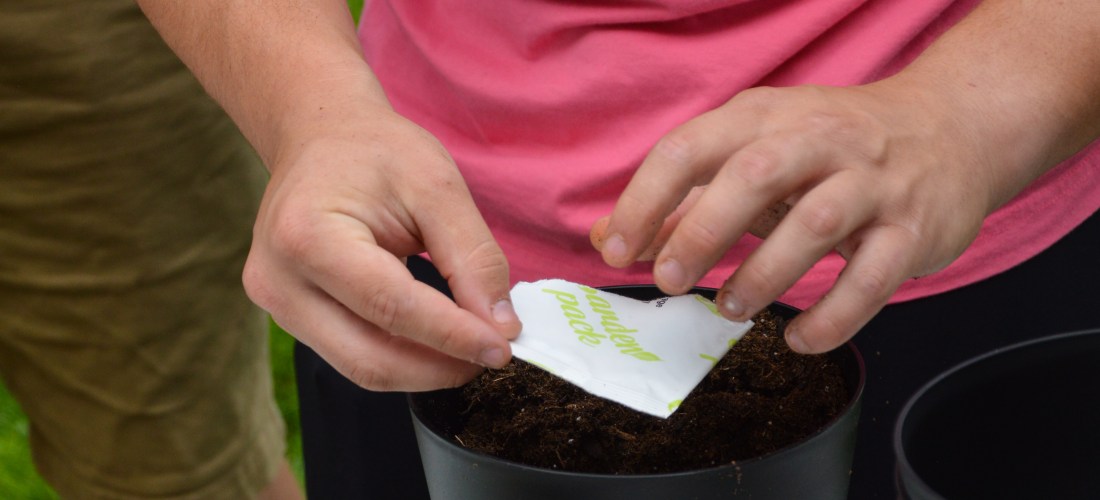
But they can, of course, make a difference, and we look for ways to identify the actions they can take (again, not just individually but within larger contexts). In the meantime, to help connect us more fully to the environment, this semester I asked my students to plant seeds and to do their best to grow them and keep them alive. It’s my hope that working to protect and nurture one small plant will give the class a personal connection that issues of pollution, plastics, or water rights may not always have.

Changes in the STS Program: Saying Hello and Saying Goodbye

STS Faculty

As the 2021-2022 academic year ends, we are looking forward to welcoming new members to the STS program in the fall, but we are also saying goodbye to a faculty member who will be greatly missed.

Happy Welcomes

After the retirement last year of our previous department head, Allison Gilmore, and the capable leadership of Frank Van Nuys this spring, we will begin the 2022-2023 year with a new department head: Kyle Knight. He comes to us from the University of Alabama in Huntsville, where he was Associate Professor of Sociology and Chair of the Department of Sociology. He has an emphasis in environmental sociology, which will add new expertise to the STS program’s environment & sustainability track.

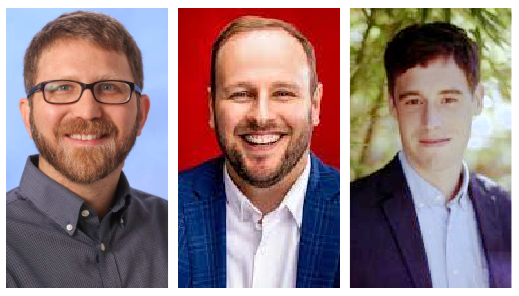
We also welcome two new assistant professors: Gerrit Scheepers as Assistant Professor of Music and Paul Showler as Assistant Professor of Philosophy!

We are excited to get to know and work with all of them. Look for more about and/or from each of them in the future!

Kyle Knight (left), Gerrit Scheepers (center), and Paul Showler (right)

And a Sad Goodbye

Even as we look forward to new people joining us, we are very sad to say goodbye to Laura Kremmel (Assistant Professor of English & Humanities), who has accepted a position at Brandeis University. She has been a wonderful colleague and friend for the years she has been here, and little we could write in this short space would adequately express our sadness that she is leaving. Nonetheless, we all wish her well and hope that her colleagues at Brandeis appreciate her!

Woman smiling at the camera on the left, skull and crossbones carving on the right.
Laura Kremmel and a friendly skull.