Director of Bands Dr. Haley Armstrong and a team of SD Mines computer science and engineering students have created Score-Score, a program designed to let music teachers and professors find and review sheet music. Score-Score went on to take fifth place and a $1,000 prize in the student division of the 2023 South Dakota Governor’s Giant Vision Business Competition. Armstrong is delighted with the success of this project, saying, “The students have made my wild idea become a reality. Their dedication and vision have taken the project further than I could have hoped to bring new ideas and focus to an idea that would have been subpar without their expertise.”
Score-Score highlights the way our faculty in the Humanities, Arts, and Social Sciences encourage students in their own research and help them see connections between their disciplines and ours. It also beautifully illustrates the interdisciplinary and creative nature of STS.
This memorial for John Dreyer has been a work in progress for months. He died last summer, before the most recent academic year began, and those of us who knew him and loved him have struggled with his absence and wrestled with how to articulate how much he meant to us. This post is one small hint of how much he meant to us, what we could put into words. These words speak truths about John and about what he meant to us, but they can never tell the whole story.
We made it through this academic year without him here. But he was missed all the time, and he will continue to be missed.
Frank Van Nuys, Professor of History
When our colleague, Dr. John Dreyer, passed away suddenly on July 9, 2022, at the age of 44, we were all shaken to the core. It was nearly impossible to fathom how our academic and social lives would endure without him presiding at the head of the conference table on Donut Fridays; sitting in the back of the room at department meetings and presentations; working in his packed office surrounded by hundreds of books and collectibles with the Ohio state flag nailed to the wall; holding forth at Dakota Point or in Haley’s backyard gatherings; accompanying his beloved daughter when it came time to order Girl Scout cookies. From here on out we have to wrestle (a term I choose deliberately in honor of his devotion to professional wrestling) with this heartbreak.
John arrived here at SD Mines to teach Political Science in 2009. To be honest, unlike many others who come to the Black Hills and decide they never want to leave, John always longed to return east, particularly to his incomparable northwestern Ohio. I grew up in the southwestern part of that state, which I suppose made me alright in his book. He even gave me a Pete Rose-autographed baseball not long after he came here. I used to needle him about his “Ohiophilia,” referring to Toledo as “Paris-on-the-Lake” and his office as our “Ohio Embassy.”
There were so many facets to John beyond his love for Ohio. He was a brilliant colleague, a true friend, a loving father and family man, and a consummate storyteller. To honor John, we offer the following thoughts from his colleagues in the Department of Humanities and Social Sciences and others from around campus.
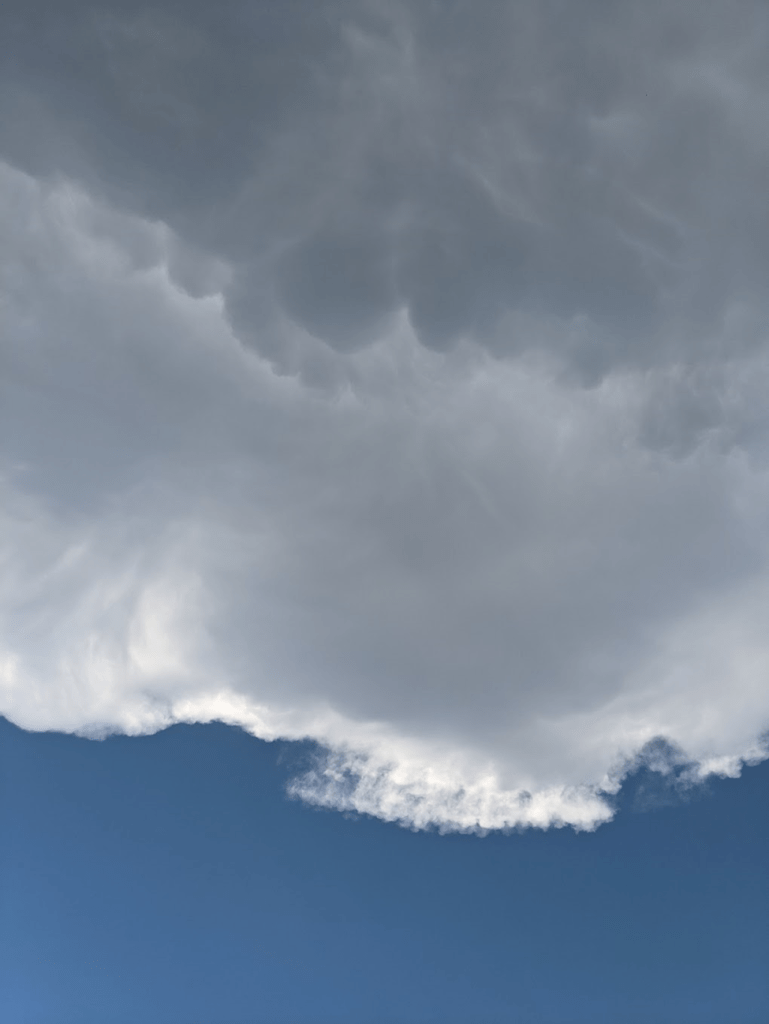
As a weather lover, I always fangirl when a big storm rolls through. I love going outside or chasing it (safely) and seeing all aspects of the storm. Sometimes before a thunderstorm that will produce hail, mammatus clouds form. Mammatus clouds are bubbly in appearance, and are considered unique, but we often see them in the Black Hills. These are my favorite clouds due to how unique they are and how telling of the storm components they are.
This image was taken last summer from Rushmore Crossing. Up at the top of the image are the dark, bubbly mammatus clouds. Mammatus clouds typically foreshadow hail, and are rare in most areas, but are somewhat common during the summer in South Dakota.
I especially love the aftereffects of a thunderstorm. The stillness in the air, the rainbows, the smell of freshly fallen rain, and the glow of the atmosphere are all amazing to me. It also amazes me how much energy storms produce and use as they race across the plains of South Dakota, dropping rain, wind, hail, and lightning as they go. One storm that particularly amazes me is one that occurred on July 23rd, 2010, in Vivian, SD. This storm produced the largest hailstone ever recorded in the United States (3D printed model pictured above). This hailstone is 8 inches in diameter, 18.6 inches in circumference and weighs nearly 2 pounds! Imagine that hitting your house!
Because I have always loved severe weather, I knew my senior research topic needed to be in that category. I especially find hail fascinating, so I decided to use hail as my main topic. South Dakota summer thunderstorms are known for the hail they bring. From car damage, broken windows, roof damage, livestock casualties, plant damage, and human casualties, hail causes many problems. As a lifelong South Dakotan, there have been many times I have been out and about when suddenly I get a National Weather Service emergency warning about hail, but by that point it is too late to move my car into a safe area. Over the years, it has seemed like hail has increased in frequency and size on a regular basis. For example, last summer it seemed like the majority of storms brought at least pea-sized hail, where just a decade ago I remember hail being a more special occurrence. This struck me as an important hypothesis to address because as climate change becomes worse hail will, too, so I figured it would make for an interesting capstone project.
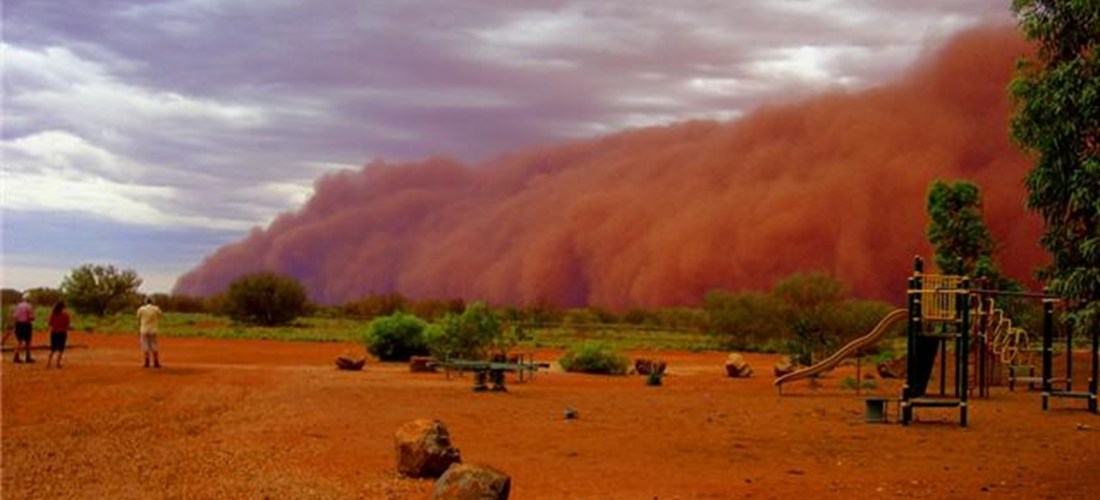
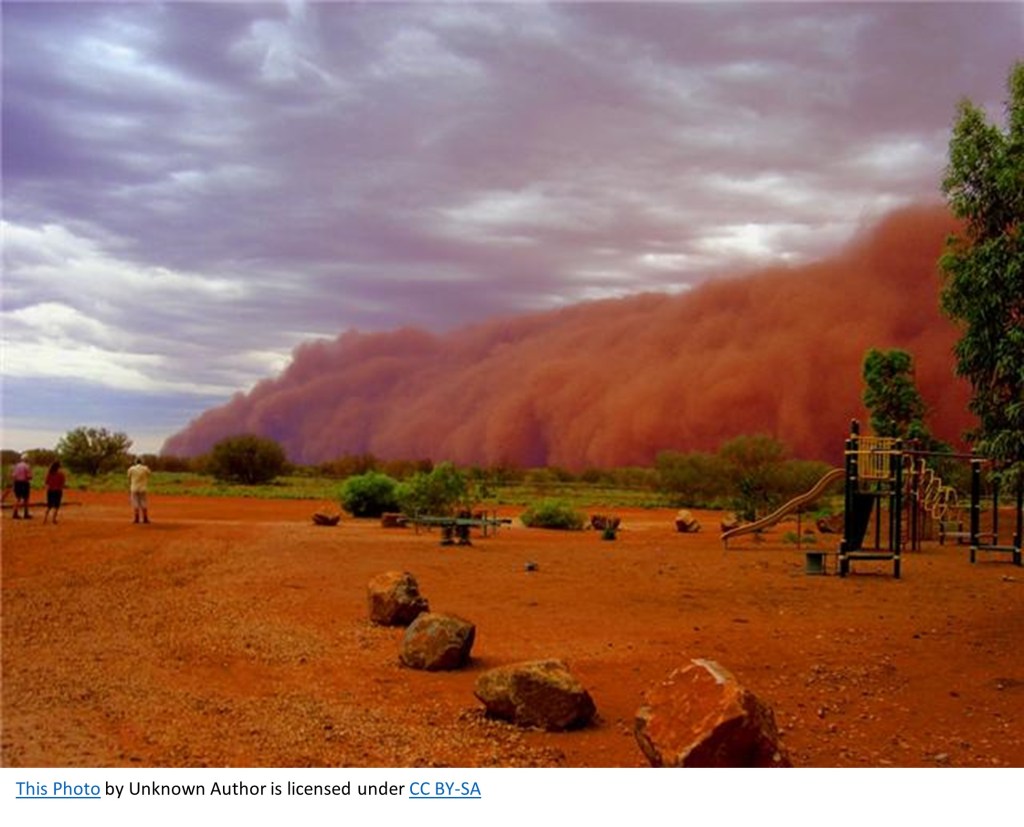
Weather affects all people, and it is important for meteorologists to understand a wide range of events to communicate effectively to the public. My capstone is a project designed to dissect a particularly interesting phenomenon, especially to South Dakota. I have chosen to do a case study of a particular dust storm known as a haboob. The storm I am focusing on occurred May 12th, 2022, and it impacted the eastern part of South Dakota. A widespread, long-lived thunderstorm called a derecho created the haboob beginning in the south central portion of Nebraska and traveled north and east towards Sioux Falls. It sustained winds of 80 miles per hour, and the highest recorded winds of the event were 107 miles per hour. This storm is a good example of what is possible and can become a sample case for the future.
A haboob is a giant dust storm. It is named after the Arabic word habb, meaning “blown.” This type of storm is most common in the Middle East and Northern Africa, where is it historically arid. But haboobs are also well known in the Southwestern United States and are becoming an occurrence in previously unlikely places as well. Haboobs are created from loose particles that are picked up by strong winds caused by storms like monsoons or derechos sweeping across the surface of the earth. The massive amount of precipitation associated with these events evaporate, which is a cooling process, so cool air called a gust front accelerates out in front of the storm at a fast rate, picking up particles and building a wall of air and dirt. The particles are mostly less than 10 micrometer pieces of dirt, dust, and sand, but they can be as large as a pea, and the wind can pick up other debris along with it. These walls of air and dirt can reach grow to 5000 feet tall and 100 miles wide, and they can move at 60 miles an hour (Eagar, Herckes, Hartnett, 2016). Overall it is a phenomenon that is quite terrifying.
If you look at the annual average number of tornadoes per country, the United States reigns supreme, whether we like it or not. And if we look at South Dakota, the state is not without its share of tornadic activity. For instance, as Dennis Todey, Jay Trobec, and H. Michael Mogil write, “A massive outbreak of tornadoes placed the state in the severe weather record book on the evening of June 24, 2003” (19). On that day, sixty-seven tornadoes touched down over a 6-hour period, a single-state record tornado occurrence.
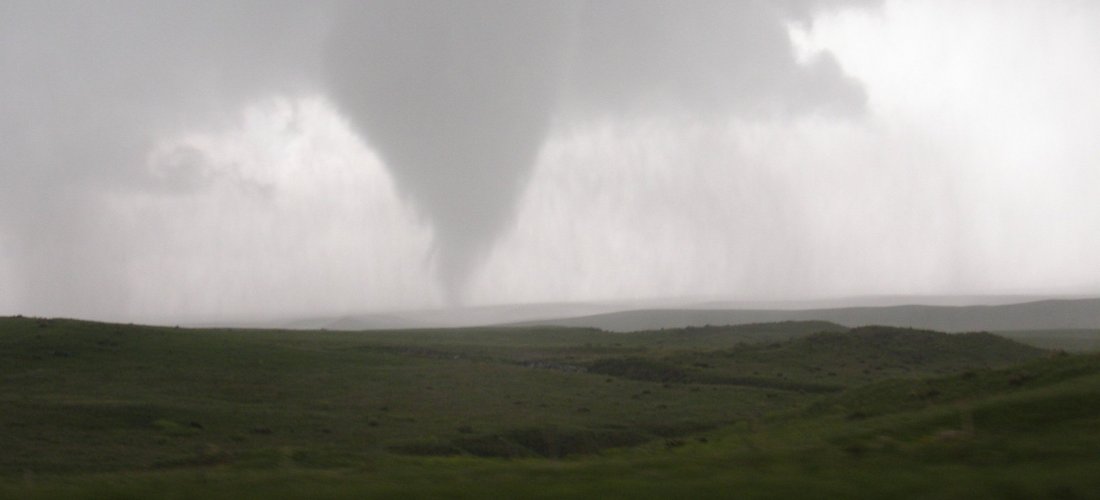
So, you may be thinking to yourself right now, “I live in the Black Hills region of South Dakota. We don’t have a problem with tornadoes.” Well, what if I told you that tornado activity has increased in the Northern Black Hills of South Dakota in the last decade? This increase in activity is not typical for the Northern Black Hills, since only nine tornadoes have been reported in this region since NOAA started gathering tornado data in 1950. What makes this even more alarming is that, of these nine cases, four have occurred in the last decade. This increase is the focus of my capstone with my two-part research question: Do the Northern Black Hills tornadoes that occurred in 2015, 2018, and 2020 have any similar characteristics to each other? Will this help determine when new tornadoes will form over the same region?
Map of Northern Black Hills tornado tracks and strengths on the EF scale. Red circles indicate tornadoes being researched for this capstone. Source: National Oceanic and Atmospheric Administration
What does it sound like to sound educated yet know nothing? In a 17th-century comedy by Molière, Le Bourgeois Gentilhomme (“The Middle-Class Aristocrat”), a rich cloth merchant tries to imitate aristocratic education and speech. He takes philosophy classes and learns that his normal expressions “require a little lengthening” – he must learn how to stretch heartfelt statements (“your lovely eyes make me die of love”) into aristocratic contortions (“Of love to die make me, beautiful marchioness, your beautiful eyes”; “Your lovely eyes, of love make me, beautiful marchioness, die”; “Die, your lovely eyes, beautiful marchioness, of love make me”; “Me make your lovely eyes die, beautiful marchioness, of love”). The joke is on him, as his rhetoric tutor cruelly exploits his easy admiration for excessive, voluminous, amplitudinous, prolix, verbose, copious speech.
The example of the Bourgeois Gentilhomme is echoed in a new development in AI. Recently, OpenAI released ChatGPT, a large-language model (“LLM”) AI that appears to have tremendous facility at composing passable long-form texts. As an educator in higher ed, I don’t think that writing pedagogies are remotely ready yet for the instructional challenges posed by this technology. The main concerns that academics have had about AI and collegiate writing have to do with academic integrity. These are important concerns and addressing them will probably have massive relevance in the years to come.
However, not all academics are especially concerned by the threat posed by AI language models. First, some academics express confidence that their domain-specific knowledge is too inscrutable for a machine to understand. Second, others suggest that the strength of their bonds with their students would make it impossible for their students to make an unnoticed switch to a different voice. Whether the first or second case is true, whether some content or character is indelible, there are finer, more constructive applications of LLMs to writing in higher ed.
Primarily, I focus on interpersonal communication: listening, nonverbal, verbal, and written. I’ve taught communication and presentation skills in business, STEM fields, and performance. I also enjoy working with other people’s writing and helping them refine their skills and ability to communicate efficiently.
What do you primarily research and/or teach?
Although I have taught business writing, advanced writing, composition, and literature classes, I have found my niche in the STEM/technical communications courses. Teaching especially STEM Comm II (ENGL 289) has allowed me to work with students to hone their writing and speaking skills in their areas of expertise and passion. Their excitement in their work is contagious.
And what drew you to this field?
Literally, a mentor and professor at USD lured me in, suggesting I pursue graduate studies and apply for a TA position. Initially, this was far from my plan; I had never planned to pursue a teaching career. However, as I finished my undergraduate degrees in English and Speech Communications, my husband was entering his second year of law school at USD, so we would be in Vermillion, SD, for two more years. Although I was skeptical, I decided to give grad school with a TA position a try. It worked out. I’ve been teaching for 36 years; 2023 marks my 25th year at SD Mines. Making and maintaining connections with students over the years is my favorite part of teaching.
What’s one of your favorite courses, topics, or specific texts to teach? Why?
I do enjoy working with students in written communication, but I love to work with them in all areas of interpersonal communication, focusing on verbal and nonverbal skills in presenting. Listening and thinking critically are also vital for success. Seeing students strengthen their skills and confidence in presenting in classes is rewarding, but hearing of their successes in applying communication strategies in their careers is the best.
What’s something you’ve done that you’re really proud of?
Raising our six kids with my husband and watching them grow into the adults they are makes me feel accomplished; however, I am so much prouder of the people they have become than I am of anything I have ever done. It’s pretty gratifying seeing them do the things I did or say the things I said to them as they were growing up now in their own relationships and raising their own children. I am also immensely proud of my three granddaughters and two grandsons and the people they are becoming. As parents, we may sometimes not realize the daily impact we have on our children. Seeing it coming through in their everyday lives brings me great joy. I do tease them that they have become me. Occasionally, I feel I may need to add an apology for that! Regardless, they were raised to meet high standards in both personal and professional relationships, and they have.
Tell us about a book you’ve read recently, a movie you’ve seen recently, or another work of art or media you’ve engaged with recently that you really enjoyed and would like to recommend.
My reading typically centers on light-hearted books that take me away from my surroundings. However, a recent book that sticks with me is The Nightingale by Kristin Hannah. It is an historical fiction novel focused on the lives of two sisters in France during World War II and their struggle to survive and resist the German occupation of France. The story of each sister’s struggle to survive and of their contributions to France’s war efforts as well as their difficulties in maintaining their relationship in the midst of war is inspiring yet unsettling.
Tell us something about yourself outside of work. What do you enjoy doing? What’s a detail about you that your students might not already know?
The best thing that ever happened to me was getting pushed down the steps at school in kindergarten. This was my first encounter with my future husband. He had made the big move from country school to town school as a second grader, and my sister had a crush on him. Naturally, therefore, he had to pick on her, but he mistook me for her on the school steps. So, I took the fall for her. Rookie mistake, but it worked out for him. Apparently, I got past that; we started dating when I was just out of 8th grade and were married eight years later. We grew up together in rural southeastern South Dakota, sharing our families, our farms, and our lives. Through our years together, people would ask him if he had always wanted six kids. His reply every time was, “No; I wanted two, but my wife wanted six, so we compromised at six.” He eventually conceded that it was the best compromise he ever made. Growing up on a farm and working the land and livestock with family taught me a profound love of and respect for both family and the outdoors. That love transferred easily to my own family and the Black Hills. We spend our time together camping, hiking the hills, and relaxing at the lake. It’s amazing the impact, literally, that a rough push in kindergarten can have on a person’s future.
Paul Showler is Assistant Professor of Philosophy.
What’s your area of expertise? What do you primarily research and/or teach? And what drew you to this field?
When it comes to teaching and research, I am somewhat of a generalist, which is to say that I have wide-ranging interests and strive to incorporate a variety of philosophical methods and historical perspectives in both my writing and in the classroom. At SD Mines, I teach Introduction to Philosophy, Ethics, Logic, Philosophy and Literature, and I am excited to be teaching History and Philosophy of Science next fall.
Much of my past and current research focuses on problems in ethics or moral philosophy. Currently, I am especially interested in questions about the basis for our obligations to others. Most of us take it for granted that we have moral responsibilities towards other people, but what about non-human animals or machines displaying intelligence? I am also interested in questions about the nature of moral progress and the processes through which individuals and communities undergo moral transformations.
As an undergraduate student, I had the good fortune of attending a department with an active philosophy club. Among other things, the group organized a weekly “Bagel Tuesday” where students would get together to drink coffee, eat bagels, and talk philosophy. The sense of intellectual community that I discovered through my involvement in that club was something that drew me to philosophy. That and the free bagels.
What’s one of your favorite courses, topics, or specific texts to teach? Why?
Although I don’t have a favorite course, I especially enjoy teaching PHIL 100: Introduction to Philosophy. We get to cover a lot of ground in that class, which is both challenging and exciting. One of my favorite experiences as a teacher is when students make unexpected and illuminating connections between different philosophical topics, problems, or intellectual traditions. Because of its broad scope, I think that PHIL 100 lends itself well to this sort of syncretic thinking.
What’s something you’ve done that you’re really proud of?
In graduate school I was a three-time intramural floor hockey champion. And recently I have returned to the sport of ice hockey after a nearly fifteen-year hiatus.
What is your favorite book, movie, or other work of art or media? Why?
I am a big fan of the director Yorgos Lanthimos. For my part, I enjoy the dark humor in his films as well as their uncanny plots. The characters he depicts often exhibit bizarre behavior (such a brutal honesty or extreme pettiness) and inhabit worlds whose social norms differ in striking ways from our own. The result is something marvelously not-quite-human. If I had to choose, I would say The Lobster is my favorite film of his.
Tell us something about yourself outside of work. What do you enjoy doing? What’s a detail about you that your students might not already know?
Along with some of my colleagues in the Humanities and Social Sciences department, I have recently taken up the venerable sport of curling. For those who are unfamiliar, it is sort of like shuffleboard but played on a large sheet of ice.
Haley Armstrong is Director of Bands and Coordinator of Musical Activities.
What’s your area of expertise? What do you primarily research and/or teach? And what drew you to this field?
On paper I direct the University Band, Wind Ensemble, and Jazz Ensemble, as well as teaching lower and upper division music theory and topics while working a lot of the administration tasks to help the entire Music Center run smoothly. However, in reality my job is helping college students stay connected with music, any music, from pep band rock tunes to high level classical music. I’ve always loved music and teaching but what drew me to teaching at SD Mines is the fact that I get to support a mission bigger than just music. I believe that fine arts and humanities are extremely important elements to a well-rounded STEM education and while I love my subject I equally love connecting to our students in the fields they are majoring in and learning about the amazing careers they are planning for their lives.
What’s one of your favorite courses, topics, or specific texts to teach? Why?
I love teaching our upper division humanities music topic courses at SD Mines. It is a chance for me to talk about advanced concepts in music with a small group of students, and it always energizes me to see the world through their ideas. For example, this semester we have been looking at music history through the lenses of sacred, secular, and sacrilegious music, ending with a class trip to see the Tony award-winning musical Book of Mormon. During this class I know I pushed and challenged them but they pushed and challenged me to bringing up relevant ideas that I never would have considered!
What’s something you’ve done that you’re really proud of?
Even though I didn’t really mean to join the U.S. Air Force (that is a story for another day) I am extremely proud of my 22 years of service so far. Specifically, the 17 years I spent working with Air Force bands using music to inspire and bridge borders. Within this time, I was lucky to have two of my proudest moments documented. First was an outreach mission we did while I was living in Japan to the small town of Wakayama where we got to thank them for honoring our U.S. service members during WWII.
The second was about our mission during my second deployment. I was lucky to be in command of this group and SSgt Perry as we travelled around southwest Asia and her story here has represented this time for me more than any of my words ever had.
Tell us about a book you’ve read recently, a movie you’ve seen recently, or another work of art or media you’ve engaged with recently that you really enjoyed and would like to recommend.
I just finished the children’s book series The Incorrigible Children of Ashton Place by Maryrose Wood and highly recommend it, especially when you need something both light and occasionally thought-provoking. I’ve always been a voracious reader but, in all honesty, since having my son, I don’t have any time to sit and “read” books anymore but I have found great joy in listening to audiobooks. Written at a fifth-grade level, some might disregard these books as “childish” for a grown adult, but during the past few overwhelming years, these are the perfect books to enjoy having read out loud by a talented voice actor and an author that speaks to both children and adults.
Tell us something about yourself outside of work. What do you enjoy doing? What’s a detail about you that your students might not already know?
I think the most surprising thing for students and colleagues to learn about me is that I am truly an introvert. I know I come off as extroverted, which is a learned trait from years of trying to fit in in stereotypically extroverted musical communities. But I recharge by myself or with very small groups of people and after big concerts or events I am EXHAUSTED and need time with earbuds in and a good audiobook! I am very glad I have the capability to exist in both worlds because professionally both are needed, but it took me a long time to accept myself when I thought the world needed me to act one way. I just encourage everyone on the path to figure out how they tick and how to adapt to situations but stay true to themselves to keep going!
Elizabeth Benzmiller is a senior in the Science, Technology, and Society: Policy & Law Major. Throughout her time as a student at South Dakota Mines, she studied abroad in Limerick, Ireland, participated and held leadership roles in student organizations, and interned at the South Dakota Legislature and Raven Industries/Viaflex, Inc.
I was raised by two polar opposite parents. One chose a STEM career, worked in healthcare and laboratories, and was a very analytical and logical thinker. The other was a professional artist, singer, ballroom dance instructor, writer, and more. Growing up, I was able to see first hand how a STEM professional and an artist communicate and view the world very differently! One parent was a logical, straight to the point teacher who learned from a textbook and lectures, while the other was a creative, adventurous, empath who learned through experiences in their life.
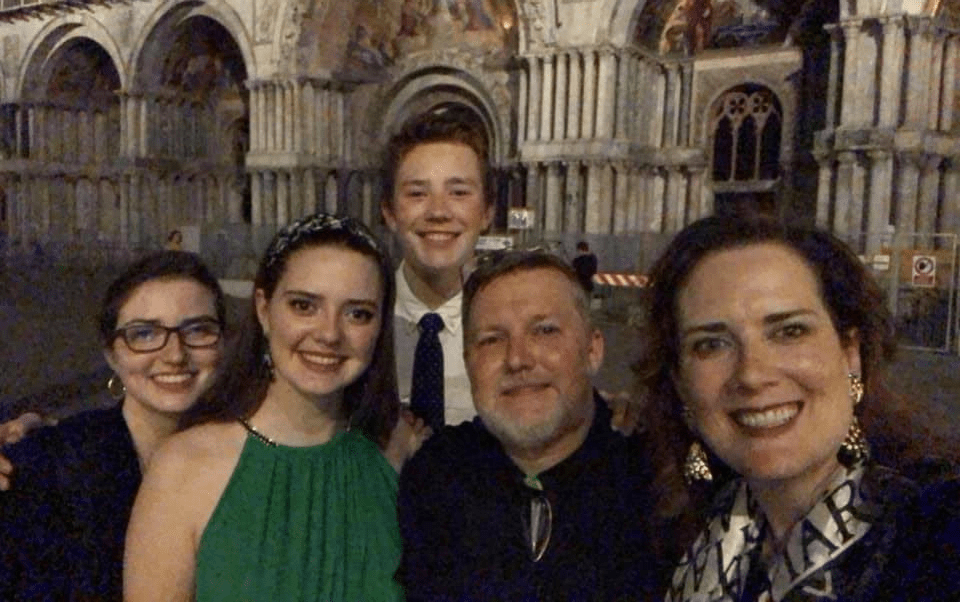
This is my family in Italy, while we were visiting my sister while she performed in an opera. She did this before she graduated college with a degree in Computer Science and Data Analytics. From left to right, Sonya (older sister), Elizabeth (myself), Vincent (younger brother), James (father), and TracieLea (mother).
I was taught the importance of the arts and STEM from a young age and told I didn’t need to choose between the fields. From a young age, I was playing instruments, singing in proper form, reading like a true bookworm, and looking for any opportunity to get crafty and creative. We would have Craft Thursdays and Field Trip Fridays, exploring museums and historical centers, trying new things, and seeing the world from a new perspective each week. At the same time, I was encouraged to ask questions, research the world around me, explore nature and get my hands dirty. I could build rockets, play with Legos, and learn how to use a microscope. I could travel the world and see new sights, cultures, and experience new things.
Every day, I was encouraged to explore my passions and be a lifelong learner. I didn’t have to choose between the Arts and STEM, and I was a more well-rounded individual because I could do both. I eventually decided to study in a STEM-field, but I never wanted to lose my grasp on influences that the arts had on me and I wanted to explore their interactions with the scientific community. This led me to my senior capstone project researching the influence and impact that arts-based instruction has on engineering and STEM undergraduate students.













 The Novum