Zinefest: World-Making, Creativity, & Technology

Apex Gallery, Arts, Classes, communication, Events, Humanities

By Christy Tidwell

“[Zines] are practices of ‘poetic world-making’—poetic not in the sense of a poem on the page (although they can be this too),
but in the sense of poesis: the process of creating something that did not exist before.” 
– Gwen Allen

The classes I teach create communities. Students get to know each other as they learn the course material, and they share ideas and work with each other. This is a form of world-making, even if temporary, and I love this about my classes. But I don’t want the connections and sharing to stop at the classroom door or to be forgotten when the semester ends. The goal is for my students to connect what they’re learning in class with the rest of the world, to share what they’ve learned with others, to hear what others have learned, and to join and build other communities.

Finding ways to do this can be challenging, but it’s not impossible.

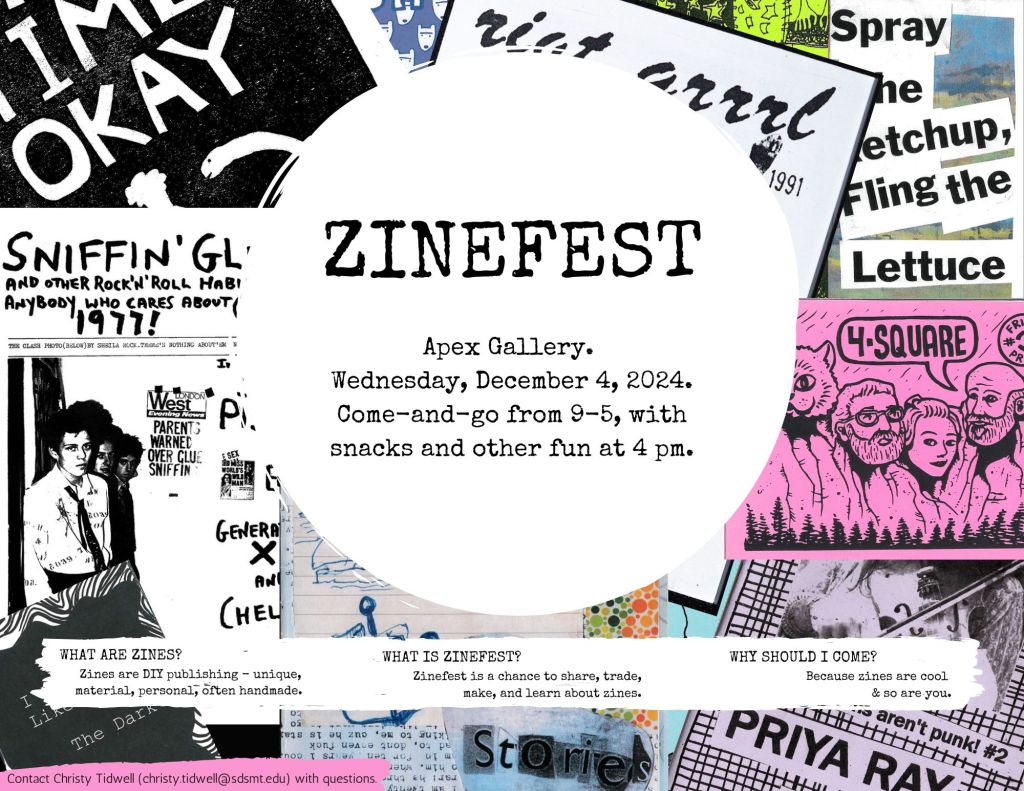
This semester, as a way for students to connect across classes and share work with broader audiences, a few of us in the Humanities, Arts, and Social Sciences department (myself, Matt Whitehead, Evan Thomas, Erica Haugtvedt, and Mary Witlacil) put on a series of zinemaking events that culminated in a Zinefest in the Apex Gallery on December 4th. Zinefest was an all-day come-and-go event that displayed the zines students made in classes (and, in a few cases, just for fun!), provided some examples of interesting zines made by others, and gave visitors a chance to make their own zines. (If you missed it this year, watch out for another event next year!)

This event let students share some of what they have learned this semester, giving them a broader audience, and it also connected them to students in other classes and to the audiences who came to Zinefest. While I did not count the number of visitors during Zinefest, the gallery filled several times and was rarely empty. Some people walked through relatively quickly and took in only a few zines; others stayed for quite a while, standing and reading multiple zines before finally deciding on some they wanted to keep. One student – who will remain nameless for obvious reasons – wrote in a reflection afterward, “I spent almost 2 hours there and accidentally missed class, so I would say I had a good time.” Although I would (of course) never encourage a student to miss class, this indicates that Zinefest offered this student something meaningful.

Because most students were asked to bring multiple copies of their zines, visitors could take a copy of one if they were particularly interested in its ideas or really loved it. Hopefully, they will re-read any zines they took, remember the event, and maybe even be inspired to make their own! Leaving with a material artifact helps the experience and community created through this event extend past Zinefest itself.

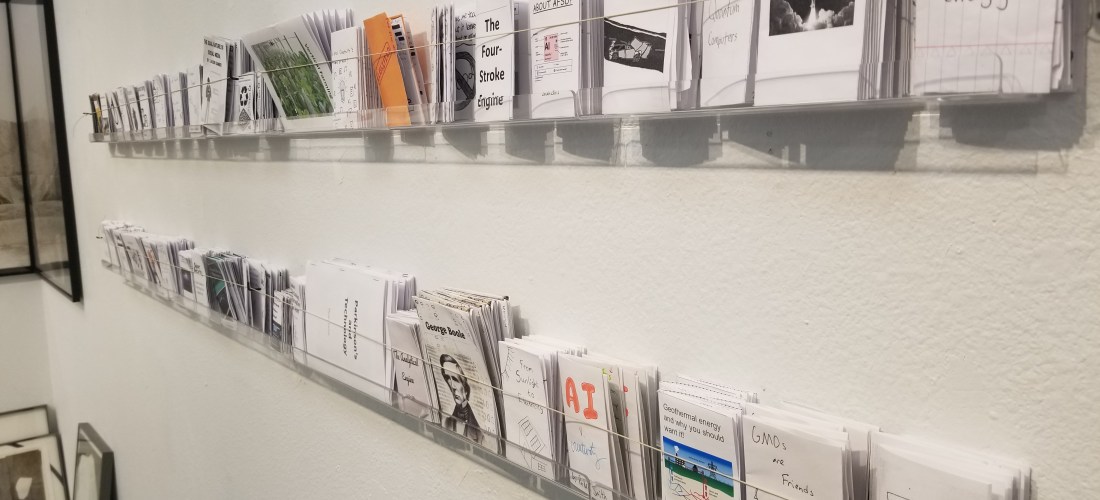
Two rows of zines displayed on the wall, with a handwritten sign above them: See a zine you like? Feel free to take it. Just don't take the last one! Thanks for stopping by.
Student zines on display with an invitation to take a zine.

As an event, Zinefest promoted connections and community; as a practice, making zines (even without an event like Zinefest) provides us all with an opportunity to create something new – to engage in world-making – and to share that something with others, without requiring elaborate technology or infrastructure, refined skills, or many resources. Anyone can make a zine, and that’s what’s so beautiful about them.

Audio Walks: Exploring the Experience of Place

Humanities, STS Faculty, teaching

By Bryce Tellmann

Most semesters, I teach at least one section of Introduction to Humanities (HUM 100). In order to anchor the class’s exploration of such a potentially broad topic, I choose one or two topics to guide our semester-long inquiry into the human experience. This semester, those two topics are place and sound. On the one hand, they are nearly universal categories of human experience, as we inhabit location and experience vibration every day. But on the other, they are infinitely variable. One person’s experience and understanding of a place, or of a particular set of sounds, may be entirely different than another person’s, even if that place and sound are outwardly identical.

One way that my students are exploring the possibilities of sound and space is by experimenting with an artform called “audio walks.” Popularized by artists Janet Cardiff and George Bures Miller, these mobile art installations ask the participant to go on a walk, retracing the artist’s footsteps as they listen to an audio recording of the artist’s walk. The artist will often comment on their surroundings, including exact navigation directions for the listener. Inevitable differences in the artist’s recording of their walk and the listener’s own environment (different people passing by, different vehicle sounds, even different times of the day or seasons) draw attention to the differences between the ways we represent experience and our actual experience. This, in turn, helps students appreciate the ways that media technologies affect how we experience, understand, and value the world around us.

Some audio walks are straightforward, presenting an ostensibly “authentic” recording of what the artist experienced on their walk. However, the artist may also choose to more actively compose their audio walk, either by preplanning events to be captured during the recording or by editing the recording after the fact. Such additions amplify the disjuncture between what listeners hear in the recording and what they experience as they retrace the walk.

Eden Otten, a freshman Civil Engineering major, captured the contrast well in a discussion board reply:

I think a sense of community in sound is more fleeting than one in place. We still shared the same trail to Boneyard, and I was in the same place that this audio tour gave meaning to. However, many aspects of sound that gave the walk uniqueness were gone in the days between capturing it and listening to it. We experienced the place the same, but the unique sound couldn’t be a shared experience, as I could hear your contributions to the soundscape, but you couldn’t hear mine.

Below are links to download some of the students’ audio walks. If you’re on campus, I encourage you to download one or more to your mobile device and go on the same walk that the artist did! Walks are best experienced with headphones.

Printing in the Classroom: Hands-On Creation & History of Technology

art, Classes, Humanities, teaching, Technology

By Christy Tidwell

This semester, I am teaching a section of Connections: Humanities & Technology (HUM 200), which is one of our core STS courses as well as a general education course that students from across the university take to fulfill their humanities requirement. There are many ways to teach this course to get students to think more critically and more deeply about the relationships between the humanities and various technologies, and this particular semester’s class begins with a few weeks exploring printing technologies.

What better way to understand printing technologies than to try them out?

To incorporate a hands-on approach to printing in the class, I worked with our art professor, Matt Whitehead, to prepare an activity for students in the art room. We wanted to give students a chance to work with printing presses in a couple of different ways, to try using a typewriter and a Leroy lettering set, and to check out some old toy moveable type presses. These toy presses date from the 1940s and are no longer totally functional, so they were more on display than for use, but they still allowed students to get a better sense of what a moveable type printing press is like on a small scale.

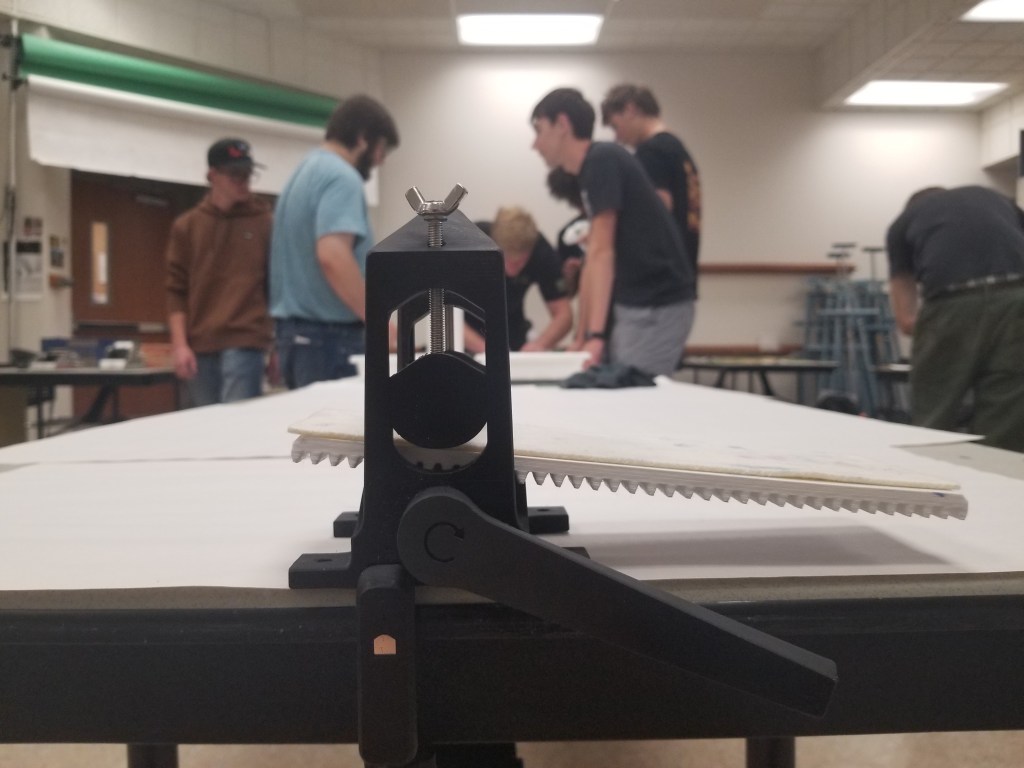
Photo of a mini printing press ready for use.
A mini printing press from the Open Press Project, with students working in the background.

After a brief introduction to some basic printing techniques and explanation of what was available, students were given the freedom to explore these technologies in whatever order they wished. Some made an effort to try everything and even combined elements (the printing press with text from the typewriter or lettering set, for instance); some really focused in on one technology or technique and tried it multiple times or in multiple ways.

Writing on Demand vs. Writing on Purpose

computers, teaching, Technology, writing

By Evan Thomas

What does it sound like to sound educated yet know nothing? In a 17th-century comedy by Molière, Le Bourgeois Gentilhomme (“The Middle-Class Aristocrat”), a rich cloth merchant tries to imitate aristocratic education and speech. He takes philosophy classes and learns that his normal expressions “require a little lengthening” – he must learn how to stretch heartfelt statements (“your lovely eyes make me die of love”) into aristocratic contortions (“Of love to die make me, beautiful marchioness, your beautiful eyes”; “Your lovely eyes, of love make me, beautiful marchioness, die”; “Die, your lovely eyes, beautiful marchioness, of love make me”; “Me make your lovely eyes die, beautiful marchioness, of love”). The joke is on him, as his rhetoric tutor cruelly exploits his easy admiration for excessive, voluminous, amplitudinous, prolix, verbose, copious speech.

The example of the Bourgeois Gentilhomme is echoed in a new development in AI. Recently, OpenAI released ChatGPT, a large-language model (“LLM”) AI that appears to have tremendous facility at composing passable long-form texts. As an educator in higher ed, I don’t think that writing pedagogies are remotely ready yet for the instructional challenges posed by this technology. The main concerns that academics have had about AI and collegiate writing have to do with academic integrity. These are important concerns and addressing them will probably have massive relevance in the years to come.

Headline: Schools Ban ChatGPT Amid Fears of Artificial Intelligence-Assisted Cheating
Headline: Teachers Fear ChatGPT Will Make Cheating Easier Than Ever

However, not all academics are especially concerned by the threat posed by AI language models. First, some academics express confidence that their domain-specific knowledge is too inscrutable for a machine to understand. Second, others suggest that the strength of their bonds with their students would make it impossible for their students to make an unnoticed switch to a different voice. Whether the first or second case is true, whether some content or character is indelible, there are finer, more constructive applications of LLMs to writing in higher ed.

Planting Seeds: Anchoring Ethics in the Dirt

Classes, Environment, teaching

By Christy Tidwell

My Environmental Ethics & STEM class asks big questions about knowledge, values, justice, and responsibility – both individual and systemic – related to environmental issues. Although I try to situate these conversations in specific, real-world examples, they can still sometimes seem abstract or beyond the scale of my students’ reach. They may wonder what they can do to address climate change, for instance, or to change corporate policy.

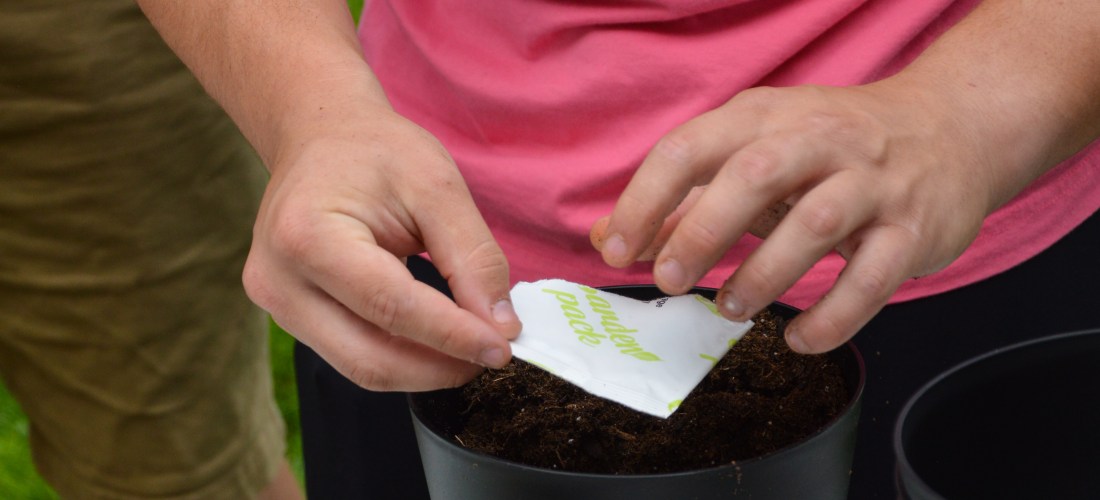
But they can, of course, make a difference, and we look for ways to identify the actions they can take (again, not just individually but within larger contexts). In the meantime, to help connect us more fully to the environment, this semester I asked my students to plant seeds and to do their best to grow them and keep them alive. It’s my hope that working to protect and nurture one small plant will give the class a personal connection that issues of pollution, plastics, or water rights may not always have.

STS Faculty Profile: Christy Tidwell

STS Faculty Profile

Christy Tidwell is Associate Professor of English & Humanities. You can learn more about her research and teaching at her website.

What’s your area of expertise? What do you primarily research and/or teach? And what drew you to this field?

I typically research and write about speculative fiction, environment, and gender. My dissertation was about feminist science fiction and feminist science, for instance, and since then I’ve co-edited and written for two books on speculative fiction and the environment: Gender and Environment in Science Fiction and Fear and Nature: Ecohorror Studies in the Anthropocene. I have an ongoing interest in dinosaurs in popular culture, especially as dinosaur stories relate to ideas about extinction, and I also sometimes write about Black film/media and disability.

In my work on science fiction – whether related to environmental issues, gender, race, or disability – I look at how we respond to the problems in the present and how we might imagine different possibilities in the future. In my work on horror – again, no matter which of these issues I’m addressing – I look at how our fears (for instance, fears of the natural world or fears for the natural world) shape our lives.

Automatic Art: or, How to Take the Human out of the Humanities

art, Humanities, teaching, Technology

By Evan Thomas

I often teach a general education Humanities course (HUM 200, officially titled Connections: Humanities and Technology) on the topic of “Automatic Art.” As a Humanities class, we study representative elements from the entire range of arts and letters:

Those are representative examples of the coursework – but what is “Automatic Art”? The term doesn’t actually have much reality outside of my course. (Frustrated students will often turn to the surrealist technique of Automatic Writing, which does exist, but has little bearing on the collection of objects we study.) I like to tell students that “automatic art” is equivalent to “taking the human out of art,” but what does that actually mean?

Humanities & Technology: Defining Terms and the Complexity of STS

Classes, Humanities, Technology

By Christy Tidwell

Today marks the end of the first week back to class for South Dakota Mines, and the STS faculty are hard at work in their classes and enjoying meeting students! We are teaching classes on Environmental Ethics & STEM (HUM 250 with me), Computers in Society (HUM 375 with Dr. Erica Haugtvedt), E-sports (HUM 376 with Dr. John Dreyer), History and Philosophy of Science (PHIL 335 with Dr. Michael Hudgens), Terror & Horror (ENGL 392 with Dr. Laura Kremmel), and Licit and Illicit Drugs (SOC 411 with Dr. Kayla Pritchard) – plus many others! As this list of courses indicates, STS covers a lot of ground. It needs to, given its promise to study science, technology, and society, and there are countless ways to approach the field and the topics it includes.

In addition to Environmental Ethics & STEM (mentioned above), I am also teaching Connections: Humanities & Technology (HUM 200) this semester, which is a great illustration of what the STS major is all about. Since the course description and title are pretty broad, I’ve narrowed things down to focus on the following big questions:

1. How do we communicate with each other?
2. How do we design and build the places we live?

In response to these questions we will explore communication technologies from paper and books to social media, film, and robots, and we will consider urban design issues like curb cuts and plumbing, historical and contemporary ideas about what a home looks like, and what the city of the future could look like.