How to Look at the World: Poetry, Science, and Creativity

art, Events, Humanities, Poetry, STS Faculty

By Christy Tidwell

Last week, Matt Whitehead and I gave a presentation about the relationship between poetry and science for National Poetry Month as part of the STEAM Cafe series at Hay Camp Brewing. If you were not able to attend, this is a brief version of what we presented.

As members of the Humanities, Arts, and Social Sciences department, Matt and I (as Art and English faculty, respectively) spend a lot of time thinking about how to get students thinking creatively and engaging in creative projects. Given our work with the Science, Technology, & Society degree, we also work with connections between humanities/arts and science/technology, and we encourage our students to see creativity as something that they don’t do only in our classes but that is a part of their scientific and engineering work, too.

Our core question grows out of this work: What does poetry have to do with science?

The two might seem fundamentally dissimilar, belonging to different realms, but both offer opportunities to look carefully, communicate observations, make connections, and understand the world more fully – piece by piece, experience by experience.
Measuring Fear: What the Science of Scare Can – and Cannot – Tell Us

Film, horror, Humanities, science

By Christy Tidwell

The Exorcist. Hereditary. The Ring. Texas Chain Saw Massacre. These are often named some of the scariest movies out there. They’re also among the most popular horror movies, ones that are watched and re-watched, considered classics. Horror movie fans want to be scared, after all.

But what makes these movies – and others like them – so scary? And which is really the scariest?

Since 2020, the Science of Scare Project has run an experiment to try to answer the second of these questions. The project asks a panel of 250 people to watch horror movies while measuring their physiological responses to them and then ranks the scariest movies based on those responses. In past years, they have relied simply on heart rates, but – after some criticisms from horror fans that this emphasizes only one sudden type of fear – they have updated this for 2023. Now their study includes not only heart rate as way to measure excitement and fear but also heart rate variance, arguing that “the lower the heart rate variance the more stressed our audience members became, a good indicator of slow burn fear and dread.”

STS Faculty Profile: Laura Kremmel

STS Faculty Profile

Laura Kremmel is Assistant Professor of English & Humanities.

What’s your area of expertise? What do you primarily research and/or teach? And what drew you to this field?

My training is in Gothic Studies and British Romanticism (British literature of the late eighteenth and early nineteenth centuries), so my expertise is in the early Gothic novels, poetry, and drama that started the Gothic tradition we still read today. I’ve always been particularly interested in two authors: Matthew Lewis, who wrote a scandalous novel called The Monk (1796), and Charlotte Dacre, who wrote an even more scandalous novel called Zofloya (1806). Both are about transgressing boundaries through shockingly graphic and gory scenes, leading me to become curious about the ways that they challenge conventional understandings of what bodies are, do, or could be.

In my teaching and recent research, I’ve expanded into the Health Humanities, history of medicine, other eras of Gothic literature, and horror film. The Gothic is so obsessed with empowering bodies of all kinds that there’s a lot of work in combining the Gothic with the Health Humanities, Disability Studies, and Death Studies. I started to see these fields coming together while visiting medical museums (like the Mütter Museum in Philadelphia), where I saw Gothic narratives being applied to the history of medicine and its impacts.   

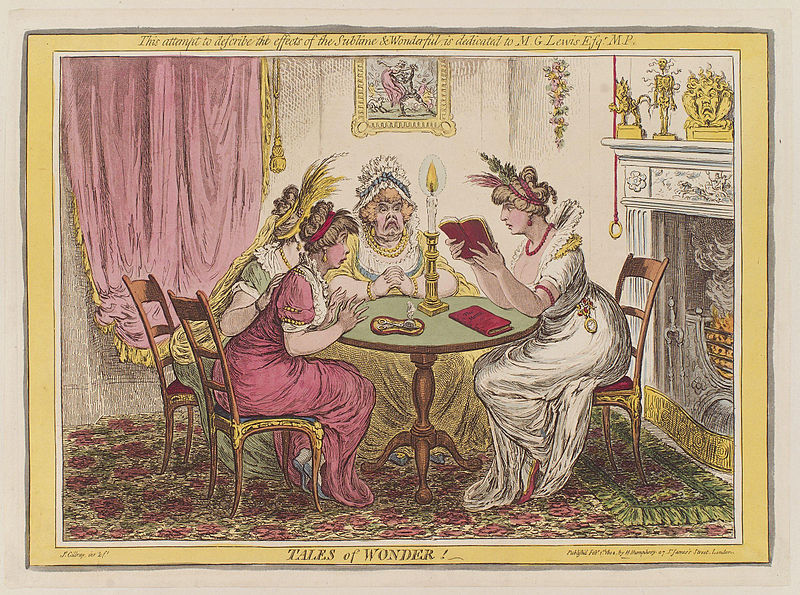
A group of women seated around a table with a candle and books.
Tales of Wonder by James Gillray (1802)

Environmental Literature & Culture: Spring 2022 Course

Classes

By Christy Tidwell

What is nature? What do you imagine when you think of nature? What are the qualities of nature (better yet, of Nature with a capital N)? 

Pause now and think about that for a minute. 

Seriously. 

What is the image of Nature you hold in your mind? Picture it.

Photo by James Wheeler on Pexels.com

Did you imagine something like that? Maybe not that exact image, but something similar? If so, consider this response more fully. What are the qualities of this representation of nature? It’s beautiful. It has lots of elements of the natural world (I know, that seems circular, but stick with me), like trees, mountains, a lake. It’s pure and untouched. It’s wild. Notably, there are no humans in this image. 

Automatic Art: or, How to Take the Human out of the Humanities

art, Humanities, teaching, Technology

By Evan Thomas

I often teach a general education Humanities course (HUM 200, officially titled Connections: Humanities and Technology) on the topic of “Automatic Art.” As a Humanities class, we study representative elements from the entire range of arts and letters:

Those are representative examples of the coursework – but what is “Automatic Art”? The term doesn’t actually have much reality outside of my course. (Frustrated students will often turn to the surrealist technique of Automatic Writing, which does exist, but has little bearing on the collection of objects we study.) I like to tell students that “automatic art” is equivalent to “taking the human out of art,” but what does that actually mean?

Humanities & Technology: Defining Terms and the Complexity of STS

Classes, Humanities, Technology

By Christy Tidwell

Today marks the end of the first week back to class for South Dakota Mines, and the STS faculty are hard at work in their classes and enjoying meeting students! We are teaching classes on Environmental Ethics & STEM (HUM 250 with me), Computers in Society (HUM 375 with Dr. Erica Haugtvedt), E-sports (HUM 376 with Dr. John Dreyer), History and Philosophy of Science (PHIL 335 with Dr. Michael Hudgens), Terror & Horror (ENGL 392 with Dr. Laura Kremmel), and Licit and Illicit Drugs (SOC 411 with Dr. Kayla Pritchard) – plus many others! As this list of courses indicates, STS covers a lot of ground. It needs to, given its promise to study science, technology, and society, and there are countless ways to approach the field and the topics it includes.

In addition to Environmental Ethics & STEM (mentioned above), I am also teaching Connections: Humanities & Technology (HUM 200) this semester, which is a great illustration of what the STS major is all about. Since the course description and title are pretty broad, I’ve narrowed things down to focus on the following big questions:

1. How do we communicate with each other?
2. How do we design and build the places we live?

In response to these questions we will explore communication technologies from paper and books to social media, film, and robots, and we will consider urban design issues like curb cuts and plumbing, historical and contemporary ideas about what a home looks like, and what the city of the future could look like.