Last week, Matt Whitehead and I gave a presentation about the relationship between poetry and science for National Poetry Month as part of the STEAM Cafe series at Hay Camp Brewing. If you were not able to attend, this is a brief version of what we presented.
As members of the Humanities, Arts, and Social Sciences department, Matt and I (as Art and English faculty, respectively) spend a lot of time thinking about how to get students thinking creatively and engaging in creative projects. Given our work with the Science, Technology, & Society degree, we also work with connections between humanities/arts and science/technology, and we encourage our students to see creativity as something that they don’t do only in our classes but that is a part of their scientific and engineering work, too.
Our core question grows out of this work: What does poetry have to do with science?
The two might seem fundamentally dissimilar, belonging to different realms, but both offer opportunities to look carefully, communicate observations, make connections, and understand the world more fully – piece by piece, experience by experience.
“[Zines] are practices of ‘poetic world-making’—poetic not in the sense of a poem on the page (although they can be this too), but in the sense of poesis: the process of creating something that did not exist before.” – Gwen Allen
The classes I teach create communities. Students get to know each other as they learn the course material, and they share ideas and work with each other. This is a form of world-making, even if temporary, and I love this about my classes. But I don’t want the connections and sharing to stop at the classroom door or to be forgotten when the semester ends. The goal is for my students to connect what they’re learning in class with the rest of the world, to share what they’ve learned with others, to hear what others have learned, and to join and build other communities.
Finding ways to do this can be challenging, but it’s not impossible.
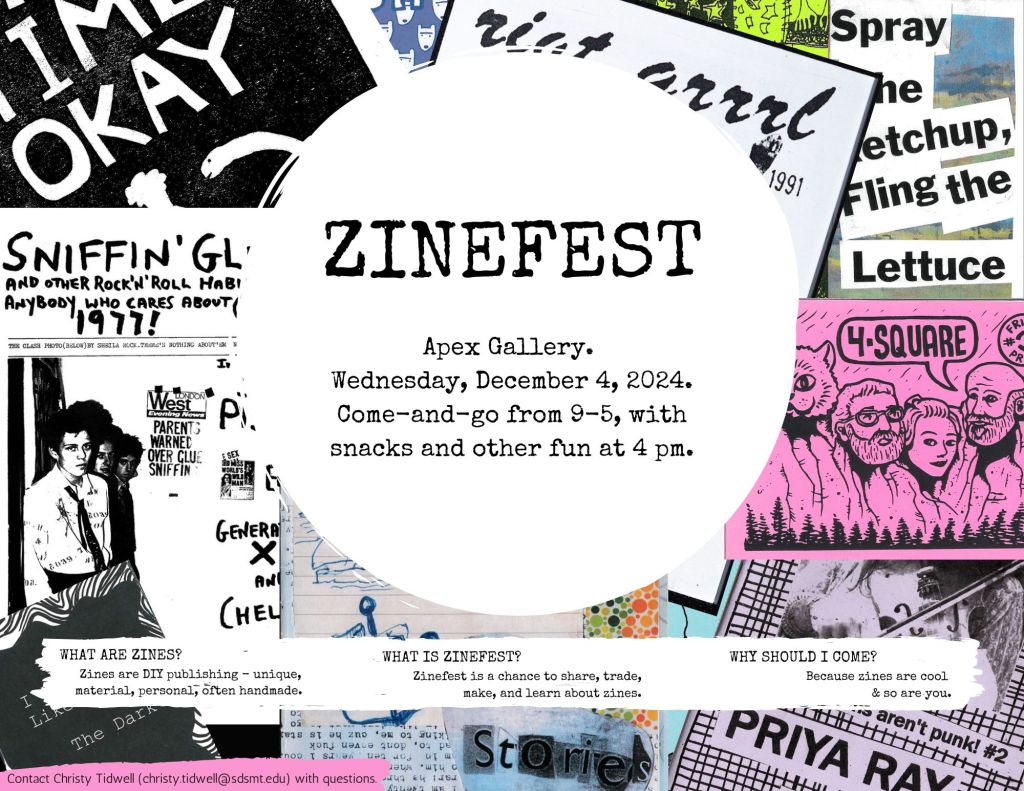
This semester, as a way for students to connect across classes and share work with broader audiences, a few of us in the Humanities, Arts, and Social Sciences department (myself, Matt Whitehead, Evan Thomas, Erica Haugtvedt, and Mary Witlacil) put on a series of zinemaking events that culminated in a Zinefest in the Apex Gallery on December 4th. Zinefest was an all-day come-and-go event that displayed the zines students made in classes (and, in a few cases, just for fun!), provided some examples of interesting zines made by others, and gave visitors a chance to make their own zines. (If you missed it this year, watch out for another event next year!)
This event let students share some of what they have learned this semester, giving them a broader audience, and it also connected them to students in other classes and to the audiences who came to Zinefest. While I did not count the number of visitors during Zinefest, the gallery filled several times and was rarely empty. Some people walked through relatively quickly and took in only a few zines; others stayed for quite a while, standing and reading multiple zines before finally deciding on some they wanted to keep. One student – who will remain nameless for obvious reasons – wrote in a reflection afterward, “I spent almost 2 hours there and accidentally missed class, so I would say I had a good time.” Although I would (of course) never encourage a student to miss class, this indicates that Zinefest offered this student something meaningful.
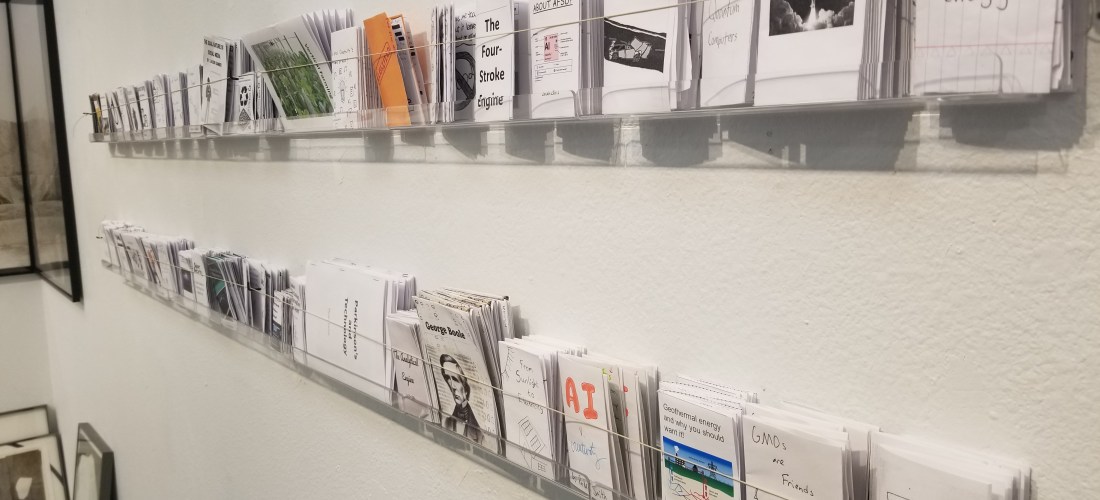
Because most students were asked to bring multiple copies of their zines, visitors could take a copy of one if they were particularly interested in its ideas or really loved it. Hopefully, they will re-read any zines they took, remember the event, and maybe even be inspired to make their own! Leaving with a material artifact helps the experience and community created through this event extend past Zinefest itself.
Student zines on display with an invitation to take a zine.
As an event, Zinefest promoted connections and community; as a practice, making zines (even without an event like Zinefest) provides us all with an opportunity to create something new – to engage in world-making – and to share that something with others, without requiring elaborate technology or infrastructure, refined skills, or many resources. Anyone can make a zine, and that’s what’s so beautiful about them.
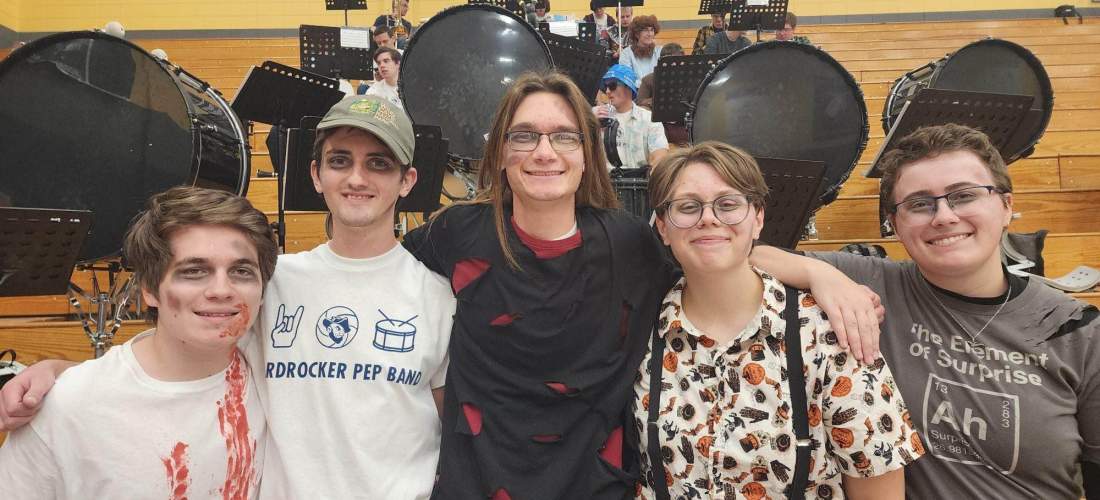
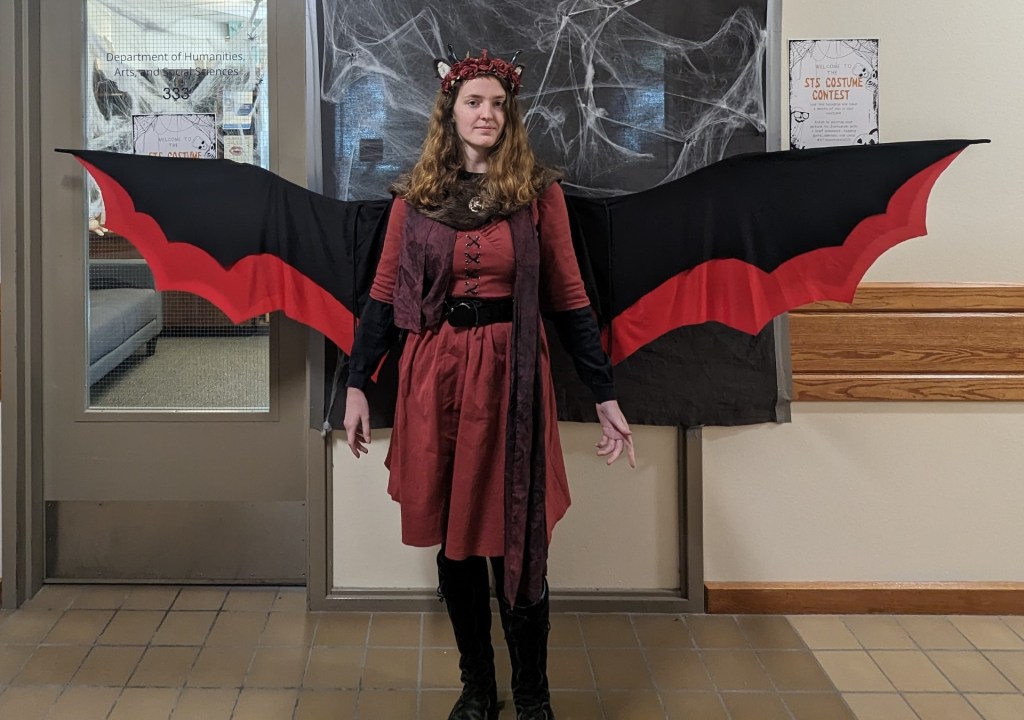
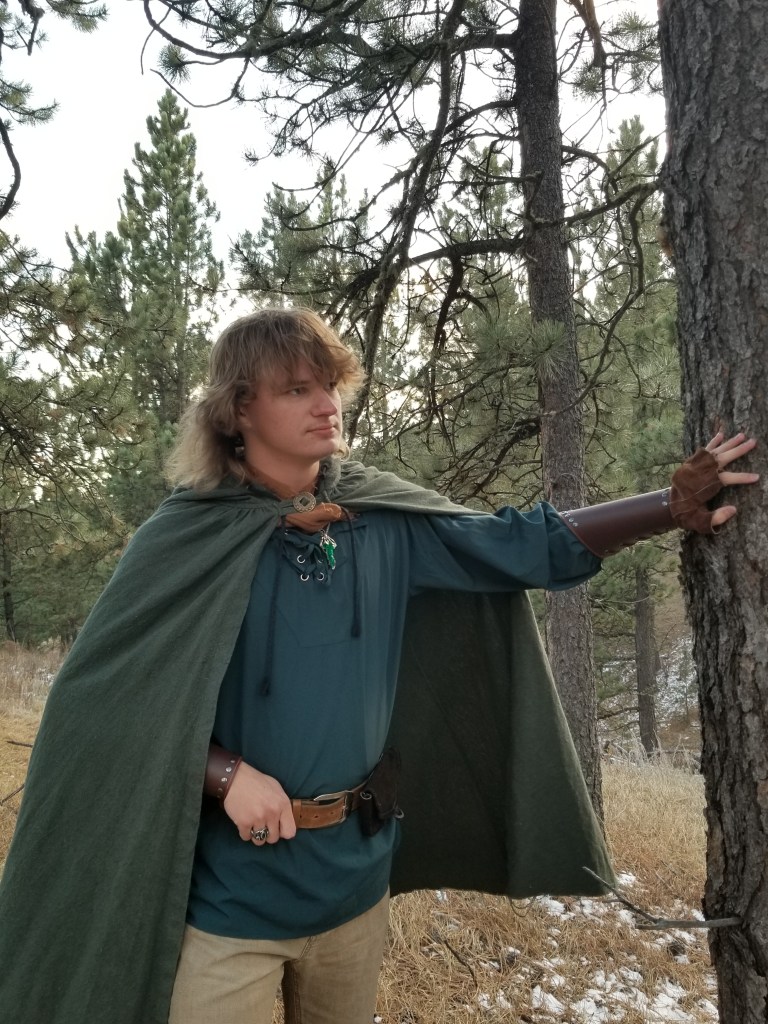
Halloween offers a great opportunity to be creative, and the STS program’s second annual Halloween costume contest received some fantastic entries! We saw characters from movies and TV, traditional horror movie types (like zombies!), animals, invented characters, and historical figures.
Although we loved all of the costumes, we did need to narrow this down to a few winners since it’s a contest. Here are the winners!
It’s nearly Halloween, so we wanted to share some information about this year’s Halloween costume contest and some spooky content from years past.
Last year, we got some great costume contest entries (see the winners here!), and we’re looking forward to more excellent costumes this year. Open to all SD Mines students, faculty, and staff, the costume contest is simple to enter and offers prizes for winners! If you love dressing up for Halloween, enter by sharing a picture and description of your costume on Instagram and tagging us (@sts_sdmines) or by emailing Dr. Christy Tidwell your entry (christy.tidwell@sdsmt.edu). We really hope to see some STS-related costumes, but all costumes are welcome!
We also wanted to highlight some past posts about scary movies to check out if you missed them the first time around: a series of posts called Spooky Science at the Movies (part 1, part 2, part 3, part 4, and part 5), as well as a post about the Science of Scare project, which measures the so-called scariest movie of the year each year. This year, the Science of Scare named Oddity the scariest movie – watch it for yourself and see what you think!
As we begin this academic year, the Science, Technology, & Society program has plenty of news to share and exciting events coming up. Check out some of what’s been going on with us and keep an eye out for events you can attend in the coming weeks and months!
Faculty News
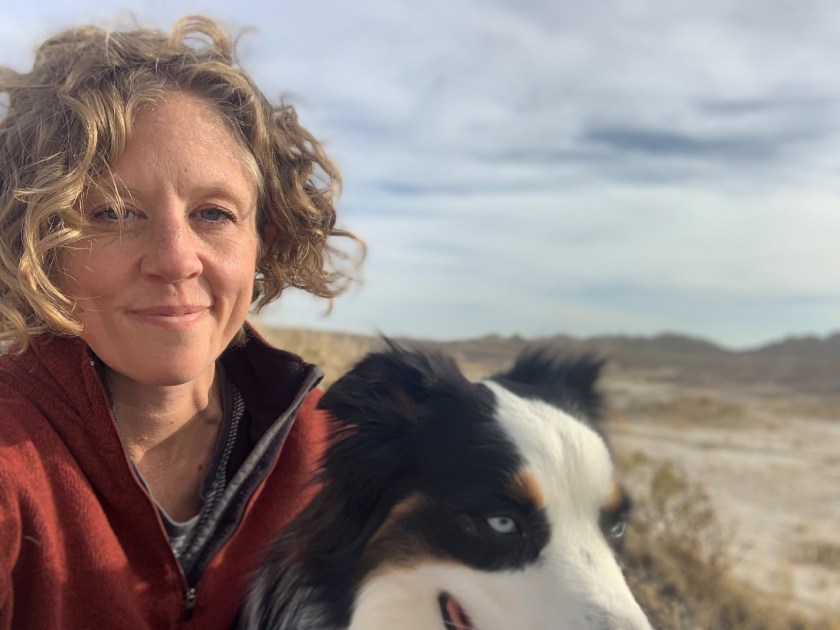
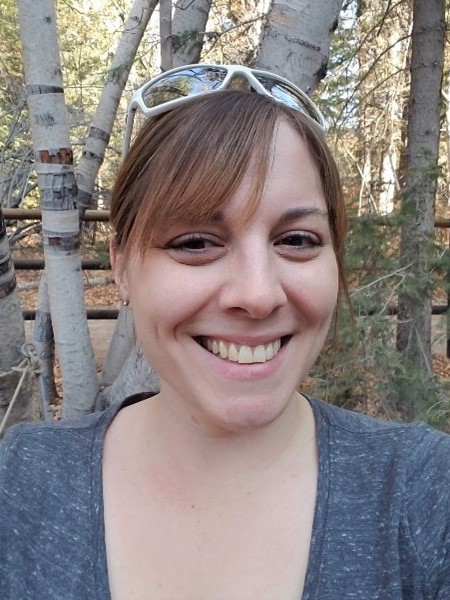
We are excited to welcome Carlie Herrick as a Lecturer in English. She has taught English classes here at South Dakota Mines for many years already and is a wonderful colleague, so we’re glad to have her take on this new position! We are also pleased to announce that Kayla Pritchard has been promoted from Associate Professor and is now Professor of Sociology.
Carlie Herrick (and dog)Kayla Pritchard
STS Program News
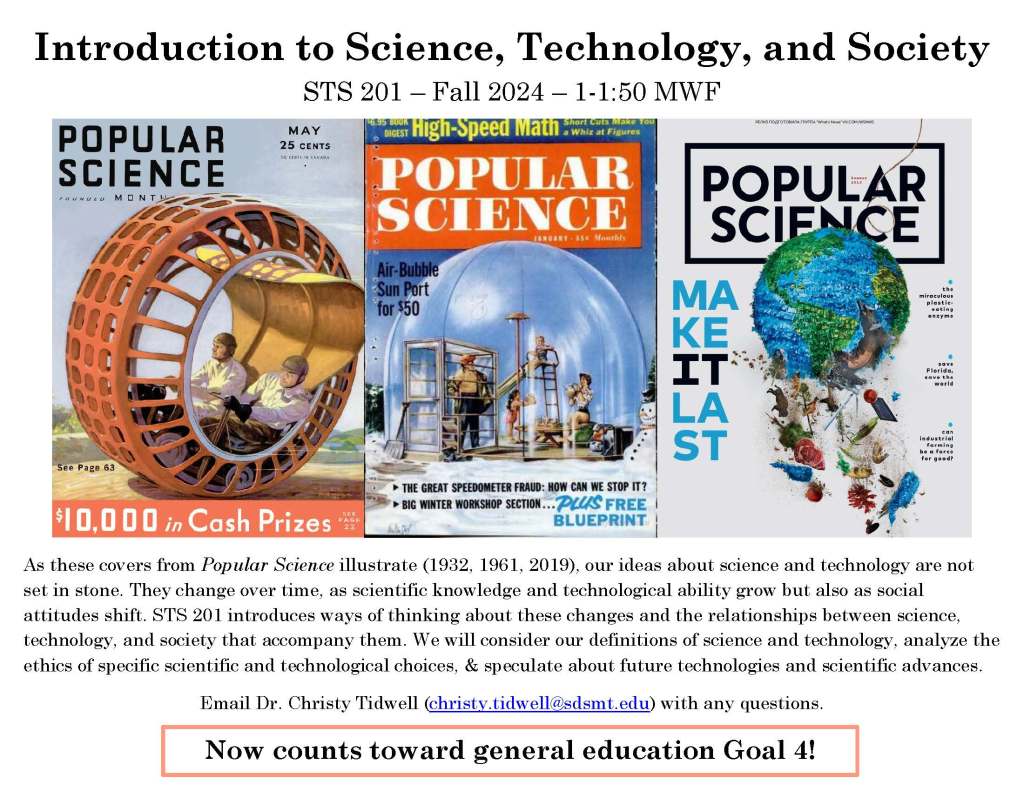
One of our core STS courses – STS 201: Introduction to Science, Technology, & Society – now counts as a Goal 4 general education course. This doesn’t change the course itself in any significant way, but it does mean that there’s now a good reason for students of all majors to take the course. The class gives students a chance to do the kind of work STS scholars do and to gain a different perspective on their own disciplines. In STS 201, students thoughtfully examine the relationships between science, technology, and society; explore the ways we define these terms and the effects of defining them in these ways; and learn about the history and ethical consequences of scientific research and technological innovations.
Upcoming Events
If you’re looking for cool things to do, STS has you covered this year! Here’s a list of upcoming events sponsored by the STS program and/or the Humanities, Arts, and Social Sciences (HASS) department. Add them to your calendar and come to as many as you can!
The Office of Student Engagement and Department of Humanities, Arts, and Social Sciences (the STS program’s home) are hosting a 2024 Local Election Forumthe evening of Thursday, September 12 (7-9 pm), in the Beck Ballroom in Surbeck Center. Come hear from local candidates, learn about ballot initiatives, and ask questions!
On Tuesday, September 17 at 6 pm, Erica Haugtvedt, Associate Professor of English, will present an introduction to George Eliot, the Victorian novel, and science as part of the university’s STEAM Cafe series. These presentations are free to the public and take place at Hay Camp Brewing Company (601 Kansas St., Rapid City).
The STS program is sponsoring a series of zinemaking events, culminating in a zinefest at the end of the fall semester. We will set up with materials, examples, instructions, and plenty of enthusiasm for a zinemaking event from 9:30-2:30 on Wednesday, September 18, on the second floor of the Classroom Building and then for another from 9:30-2:30 on Wednesday, November 13, on the first floor of the Devereaux Library. Zinefest will show off some of what has been created this semester as well as featuring some information about the history of zines, and will take place in the Apex Gallery (2nd floor of the Classroom Building) on Wednesday, December 4.
The STS program is also sponsoring an STS Book Club beginning this semester. It’s open to faculty, staff, students, and their friends and will provide a space to read and discuss books related to science, technology, and society. The first book will be Annalee Newitz’s Autonomous, a science fiction novel, but future books (to be determined by participants) may include science writing, biographies of scientists/inventors, histories of science and technology, memoirs, or other fiction addressing science. The group’s first meeting will be held in CB 334 (the Stoltz faculty and staff lounge) – Thursday, September 26 at 5 pm.
A grant-funded collaboration between South Dakota Public Broadcasting, Dick Termes, and South Dakota Mines presents an event exploring connections between art and science. The event is scheduled for Saturday, October 5, from 1-4:30 pm on the second floor of the Devereaux Library and will include a screening of parts of the new Ken Burns documentary about Leonardo Da Vinci, a talk by Dick Termes, a chance to use VR goggles to explore Termespheres, and screenprinting with Matt Whitehead (Director of the Apex Gallery and Lecturer in art) and SD Mines students. All are welcome to come check out the various parts of the event at their own pace.
Fundraising
Finally, we want to highlight a fundraising effort to support SD Mines music students. The South Dakota Mines Concert Choir has been invited to perform in the festival choir at the 2025 Salzburg International Choral Festival next summer. Choir members are raising money now to fund their trip, so if you’re able to donate, please consider doing so – it would help them immensely! This supports not only STS students and HASS faculty but students from across the university. You can find out more and donate to support their trip here.
This year, the STS program ran its first-ever Halloween costume contest. Dressing up for Halloween is a perfect chance for students to show off some creativity and possibly even highlight some connections between science/technology and society! Some of our faculty dressed up, too – we had a pirate, a fancy lumberjack, Introverty the 8th Dwarf, and Goth Judy Jetson.
We had a number of really excellent entries in the contest, and we’re happy to share the winners below (except for one person, Jace Williams, who received an honorable mention but who has not given permission to use his image – if that changes, the post will be updated accordingly).
We have plans for another costume contest next Halloween, so start thinking about costume ideas for 2024!
First place: Pari Bailey, as a Renaissance fairy.
Second place: Gaven Williams, as a creepy scarecrow (on stilts!).
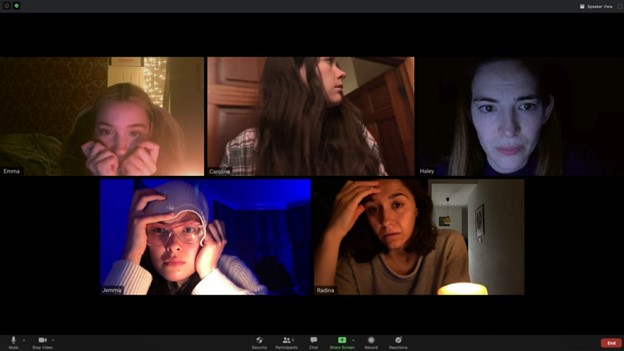
The 2020 film Host (dir. Rob Savage) was recently crowned the scariest horror movie according to a scientific study that measured the heart rates of 250 viewers watching 40 different films. As someone who watches a lot of horror and is usually not affected by it, I had to turn on all the lights in my house after watching it alone on a tablet. Why is it so scary? It’s all in the technology.
Host (2020)
The film is about a séance held by five friends and a medium, all in different locations and connected to each other not only through the medium leading them or their shared concentration but also through Zoom, a program we’ve all come to rely on to make us feel connected to each other. As the trailer asks, what if it connects us with something else?
On Tuesday, October 19, from 6-7 pm (Mountain time), Erica Haugtvedt (Assistant Professor of Humanities) and Duana Abata (Professor of Mechanical Engineering) will present as part of the STEAM Café series. This free presentation will take place at Hay Camp Brewing Company in downtown Rapid City (601 Kansas City St.) and will also be available to watch via livestream on Zoom. The talk will also be posted to the SD Mines YouTube channel and the SD Mines Facebook page after the event.
Long before today’s pervasive digital computers, the first computer programmer was arguably Augusta Ada King, Countess of Lovelace (daughter of the famous poet Lord Byron). An exceptional mathematician, she captured the essence of Charles Babbage’s Analytical Engine, which was conceptualized by Babbage but was not constructed in his lifetime. In 1843, she wrote an algorithm to accompany Babbage’s Engine. Her contribution to calculate Bernoulli numbers with the Analytical Engine has since been successfully translated, with minor changes, to the C++ programming language. Dr. Erica Haugtvedt and Dr. Duane Abata will discuss how this extraordinary Victorian woman achieved her insights through translating between languages, people, disciplines, and between the imaginary and the real.
Watercolor portrait of Ada Lovelace by Alfred Edward Chalon (ca. 1838)











 The Novum