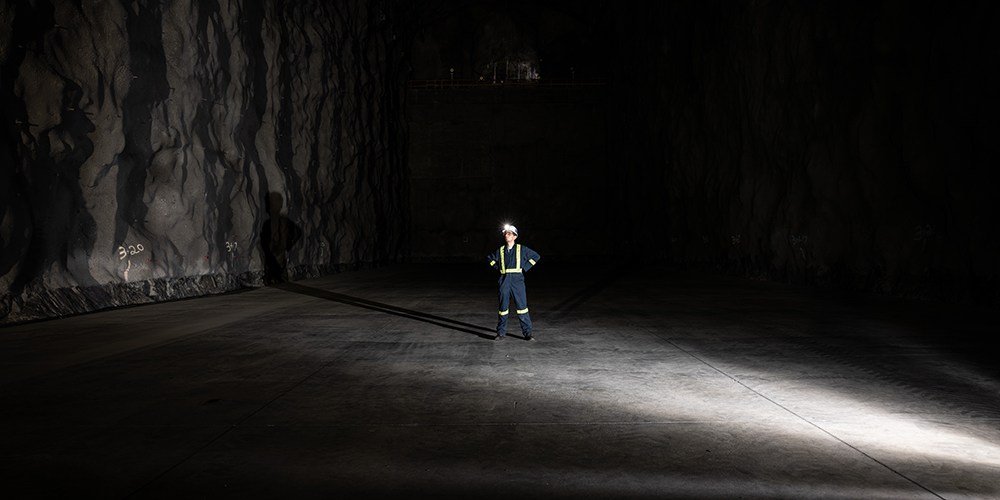
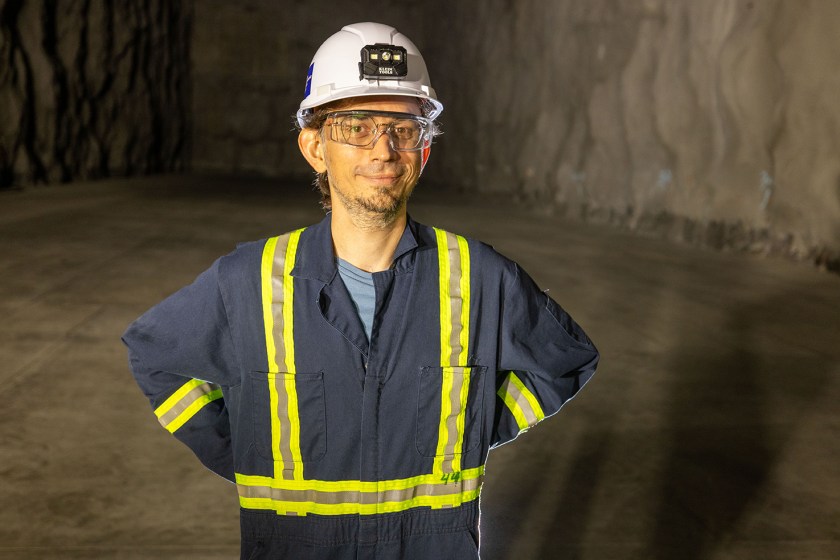
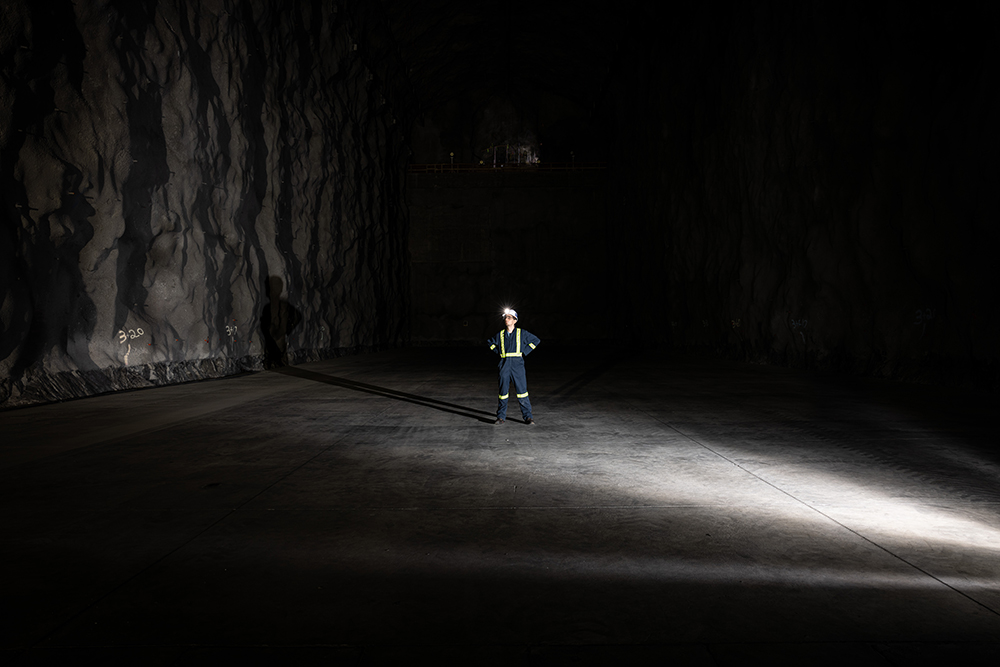
Last summer, Washington, D.C.-based artist Chris Combs swapped his urban studio at the Otis Street Arts Project for one that required a 10-minute open-cage elevator ride, personal protective equipment, and a brass tag etched with his name, indicating his presence nearly a mile underground.
The show will feature interactive, time-based sculptures crafted from found objects, metal, wood and other industrial materials—many of them salvaged during Combs’ time at the Sanford Underground Research Facility (SURF) in Lead. By weaving discarded materials into his work, he aims to echo the layered history of the Homestake Mine and its evolution into a world-class underground laboratory, a dual legacy that drew him to apply for the SURF AiR program.
“I wanted to see firsthand the machinery of particle physics, and the human ‘machinery’ that constructs and maintains it nearly a mile underground in a dusty former gold mine with flood-marked walls,” Comb said. “In my art, I think a lot about how technologies have changed our world, and Homestake/SURF is two rounds of that: first, the transformation of a mountain into 370 miles of tunnels and drifts, and then the transformation of that mine into a container for globe-spanning experiments. The idea of astrophysics occurring a mile underground was very intriguing.”
Photo credit: Stephen Kenny, SURF
Combs creates his pieces with the goal of having audience interaction. “I am lucky to get to make interactive artworks, where pushing a button or inserting a metal ball makes something happen,” he said. “At least for me, actively participating helps me remember it later. This extra little conversation between an artwork and its viewer also offers a challenge and a reward: do you dare to touch the thing? If so, here is an unexpected result. I hope that my artworks reward your curiosity.”
Last week, Matt Whitehead and I gave a presentation about the relationship between poetry and science for National Poetry Month as part of the STEAM Cafe series at Hay Camp Brewing. If you were not able to attend, this is a brief version of what we presented.
As members of the Humanities, Arts, and Social Sciences department, Matt and I (as Art and English faculty, respectively) spend a lot of time thinking about how to get students thinking creatively and engaging in creative projects. Given our work with the Science, Technology, & Society degree, we also work with connections between humanities/arts and science/technology, and we encourage our students to see creativity as something that they don’t do only in our classes but that is a part of their scientific and engineering work, too.
Our core question grows out of this work: What does poetry have to do with science?
The two might seem fundamentally dissimilar, belonging to different realms, but both offer opportunities to look carefully, communicate observations, make connections, and understand the world more fully – piece by piece, experience by experience.
“[Zines] are practices of ‘poetic world-making’—poetic not in the sense of a poem on the page (although they can be this too), but in the sense of poesis: the process of creating something that did not exist before.” – Gwen Allen
The classes I teach create communities. Students get to know each other as they learn the course material, and they share ideas and work with each other. This is a form of world-making, even if temporary, and I love this about my classes. But I don’t want the connections and sharing to stop at the classroom door or to be forgotten when the semester ends. The goal is for my students to connect what they’re learning in class with the rest of the world, to share what they’ve learned with others, to hear what others have learned, and to join and build other communities.
Finding ways to do this can be challenging, but it’s not impossible.
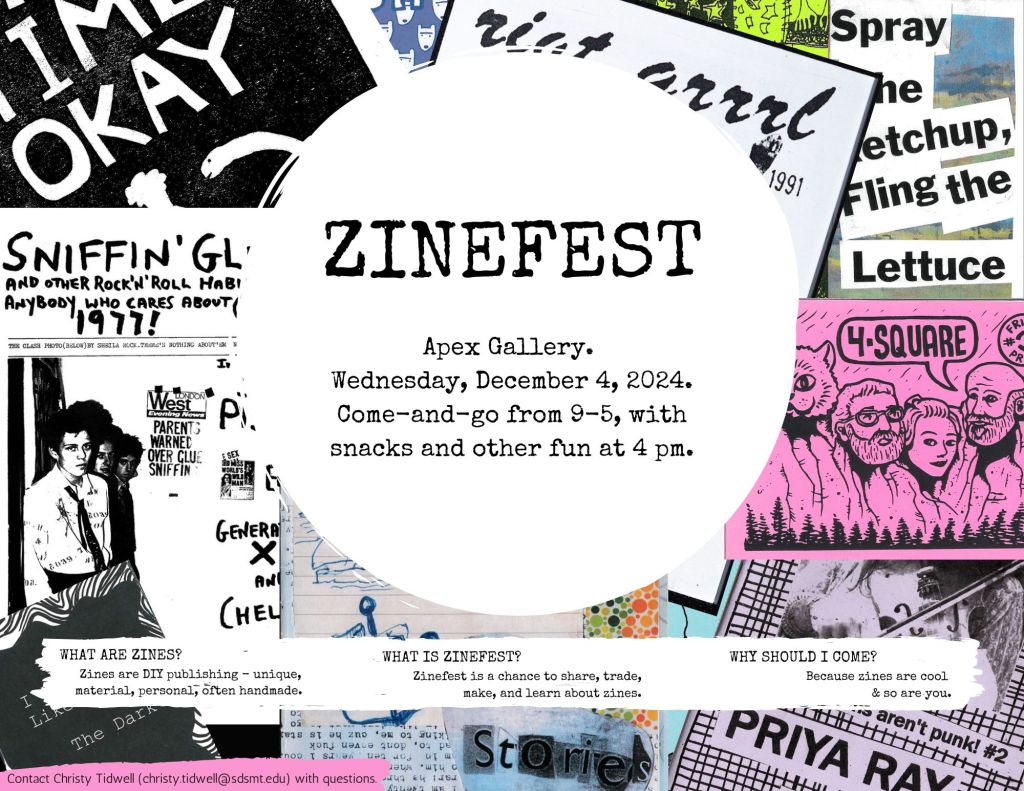
This semester, as a way for students to connect across classes and share work with broader audiences, a few of us in the Humanities, Arts, and Social Sciences department (myself, Matt Whitehead, Evan Thomas, Erica Haugtvedt, and Mary Witlacil) put on a series of zinemaking events that culminated in a Zinefest in the Apex Gallery on December 4th. Zinefest was an all-day come-and-go event that displayed the zines students made in classes (and, in a few cases, just for fun!), provided some examples of interesting zines made by others, and gave visitors a chance to make their own zines. (If you missed it this year, watch out for another event next year!)
This event let students share some of what they have learned this semester, giving them a broader audience, and it also connected them to students in other classes and to the audiences who came to Zinefest. While I did not count the number of visitors during Zinefest, the gallery filled several times and was rarely empty. Some people walked through relatively quickly and took in only a few zines; others stayed for quite a while, standing and reading multiple zines before finally deciding on some they wanted to keep. One student – who will remain nameless for obvious reasons – wrote in a reflection afterward, “I spent almost 2 hours there and accidentally missed class, so I would say I had a good time.” Although I would (of course) never encourage a student to miss class, this indicates that Zinefest offered this student something meaningful.
Because most students were asked to bring multiple copies of their zines, visitors could take a copy of one if they were particularly interested in its ideas or really loved it. Hopefully, they will re-read any zines they took, remember the event, and maybe even be inspired to make their own! Leaving with a material artifact helps the experience and community created through this event extend past Zinefest itself.
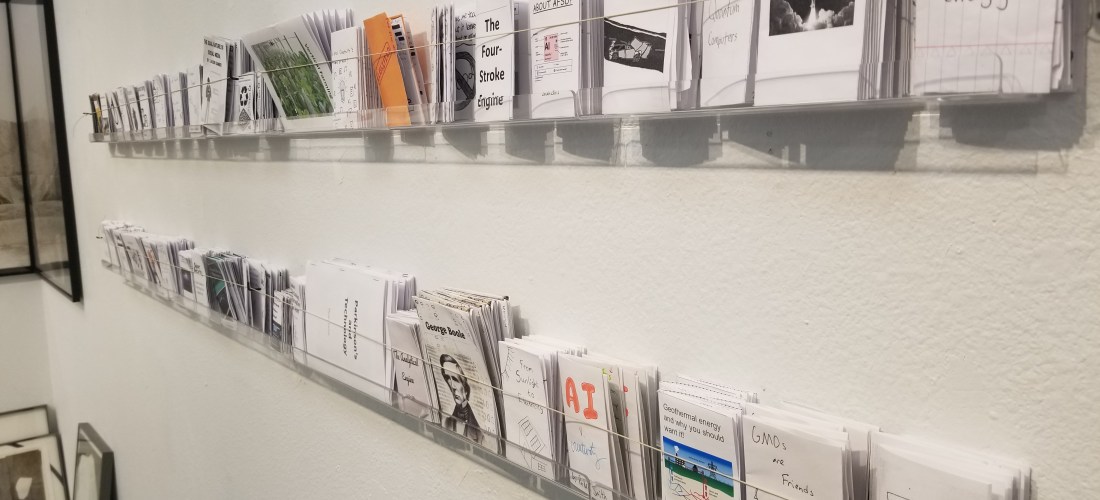
Student zines on display with an invitation to take a zine.
As an event, Zinefest promoted connections and community; as a practice, making zines (even without an event like Zinefest) provides us all with an opportunity to create something new – to engage in world-making – and to share that something with others, without requiring elaborate technology or infrastructure, refined skills, or many resources. Anyone can make a zine, and that’s what’s so beautiful about them.
This semester, I am teaching a section of Connections: Humanities & Technology (HUM 200), which is one of our core STS courses as well as a general education course that students from across the university take to fulfill their humanities requirement. There are many ways to teach this course to get students to think more critically and more deeply about the relationships between the humanities and various technologies, and this particular semester’s class begins with a few weeks exploring printing technologies.
What better way to understand printing technologies than to try them out?
To incorporate a hands-on approach to printing in the class, I worked with our art professor, Matt Whitehead, to prepare an activity for students in the art room. We wanted to give students a chance to work with printing presses in a couple of different ways, to try using a typewriter and a Leroy lettering set, and to check out some old toy moveable type presses. These toy presses date from the 1940s and are no longer totally functional, so they were more on display than for use, but they still allowed students to get a better sense of what a moveable type printing press is like on a small scale.
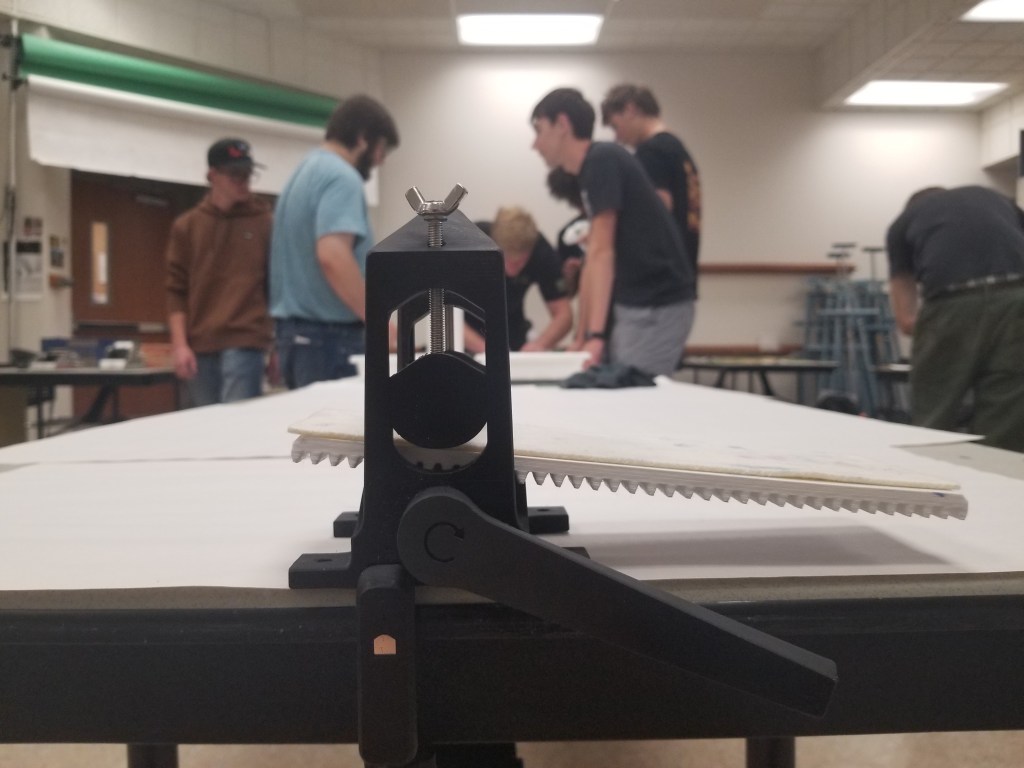
A mini printing press from the Open Press Project, with students working in the background.
After a brief introduction to some basic printing techniques and explanation of what was available, students were given the freedom to explore these technologies in whatever order they wished. Some made an effort to try everything and even combined elements (the printing press with text from the typewriter or lettering set, for instance); some really focused in on one technology or technique and tried it multiple times or in multiple ways.
Frey speaking about his piece “Minesweeper World Map” (2018).
While here, Frey also visited Matt Whitehead’s Drawing class and worked with students on a poster creation project. In preparation for his visit, the class toured his show in the Apex Gallery and discussed the work and how it fit within the class’s idea of “the grid.” For the workshop, Frey started by discussing his take on the grid, which he sees as being all around us. He shared images that he took in his hotel that morning to help illustrate this. In his artwork he examines various ideas but is often looking for ways to challenge our understanding of the grid, while still working within it.
Asked to design posters for invented events and issues (using Nathaniel Russell’s fake flyer assignment described here), students invented lost animal posters with a twist, public service announcements about wearing sunscreen, warnings about birds, and much more. Many posters used similar design techniques even when their content was wildly different, illustrating how specific kinds of media (like informational posters) come with formal expectations that shape their content and presentation and connecting to Frey’s work in its focus on the idea of disrupting the social grid.
Elizabeth Benzmiller is a senior in the Science, Technology, and Society: Policy & Law Major. Throughout her time as a student at South Dakota Mines, she studied abroad in Limerick, Ireland, participated and held leadership roles in student organizations, and interned at the South Dakota Legislature and Raven Industries/Viaflex, Inc.
I was raised by two polar opposite parents. One chose a STEM career, worked in healthcare and laboratories, and was a very analytical and logical thinker. The other was a professional artist, singer, ballroom dance instructor, writer, and more. Growing up, I was able to see first hand how a STEM professional and an artist communicate and view the world very differently! One parent was a logical, straight to the point teacher who learned from a textbook and lectures, while the other was a creative, adventurous, empath who learned through experiences in their life.
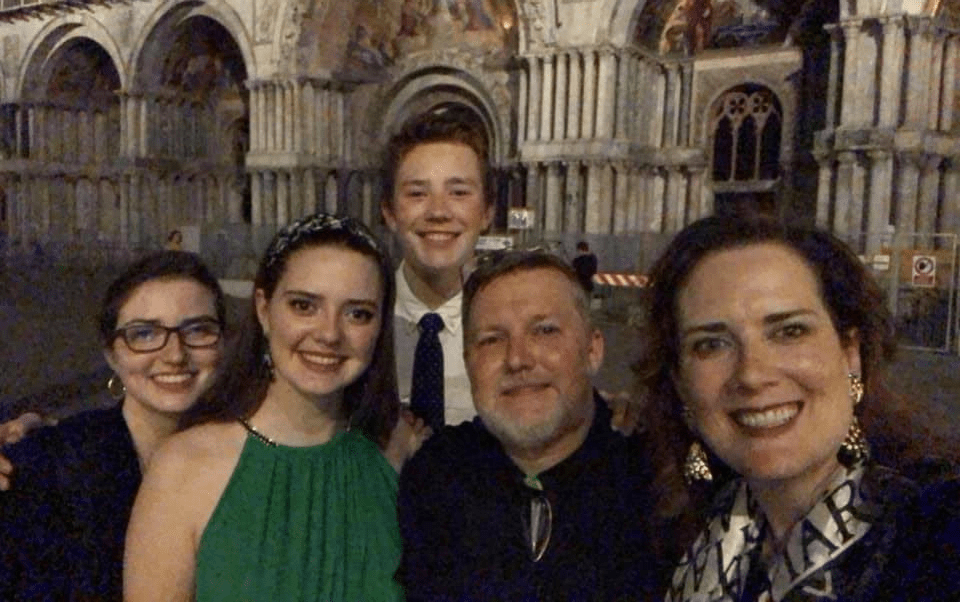
This is my family in Italy, while we were visiting my sister while she performed in an opera. She did this before she graduated college with a degree in Computer Science and Data Analytics. From left to right, Sonya (older sister), Elizabeth (myself), Vincent (younger brother), James (father), and TracieLea (mother).
I was taught the importance of the arts and STEM from a young age and told I didn’t need to choose between the fields. From a young age, I was playing instruments, singing in proper form, reading like a true bookworm, and looking for any opportunity to get crafty and creative. We would have Craft Thursdays and Field Trip Fridays, exploring museums and historical centers, trying new things, and seeing the world from a new perspective each week. At the same time, I was encouraged to ask questions, research the world around me, explore nature and get my hands dirty. I could build rockets, play with Legos, and learn how to use a microscope. I could travel the world and see new sights, cultures, and experience new things.
Every day, I was encouraged to explore my passions and be a lifelong learner. I didn’t have to choose between the Arts and STEM, and I was a more well-rounded individual because I could do both. I eventually decided to study in a STEM-field, but I never wanted to lose my grasp on influences that the arts had on me and I wanted to explore their interactions with the scientific community. This led me to my senior capstone project researching the influence and impact that arts-based instruction has on engineering and STEM undergraduate students.
Matthew Whitehead is the Director of the Apex Gallery and a Lecturer who teaches Art and Art History classes in the Humanities department.
What’s your area of expertise? What do you primarily research and/or teach? And what drew you to this field?
I am an artist. I appropriate images and visual experiences from my surroundings and use them as inspiration for abstractions, mostly drawings, paintings, and collages. I work intuitively, paying close attention to composition and craft. My interest in the arts and the effect it has had on my life pushed me to pursue a career in education. I have taught painting, drawing, photography, illustration, design, graphic design, ceramics, stained glass, sculpture, art history, and foundational arts to students of all ages.
The arts have always been an important part of my life. I come from a family of artists and creatives. On my mother’s side, my grandfather was a renowned potter, painter, and art professor, and my grandmother was a social worker who now spends her time making traditional braided rugs and hand stitching quilts. My mother is a costume designer and art educator by trade but is also an actress and choir singer. My uncle is a potter, and my aunts are also artists of one kind or another. My grandmother on my Dad’s side was a trained aerial performer and painter. My dad was an actor, then a lawyer, and now he’s back to acting again. Given our family background, my siblings and I had no choice but to go into creative fields. My oldest brother is an actor, director, producer, filmmaker, and a professor of acting while my sister is an artist and landscape architect. Becoming an artist always felt like a natural fit.
I often teach a general education Humanities course (HUM 200, officially titled Connections: Humanities and Technology) on the topic of “Automatic Art.” As a Humanities class, we study representative elements from the entire range of arts and letters:
we study the Hockney-Falco hypothesis that primitive optical cameras were used in the paintings of the Dutch Golden Age;
Those are representative examples of the coursework – but what is “Automatic Art”? The term doesn’t actually have much reality outside of my course. (Frustrated students will often turn to the surrealist technique of Automatic Writing, which does exist, but has little bearing on the collection of objects we study.) I like to tell students that “automatic art” is equivalent to “taking the human out of art,” but what does that actually mean?
In this third entry in our women in science and technology series, we focus on women working right now and on the impacts women can continue to have into the future. Two of today’s entries deal with weather and climate, attesting to the importance of climate to our present and future; two emphasize the relationship between science and the arts; and one illustrates the potential our students here at South Dakota Mines have to build on the accomplishments of past women in STEM and to shape the future.
Katherine Hayhoe – selected by Frank Van Nuys
Canadian-born Katherine Hayhoe is a well-known figure in climate activism circles, in large part because of her down-to-earth and engaging skills as a science communicator. After completing a B.S. in physics and astronomy at the University of Toronto, she switched to atmospheric science for her M.S. and Ph.D. at the University of Illinois-Champaign. She is currently a professor of Political Science at Texas Tech University, where she also co-directs that institution’s Climate Center. In addition to more than 125 peer-reviewed publications, Hayhoe has contributed to climate change studies by the National Academy of Sciences and the Intergovernmental Panel on Climate Change. As an evangelical Christian, Dr. Hayhoe has tried to bridge the gap between science and religion, particularly on climate change. Between 2016 and 2019, she hosted and produced a PBS web series, Global Weirding: Climate, Politics, and Religion.
Nathalie Miebach – selected by Matt Whitehead
Nathalie Miebach is an artist who uses weather data to create sculptures and collaborative musical scores. In her sculptures she uses basket weaving techniques, assigning different reed thickness, colors, and other objects to specific types of weather data, often focusing on extreme weather events such as hurricanes. As she says in her TED talk, “Weather is an amalgam of systems that is inherently invisible to most of us. So I use sculpture and music to make it, not just visible, but also tactile and audible.” Science is important, but if it cannot be communicated to others and understood – both intellectually and emotionally – its importance is limited. Miebach’s work helps communicate science to a broader audience and also shows that art and science can be understood together. Learn more about her work at her site, and check out her TED talk about her art using weather data below.
Laurie Spiegel – selected by Matthew Bumbach
Laurie Spiegel (b.1945) is a computer graphics specialist who has worked at Bell Laboratories since 1973. She is also a classical composer, guitarist, and lutist. Spiegel has found a way to combine her passions through the medium of electronic music both as a composer and as a programmer. Though she is a well-known composer and performer, she is most celebrated as the creator of the program Music Mouse.
Music Mouse demonstration
Music Mouse is an “intelligent” algorithmic music composition software. With a built-in knowledge of chords use, scale conventions, and stylistic practices, the software allows the user to create real-time compositions by simply moving the mouse. Spiegel has used the software for several compositions, including Cavis muris (1986) and Sound Zones (1990).
Laurie Spiegel - The Expanding Universe (1980)
Laurie Spiegel’s revolutionary work in the field of technology has led to countless innovations. Her influence as a composer and performer, however, has propelled electronic music forward at warp speed. While science, technology, engineering, and mathematics (STEM) profoundly impact our world, Laurie Spiegel’s ground-breaking career illustrates the potential impact of arts integration (STEAM).
Kiley Westergaard – selected by Karen Westergaard
Without even knowing it, we rely on scientists for information in our everyday lives. We take products, and our scientists behind the scenes, for granted. Behind the scenes, a female scientist tests and labels our products, ensures they are safe, quality products for us to use. She’s behind that nutrition label on your food products. At her lab, she tests for the protein, the fat, the fiber, all the items on your nutrition label. She then generates the product nutritional label so that you know what you are consuming. For instance, those trending seltzers right now? She’s testing each seltzer and creating the nutritional label for each. Ever wonder how long a certain food lasts before it becomes rancid? She’d know. She tests products for that too. That’s why you have the convenience of product expiration labeling. Worried about consuming products with GMOs? She’s got that too. She tests products like corn and soybeans to determine if they are genetically modified. She’s the reason you can find products labeled non-GMO. Worried about your food containing traces of chicken, beef, pork, alligator, kangaroo, goat, or rabbit? With meat speciation, she tests to ensure the product that reaches your home is safe to consume and is labeled accurately. Ever think about who’s behind the scenes? Scientists like you. Scientists like Kiley Westergaard, Chem ’19, SD Mines.
If you missed them, check out our first and second entries in this series, too!
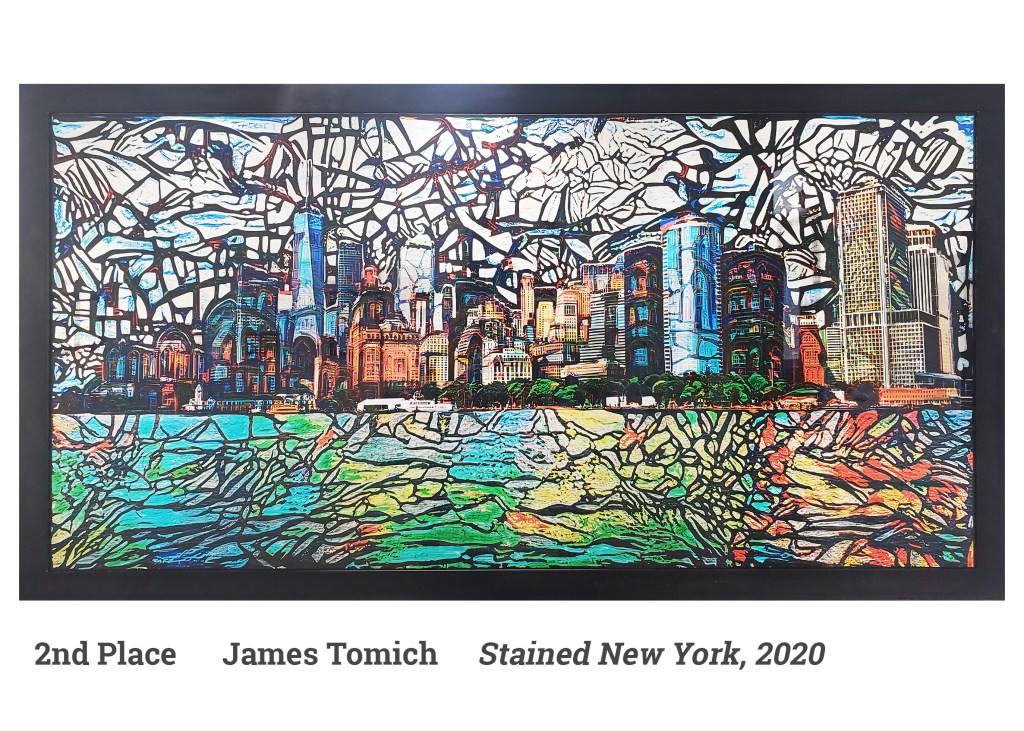
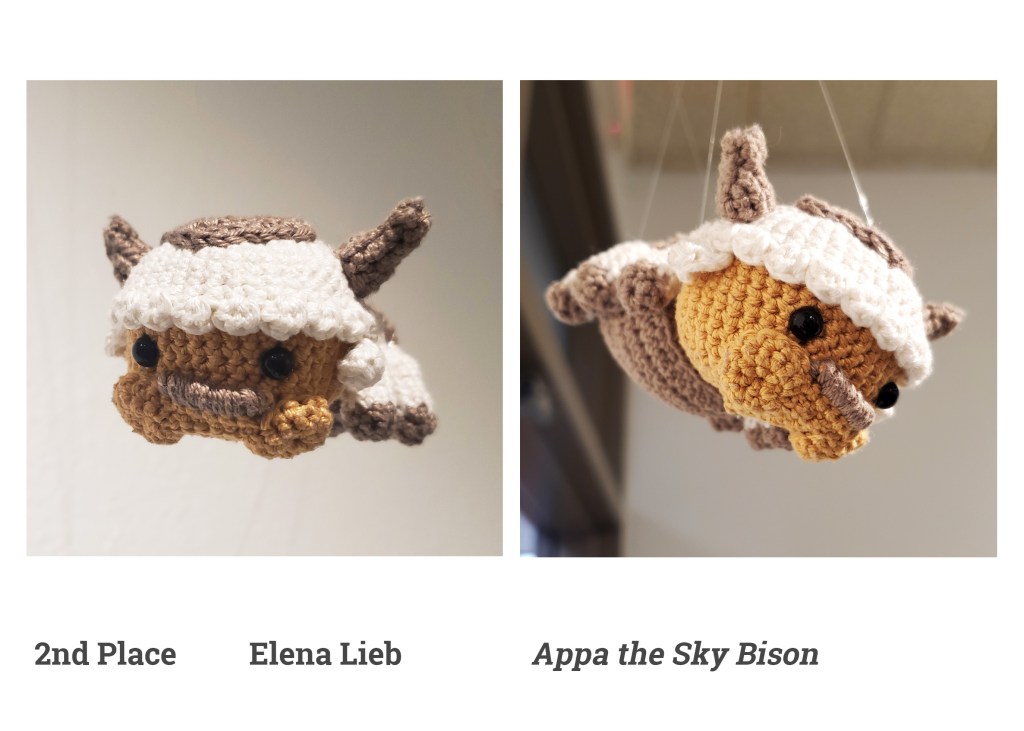
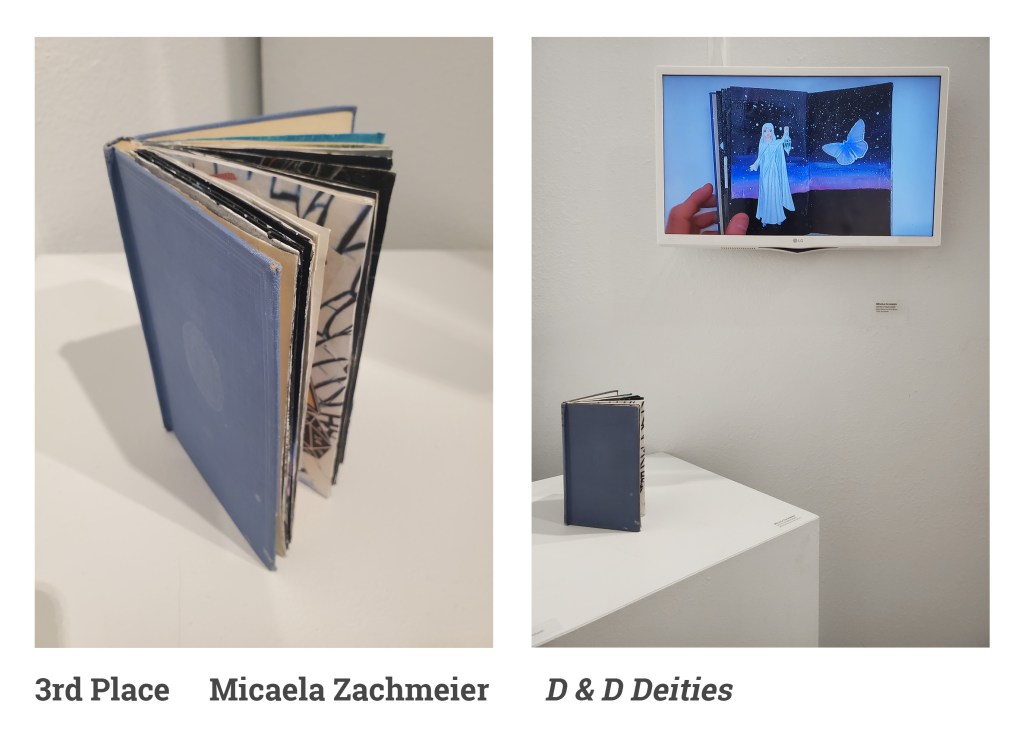
The 2021 Student Art Show at South Dakota Mines has just concluded and, while it may have gotten less attention than previous years, it was a great success. With over 50 submissions, the works demonstrated the wide variety of talents our students have. The show consisted of paintings, drawings, crochet, photography, sculpture, beadwork, mixed media collage, blacksmithing, and musical performances.
Over the last month, people who were able to visit the APEX Gallery in person had the opportunity to vote for their favorite piece.
Here are the results of our Viewer’s Choice Awards:
Congratulations to our winners and a big thank you to all who participated! And if you weren’t able to visit the Apex Gallery to see the show, you can check it out in this walkthrough video!






 The Novum