Giant Dinosaur Marionettes: Engineering Education, Art, and STS

Apex Gallery, art, Events, teaching

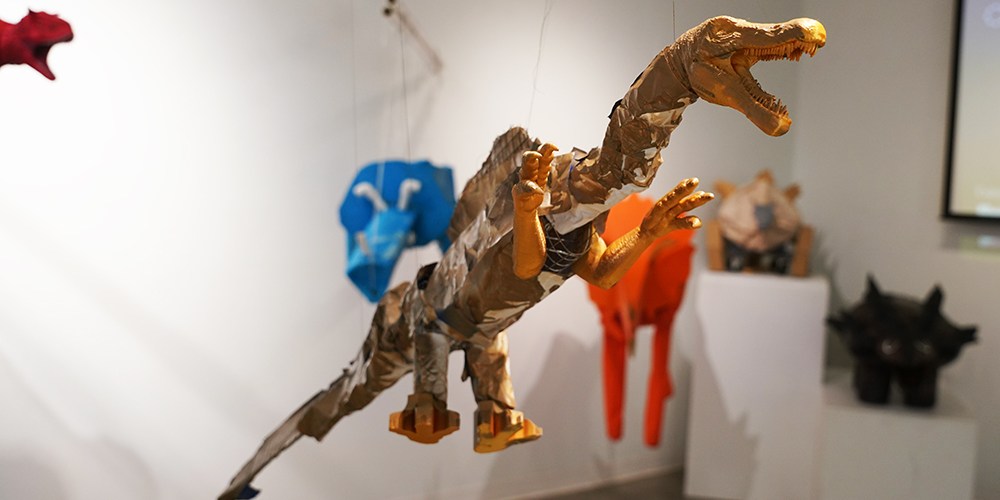
Sometimes people assume that engineers aren’t creative, but this is far from the truth, as the current Apex Gallery exhibit of dinosaur marionettes shows. In his introduction to mechanical engineering course, Dr. Cristian Vargas Ordóñez (in collaboration with Matt Whitehead, Senior Instructor of Art and Director of the Apex Gallery) asked students work in teams to use the engineering concepts they were learning to create and present large dinosaur marionettes.

This project shows what’s possible within engineering education and at the intersection of arts and engineering. It’s also a great illustration of a core principle of STS, which attends to how knowledge is created. Javier Lezaun, Noortje Marres, and Manuel Tironi write that “the larger aim of STS research and intervention . . . [is] to activate new collective imaginations of what an epistemically, technically, environmentally and materially engaged polity might be.” Working together as teams to create something new is a version of this aim at the scale of a college classroom, and it’s good practice for STS thinking and for working creatively with others in other areas! (Our Creativity and Collaboration in STEM minor further reinforces these connections.)

More details about the art exhibit are included in the press release below, and the marionettes will be on display in the Apex Gallery this week, with a reception this afternoon (Wednesday, 11/19) from 4-6 pm.


Art Exhibit Features Giant Dinosaur Marionettes Designed by Mines Mechanical Engineering Students

RAPID CITY, SD (Nov. 19, 2025) – South Dakota Mines mechanical engineering students brought engineering and imagination together to build large dinosaur marionettes, each one crafted with a variety of materials ranging from papier-mache and fabric to metal and 3D printed parts and designed with at least two movable parts.

The creatures are now on display in the Apex Gallery in the university’s Classroom Building. The project is part of the freshman introduction to mechanical engineering course taught by Cristian Vargas Ordóñez, Ph.D., assistant professor in the Leslie A. Rose Department of Mechanical Engineering.

Dr. Vargas Ordóñez in the Apex Gallery with the dinosaur marionettes.

How to Look at the World: Poetry, Science, and Creativity

art, Events, Humanities, Poetry, STS Faculty

By Christy Tidwell

Last week, Matt Whitehead and I gave a presentation about the relationship between poetry and science for National Poetry Month as part of the STEAM Cafe series at Hay Camp Brewing. If you were not able to attend, this is a brief version of what we presented.

As members of the Humanities, Arts, and Social Sciences department, Matt and I (as Art and English faculty, respectively) spend a lot of time thinking about how to get students thinking creatively and engaging in creative projects. Given our work with the Science, Technology, & Society degree, we also work with connections between humanities/arts and science/technology, and we encourage our students to see creativity as something that they don’t do only in our classes but that is a part of their scientific and engineering work, too.

Our core question grows out of this work: What does poetry have to do with science?

The two might seem fundamentally dissimilar, belonging to different realms, but both offer opportunities to look carefully, communicate observations, make connections, and understand the world more fully – piece by piece, experience by experience.

Printing in the Classroom: Hands-On Creation & History of Technology

art, Classes, Humanities, teaching, Technology

By Christy Tidwell

This semester, I am teaching a section of Connections: Humanities & Technology (HUM 200), which is one of our core STS courses as well as a general education course that students from across the university take to fulfill their humanities requirement. There are many ways to teach this course to get students to think more critically and more deeply about the relationships between the humanities and various technologies, and this particular semester’s class begins with a few weeks exploring printing technologies.

What better way to understand printing technologies than to try them out?

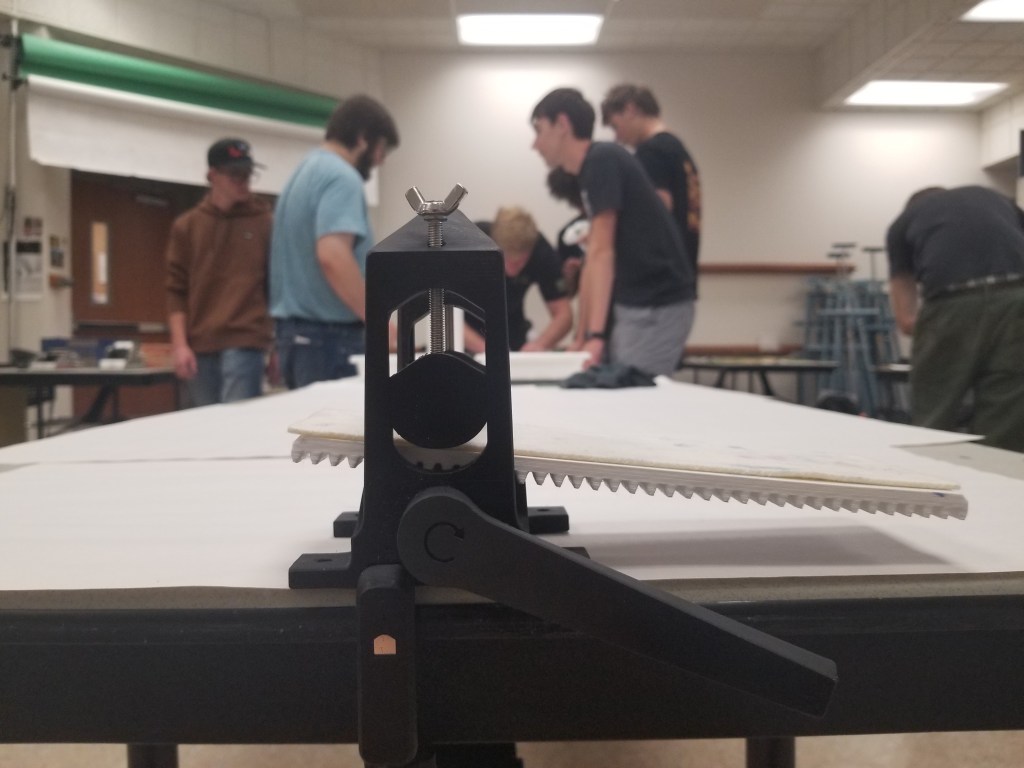
To incorporate a hands-on approach to printing in the class, I worked with our art professor, Matt Whitehead, to prepare an activity for students in the art room. We wanted to give students a chance to work with printing presses in a couple of different ways, to try using a typewriter and a Leroy lettering set, and to check out some old toy moveable type presses. These toy presses date from the 1940s and are no longer totally functional, so they were more on display than for use, but they still allowed students to get a better sense of what a moveable type printing press is like on a small scale.

Photo of a mini printing press ready for use.
A mini printing press from the Open Press Project, with students working in the background.

After a brief introduction to some basic printing techniques and explanation of what was available, students were given the freedom to explore these technologies in whatever order they wished. Some made an effort to try everything and even combined elements (the printing press with text from the typewriter or lettering set, for instance); some really focused in on one technology or technique and tried it multiple times or in multiple ways.

Grids & Creation: Visiting Artist Jonathan Frey Works with Students

Apex Gallery, art

By Christy Tidwell and Matt Whitehead

This month, the Apex Gallery featured the work of visiting artist Jonathan Frey, Assistant Professor of Art and Art History at Bucknell University, who explores games, languages, and grids in his work, considering concepts of order and identity as well as myths/stereotypes about American culture.

Jonathan Frey (a white man) stands beside and gestures toward a work of art, a world map in the style of the game Minesweeper.
Frey speaking about his piece “Minesweeper World Map” (2018).

While here, Frey also visited Matt Whitehead’s Drawing class and worked with students on a poster creation project. In preparation for his visit, the class toured his show in the Apex Gallery and discussed the work and how it fit within the class’s idea of “the grid.” For the workshop, Frey started by discussing his take on the grid, which he sees as being all around us. He shared images that he took in his hotel that morning to help illustrate this. In his artwork he examines various ideas but is often looking for ways to challenge our understanding of the grid, while still working within it.

Asked to design posters for invented events and issues (using Nathaniel Russell’s fake flyer assignment described here), students invented lost animal posters with a twist, public service announcements about wearing sunscreen, warnings about birds, and much more. Many posters used similar design techniques even when their content was wildly different, illustrating how specific kinds of media (like informational posters) come with formal expectations that shape their content and presentation and connecting to Frey’s work in its focus on the idea of disrupting the social grid.

Check out some of the students’ work below!

Automatic Art: or, How to Take the Human out of the Humanities

art, Humanities, teaching, Technology

By Evan Thomas

I often teach a general education Humanities course (HUM 200, officially titled Connections: Humanities and Technology) on the topic of “Automatic Art.” As a Humanities class, we study representative elements from the entire range of arts and letters:

Those are representative examples of the coursework – but what is “Automatic Art”? The term doesn’t actually have much reality outside of my course. (Frustrated students will often turn to the surrealist technique of Automatic Writing, which does exist, but has little bearing on the collection of objects we study.) I like to tell students that “automatic art” is equivalent to “taking the human out of art,” but what does that actually mean?