STS Costume Contest 2023

Events

This year, the STS program ran its first-ever Halloween costume contest. Dressing up for Halloween is a perfect chance for students to show off some creativity and possibly even highlight some connections between science/technology and society! Some of our faculty dressed up, too – we had a pirate, a fancy lumberjack, Introverty the 8th Dwarf, and Goth Judy Jetson.

We had a number of really excellent entries in the contest, and we’re happy to share the winners below (except for one person, Jace Williams, who received an honorable mention but who has not given permission to use his image – if that changes, the post will be updated accordingly).

We have plans for another costume contest next Halloween, so start thinking about costume ideas for 2024!

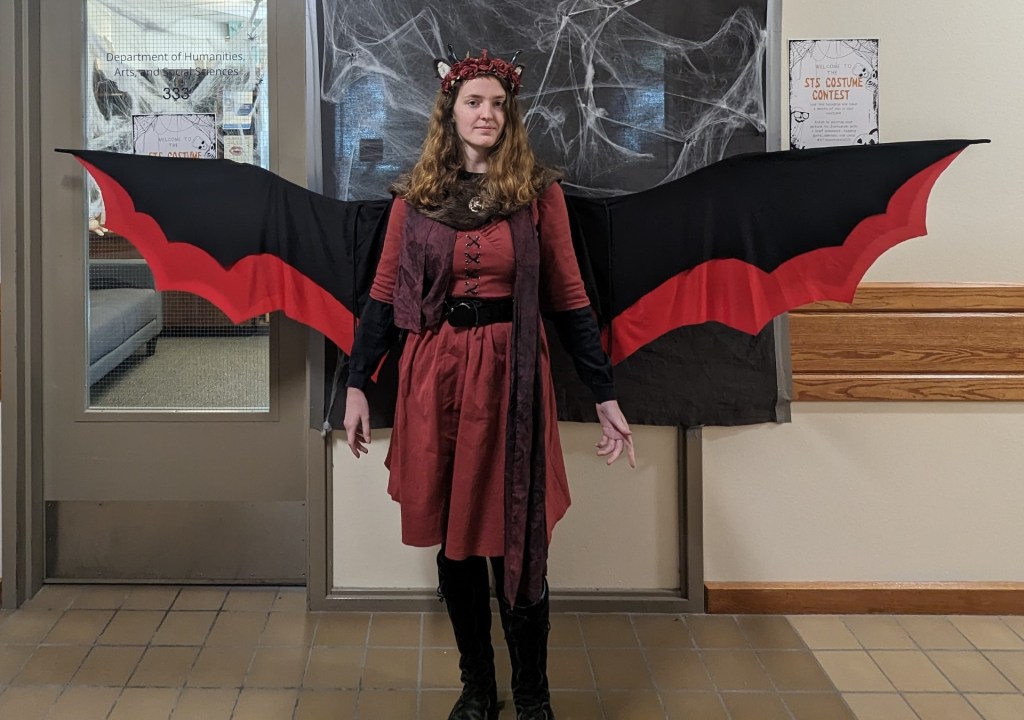
A young woman in a Renaissance-style lace-front dress with tall boots and a headpiece. Most notably, she is also wearing wide black-and-red wings.
First place: Pari Bailey, as a Renaissance fairy.
Person on stilts wearing long patched jeans, a ragged brown jacket and plaid shirt, and a bucket hat. They are also wearing a rope and hook belt and a chain hanging from their neck, with makeup as if their face is stitched together.
Second place: Gaven Williams, as a creepy scarecrow (on stilts!).
Headshot of a student wearing a Grubby mascot head but with the teeth modified to be very pointy and too many.
Third place: Jaxxen Cheney, as Nightmare Grubby.
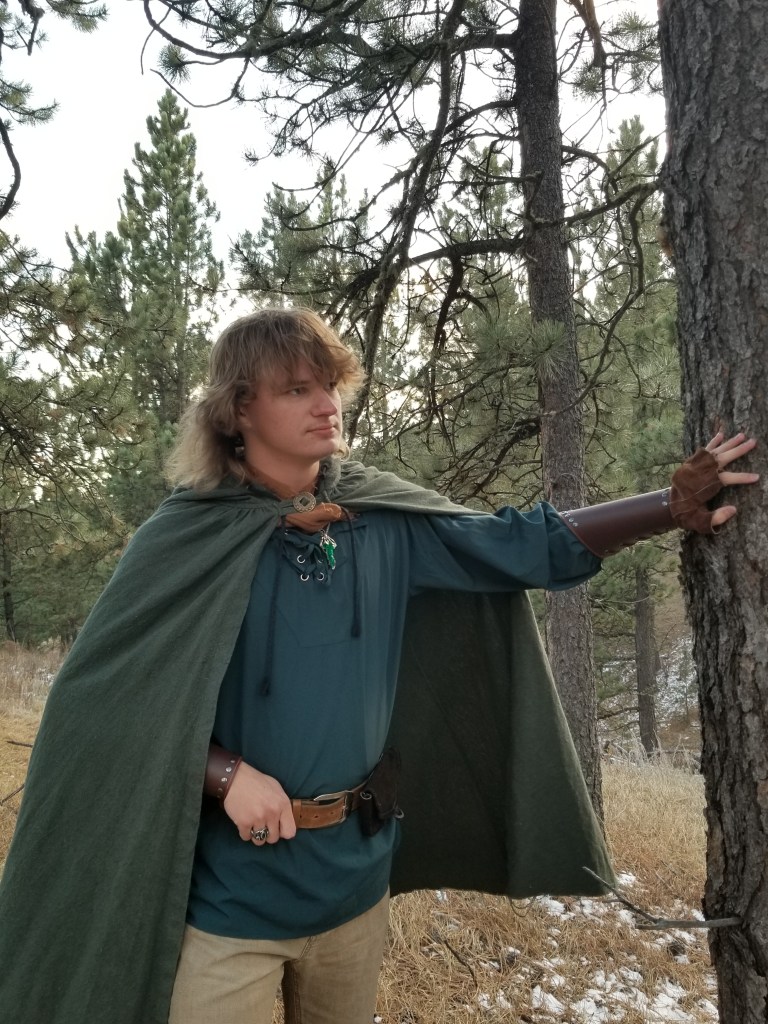
Young man posing in the forest with Renaissance-style clothing - a lace-up shirt, a cape, and leather wristbands.
Honorable Mention: Caleb Noe
Young man wearing a steampunk-style outfit featuring a black coat with tails, a chain wallet, and goggles around his neck.
Honorable Mention: Will Eby

STS Faculty Profile: Natalie Neumann

STS Faculty Profile, Uncategorized

Natalie Neumann is Instructor of English.

What’s your area of expertise? What do you primarily research and/or teach? And what drew you to this field?

My area of expertise and what I got my graduate degree in is creative writing, short stories and poetry. Many years ago I got the opportunity to team-teach a creative writing class modeled after a writing group that I’ve been leading since 2000, and it was wonderful. However, to be honest, I have always loved teaching English 101. Watching students find their voice makes me smile.

What’s one of your favorite courses, topics, or specific texts to teach? Why?

Over the years, I’ve used many texts, essays, poems, and short stories, but one of my favorite essays of all time to use in English 101 is “Why Write?” by Paul Auster. It is timeless.

Measuring Fear: What the Science of Scare Can – and Cannot – Tell Us

Film, horror, Humanities, science

By Christy Tidwell

The Exorcist. Hereditary. The Ring. Texas Chain Saw Massacre. These are often named some of the scariest movies out there. They’re also among the most popular horror movies, ones that are watched and re-watched, considered classics. Horror movie fans want to be scared, after all.

But what makes these movies – and others like them – so scary? And which is really the scariest?

Since 2020, the Science of Scare Project has run an experiment to try to answer the second of these questions. The project asks a panel of 250 people to watch horror movies while measuring their physiological responses to them and then ranks the scariest movies based on those responses. In past years, they have relied simply on heart rates, but – after some criticisms from horror fans that this emphasizes only one sudden type of fear – they have updated this for 2023. Now their study includes not only heart rate as way to measure excitement and fear but also heart rate variance, arguing that “the lower the heart rate variance the more stressed our audience members became, a good indicator of slow burn fear and dread.”

Grids & Creation: Visiting Artist Jonathan Frey Works with Students

Apex Gallery, art

By Christy Tidwell and Matt Whitehead

This month, the Apex Gallery featured the work of visiting artist Jonathan Frey, Assistant Professor of Art and Art History at Bucknell University, who explores games, languages, and grids in his work, considering concepts of order and identity as well as myths/stereotypes about American culture.

Jonathan Frey (a white man) stands beside and gestures toward a work of art, a world map in the style of the game Minesweeper.
Frey speaking about his piece “Minesweeper World Map” (2018).

While here, Frey also visited Matt Whitehead’s Drawing class and worked with students on a poster creation project. In preparation for his visit, the class toured his show in the Apex Gallery and discussed the work and how it fit within the class’s idea of “the grid.” For the workshop, Frey started by discussing his take on the grid, which he sees as being all around us. He shared images that he took in his hotel that morning to help illustrate this. In his artwork he examines various ideas but is often looking for ways to challenge our understanding of the grid, while still working within it.

Asked to design posters for invented events and issues (using Nathaniel Russell’s fake flyer assignment described here), students invented lost animal posters with a twist, public service announcements about wearing sunscreen, warnings about birds, and much more. Many posters used similar design techniques even when their content was wildly different, illustrating how specific kinds of media (like informational posters) come with formal expectations that shape their content and presentation and connecting to Frey’s work in its focus on the idea of disrupting the social grid.

Check out some of the students’ work below!

STS Faculty Profile: Mary Witlacil

STS Faculty Profile
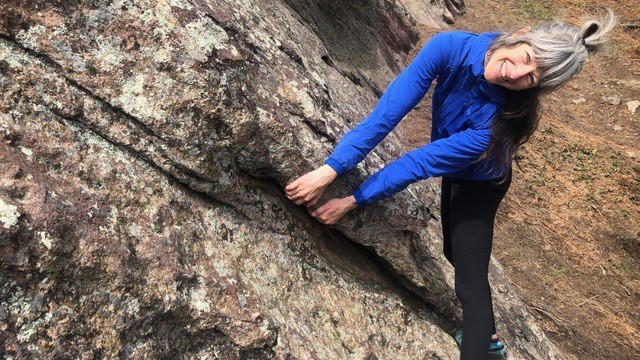
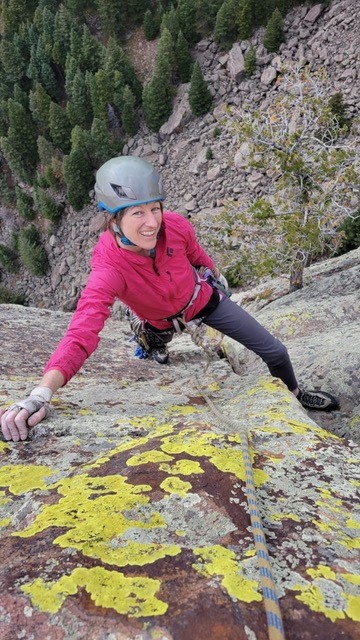
Photograph of Mary on the side of a mountain, taken from above.

Mary Witlacil is Assistant Professor of Political Science.

What’s your area of expertise? What do you primarily research and/or teach? And what drew you to this field?

As a Fine Arts Major during my undergraduate studies, I would find myself getting into impassioned political discussions with my art professor. At some point, he mentioned his love of political science. The next semester, I registered for my first American Politics class, and I was hooked. By the following Fall, I changed majors to Political Science. Then, after working outside of academia, I decided to return to graduate school to study the politics of climate change.

By training, I am an environmental political theorist, and I have broad expertise and interest in environmental politics and policy, critical theory, the politics of climate change, contemporary political theory, and international relations. It might sound peculiar to some, but I am fascinated by the study of politics.

My research draws on contemporary political thought and critical theory to consider how we cope with climate change and environmental injustice. I am curious about what it means for politics and what it means to be human during a moment of massive and catastrophic environmental change.

As a professor at SD Mines, I cover all the political science courses including American Political Issues, Political Ideologies, American Government, and Introduction to International Relations. Next semester I am excited to teach Environmental Law and Policy, and in the Fall of 2024, I look forward to teaching the Politics of Nature and Technology.

What’s one of your favorite courses, topics, or specific texts to teach? Why?

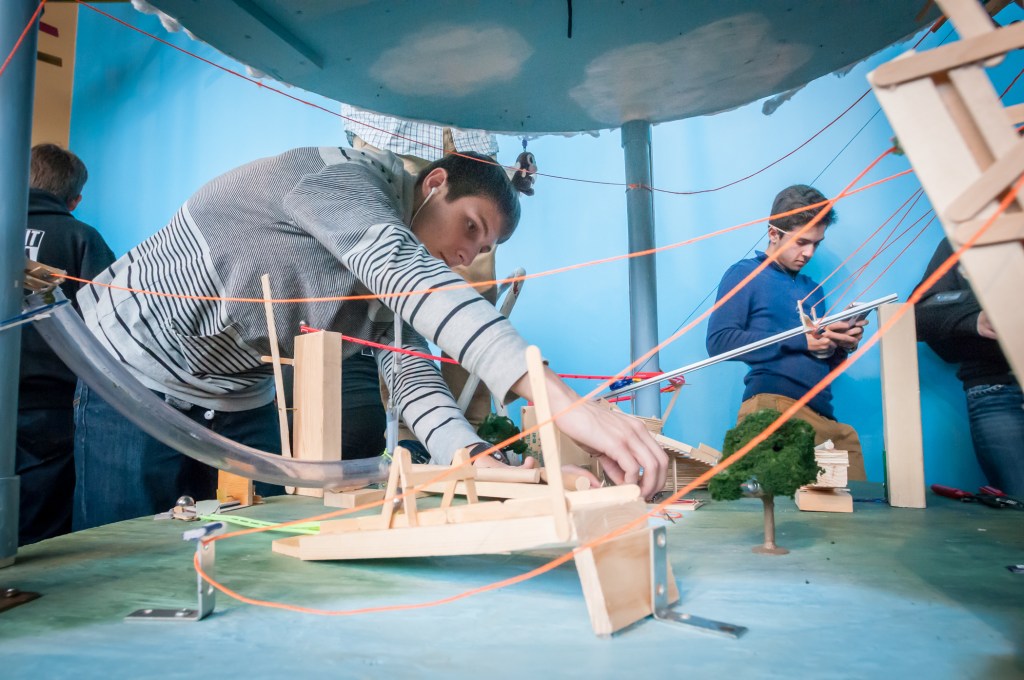
While I do not have a favorite course yet, I love teaching about political ideologies as well as the intersection between politics and the environment. This semester I have enjoyed watching students make connections between the functions (or dysfunctions) of American politics and more local or personal political issues. American politics is like a Rube Goldberg machine—or a chain-reaction machine designed to perform simple tasks in an absurdly indirect manner—where political institutions affect the functioning of the whole in bizarre and surprising ways. Whenever someone proposes or enacts a solution to a political problem, it alters and affects all the intermediary chain reactions, in a way that can be difficult to understand for years or decades. It has been fun to explore this conundrum with students.

A young man adjusts a part on a Rube Goldberg machine. String and pieces of wood are in the foreground, as part of the machine.
31441D, Rube Goldberg contest 2016. Photograph by Mark Lopez (Flickr).

STS Faculty Profile: Carlie Herrick

STS Faculty Profile

Carlie Herrick is Instructor of English.

Woman wearing backpack and hiking with grass, mountains, and blue sky behind her.

What’s your area of expertise? What do you primarily research and/or teach? And what drew you to this field?

My area of expertise is TESL and linguistics. I am a word nerd. I teach the general education writing/communication classes. I started college as a music major and realized that though I enjoy music, I was not that enthused about teaching it. In my junior year, I changed schools and switched from music to English. I love studying how language changes and how meaning flows with the cultural river and all its tributaries. 

What’s one of your favorite courses, topics, or specific texts to teach? Why?

I don’t know that I necessarily have a favorite class that I teach or a favorite text; however, my favorite aspect of teaching is watching what happens in students from Composition 101 to junior or senior year. I like seeing the growth that can occur.

Score-Score: A Music & STEM Project

Arts, music

Director of Bands Dr. Haley Armstrong and a team of SD Mines computer science and engineering students have created Score-Score, a program designed to let music teachers and professors find and review sheet music. Score-Score went on to take fifth place and a $1,000 prize in the student division of the 2023 South Dakota Governor’s Giant Vision Business Competition. Armstrong is delighted with the success of this project, saying, “The students have made my wild idea become a reality. Their dedication and vision have taken the project further than I could have hoped to bring new ideas and focus to an idea that would have been subpar without their expertise.”

Score-Score highlights the way our faculty in the Humanities, Arts, and Social Sciences encourage students in their own research and help them see connections between their disciplines and ours. It also beautifully illustrates the interdisciplinary and creative nature of STS.

Hear Dr. Armstrong talk more about this project on South Dakota Public Broadcasting’s In the Moment.

Three college students with their computers in an office full of bookshelves.

In Memory of John Dreyer

In Memoriam

This memorial for John Dreyer has been a work in progress for months. He died last summer, before the most recent academic year began, and those of us who knew him and loved him have struggled with his absence and wrestled with how to articulate how much he meant to us. This post is one small hint of how much he meant to us, what we could put into words. These words speak truths about John and about what he meant to us, but they can never tell the whole story.

We made it through this academic year without him here. But he was missed all the time, and he will continue to be missed.

Frank Van Nuys, Professor of History

When our colleague, Dr. John Dreyer, passed away suddenly on July 9, 2022, at the age of 44, we were all shaken to the core. It was nearly impossible to fathom how our academic and social lives would endure without him presiding at the head of the conference table on Donut Fridays; sitting in the back of the room at department meetings and presentations; working in his packed office surrounded by hundreds of books and collectibles with the Ohio state flag nailed to the wall; holding forth at Dakota Point or in Haley’s backyard gatherings; accompanying his beloved daughter when it came time to order Girl Scout cookies. From here on out we have to wrestle (a term I choose deliberately in honor of his devotion to professional wrestling) with this heartbreak.

John arrived here at SD Mines to teach Political Science in 2009. To be honest, unlike many others who come to the Black Hills and decide they never want to leave, John always longed to return east, particularly to his incomparable northwestern Ohio. I grew up in the southwestern part of that state, which I suppose made me alright in his book. He even gave me a Pete Rose-autographed baseball not long after he came here. I used to needle him about his “Ohiophilia,” referring to Toledo as “Paris-on-the-Lake” and his office as our “Ohio Embassy.”

There were so many facets to John beyond his love for Ohio. He was a brilliant colleague, a true friend, a loving father and family man, and a consummate storyteller. To honor John, we offer the following thoughts from his colleagues in the Department of Humanities and Social Sciences and others from around campus.

Farewell, friend. Be at peace.

Hail Raiser

Atmospheric Science Students, STS Students

By Madisen Lindholm

As a weather lover, I always fangirl when a big storm rolls through. I love going outside or chasing it (safely) and seeing all aspects of the storm. Sometimes before a thunderstorm that will produce hail, mammatus clouds form. Mammatus clouds are bubbly in appearance, and are considered unique, but we often see them in the Black Hills. These are my favorite clouds due to how unique they are and how telling of the storm components they are.

Clouds against a blue sky. The sky is visible at the bottom of the image and above that dark, bubbly mammatus clouds take up most of the image.
This image was taken last summer from Rushmore Crossing. Up at the top of the image are the dark, bubbly mammatus clouds. Mammatus clouds typically foreshadow hail, and are rare in most areas, but are somewhat common during the summer in South Dakota.

I especially love the aftereffects of a thunderstorm. The stillness in the air, the rainbows, the smell of freshly fallen rain, and the glow of the atmosphere are all amazing to me. It also amazes me how much energy storms produce and use as they race across the plains of South Dakota, dropping rain, wind, hail, and lightning as they go. One storm that particularly amazes me is one that occurred on July 23rd, 2010, in Vivian, SD. This storm produced the largest hailstone ever recorded in the United States (3D printed model pictured above). This hailstone is 8 inches in diameter, 18.6 inches in circumference and weighs nearly 2 pounds! Imagine that hitting your house!

Because I have always loved severe weather, I knew my senior research topic needed to be in that category. I especially find hail fascinating, so I decided to use hail as my main topic. South Dakota summer thunderstorms are known for the hail they bring. From car damage, broken windows, roof damage, livestock casualties, plant damage, and human casualties, hail causes many problems. As a lifelong South Dakotan, there have been many times I have been out and about when suddenly I get a National Weather Service emergency warning about hail, but by that point it is too late to move my car into a safe area. Over the years, it has seemed like hail has increased in frequency and size on a regular basis. For example, last summer it seemed like the majority of storms brought at least pea-sized hail, where just a decade ago I remember hail being a more special occurrence. This struck me as an important hypothesis to address because as climate change becomes worse hail will, too, so I figured it would make for an interesting capstone project.

To Dust We Shall Return?

Atmospheric Science Students, STS Students

By Lillian Knudtson

Weather affects all people, and it is important for meteorologists to understand a wide range of events to communicate effectively to the public. My capstone is a project designed to dissect a particularly interesting phenomenon, especially to South Dakota. I have chosen to do a case study of a particular dust storm known as a haboob. The storm I am focusing on occurred May 12th, 2022, and it impacted the eastern part of South Dakota. A widespread, long-lived thunderstorm called a derecho created the haboob beginning in the south central portion of Nebraska and traveled north and east towards Sioux Falls. It sustained winds of 80 miles per hour, and the highest recorded winds of the event were 107 miles per hour. This storm is a good example of what is possible and can become a sample case for the future.

Photo of giant reddish-brown dust cloud blowing in from the right side of the image, approaching a playground and a few people watching it.

A haboob is a giant dust storm. It is named after the Arabic word habb, meaning “blown.” This type of storm is most common in the Middle East and Northern Africa, where is it historically arid. But haboobs are also well known in the Southwestern United States and are becoming an occurrence in previously unlikely places as well. Haboobs are created from loose particles that are picked up by strong winds caused by storms like monsoons or derechos sweeping across the surface of the earth. The massive amount of precipitation associated with these events evaporate, which is a cooling process, so cool air called a gust front accelerates out in front of the storm at a fast rate, picking up particles and building a wall of air and dirt. The particles are mostly less than 10 micrometer pieces of dirt, dust, and sand, but they can be as large as a pea, and the wind can pick up other debris along with it. These walls of air and dirt can reach grow to 5000 feet tall and 100 miles wide, and they can move at 60 miles an hour (Eagar, Herckes, Hartnett, 2016). Overall it is a phenomenon that is quite terrifying.