In 1976 my eighth-grade science teacher gave us an assignment that seems as if it possibly aligned with that year’s Earth Day activities. I recall this primarily because of its embarrassing results. We were told to dig up some soil from our family’s yard and bring it to school to develop our own little in-door plot for growing some plant or other. Being part of the only family in southwestern Ohio not possessed of an old coffee can or some other suitable container, I dutifully filled a black plastic lawn bag with what seemed like a lot of dirt and stuffed that in a gym bag. Managing to lug my Earth Day “earth” on to the school bus, I stuffed the gym bag in my locker. When the time came for science class, I opened the locker and discovered that the plastic bag had ruptured. I suppose I somehow wrestled my embarrassingly overflowing bag of dirt into class and eventually grew something, but that sickening demoralization of middle-school level humiliation was all that really stuck with me.
Poster for the ENACT (Environmental Action for Survival) Earth Day Teach-In on the University of Michigan – Ann Arbor campus in March 1970.
My hapless effort at dirt transplantation offers a metaphor of sorts for the Earth Day phenomenon. Well-intentioned individual efforts on behalf of noble aspirations to better the planet, even if more successful than mine, amount to relatively small achievements. The first Earth Day on April 22, 1970, was certainly a masterstroke in terms of generating citizen engagement and marketing an increasingly popular sentiment into a mass movement spectacle. It can even be argued that bipartisan passage of significant federal environmental legislation, such as the Clean Air Act of 1970, the Clean Water Act of 1972, and the Endangered Species Act of 1973, fed on momentum provided by Earth Day. Additional impacts included a surge in environmental organization memberships during the 1970s and growing influence of such organizations in legal actions against corporations and government agencies.
As I noted in my earlier discussion of Robert Kelly’s “Science,” poetry and science are not as separate as we might often think: they are both creative, and they both challenge us to see the world in new ways. In “The Sciences Sing a Lullabye” (2007), Albert Goldbarth illustrates another similarity between science and poetry by personifying the sciences (specifically physics, geology, astronomy, zoology, psychology, biology, and history) and imagining them as comforting figures.
Geology says: It will be all right.
Albert Goldbarth, “The Sciences Sing a Lullabye”
It is comforting to think, as Physics tells us, that our atoms will “dance / inside themselves themselves without you,” or, as Geology says, that “All of the continents used to be / one body. You aren’t alone.” Meanwhile, Astronomy comforts the reader with a reassurance that “the sun will rise tomorrow” while History hands us “the blankets, layer on / layer, down and down.” In other words, the processes of our bodies and of the world will continue, even without our attention. And science is what provides the evidence of this continuation.
As I observed in last week’s National Poetry Month post, both poetry and science provide us with new ways to see the world we live in. This week, I want to get more specific and consider one STEM field with a significant relationship to poetry: medicine.
Poets Imagining Doctors
There is a long history of poetry representing doctors and medicine. Robert Southey’s “The Surgeon’s Warning” (1796) provides one Gothic and rather gruesome vision of doctors (thanks to Laura Kremmel for the recommendation!). In it, a doctor on his deathbed worries about how his corpse will be treated:
All kinds of carcasses I have cut up, And the judgment now must be– But brothers I took care of you, So pray take care of me!
I have made candles of infants fat The Sextons have been my slaves, I have bottled babes unborn, and dried Hearts and livers from rifled graves.
And my Prentices now will surely come And carve me bone from bone, And I who have rifled the dead man’s grave Shall never have rest in my own.
This is an image of the doctor as monster, as one who perhaps deserves to receive the treatment he’s given others’ corpses (ultimately, “they carv’d him bone from bone”), and it reflects 18th century fears of doctors and surgeons themselves as well as those who worked alongside them (graverobbers, for instance).
If children are trained to treat robots with respect, saying “Excuse me, Alexa” instead of “Hey, Alexa?”, would they in turn treat other humans more respectfully? This is one of the many intriguing questions that interests Dr. Qin Zhu, who was the first speaker in our STS Speaker Series.
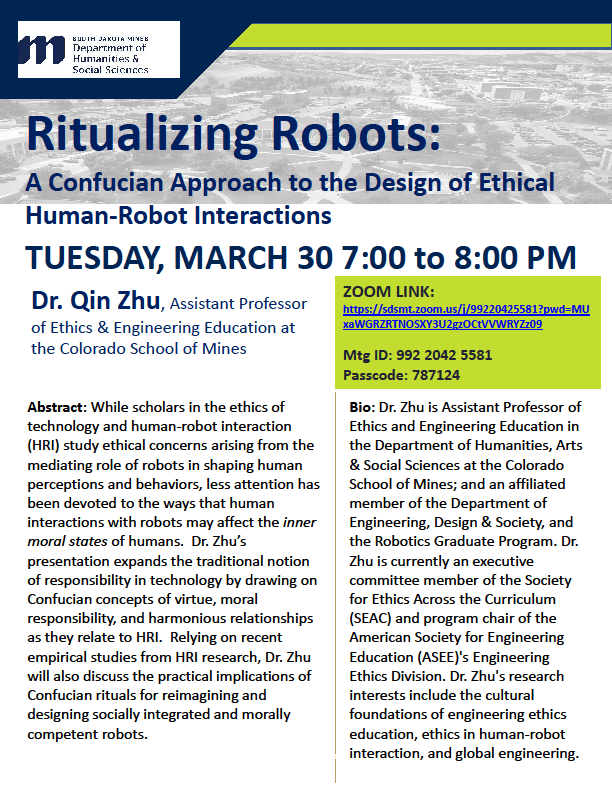
On March 30th, Dr. Zhu gave a virtual campus talk on his research titled “Ritualizing Robots: A Confucian Approach to the Design of Ethical Human-Robot Interactions.” Dr. Zhu introduced a fundamental concept in STS: technologies reflect human values. For instance, a speed bump in a quiet neighborhood slows you down because people want to create a safe environment. If you do not slow down, your car may be damaged, which is both a physical and social punishment for disregarding the value of safety.
The same applies to robots: they are designed for a purpose, they embody human values, and how we interact with them says a lot about ourselves as moral beings. For instance, if you hit a robot, you may be more likely to hit another human.
I recently binged the Netflix show Cobra Kai, which brings the characters from the 1984 film Karate Kid into the present. My favorite character in the show is not the original hero Danny Larusso (Ralph Macchio), but the down-and-out and hopelessly politically incorrect Johnny Lawrence (William Zabka), owner of the revitalized Cobra Kai dojo.
Lawrence is particularly fun to watch as he struggles to learn how to use computers and the internet – from turning on a computer and accessing wi-fi to navigating social media and all the unspoken rules of internet communication. If you’ve watched Cobra Kai on Netflix or YouTube (where it originally started), you’re already better versed in the internet than Johnny, who’d likely guess “Netflix” was a movie about basketball.
April is National Poetry Month, and although people may not always think of poetry and science together, a wealth of poetry exists that addresses science, technology, and various STEM topics.
In his 2006 poem “Science” (read full poem here), for instance, Robert Kelly writes that “science is the same as poetry / only it uses the wrong words.” Science and poetry are both ways of looking carefully at the world, expressing those observations, and helping us all understand the world more fully – piece by piece, experience by experience.
Kelly also writes that “Science explains nothing / but holds all together as / many things as it can count.” Poetry, too, does not claim to explain the world so much as show it to us. And poetry frequently works by juxtaposing meanings, holding together ideas and images to give readers an opportunity to find new meanings in their combination.
After sharing the initial post in this series, I got several messages or comments suggesting other cool women! So I thought I’d post a few additional suggestions here to conclude Women’s History Month.
Ellen Swallow Richards – suggested by Joseph Heumann, Eastern Illinois University
Best known for her work in the field of sanitary engineering, Ellen Swallow Richards was a chemist – one of the first professional women chemists in the US – whose work led to better water-quality standards and understandings of environmental systems.
Ellen Swallow Richards
Frances Arnold – suggested by Robb Winter, South Dakota School of Mines & Technology
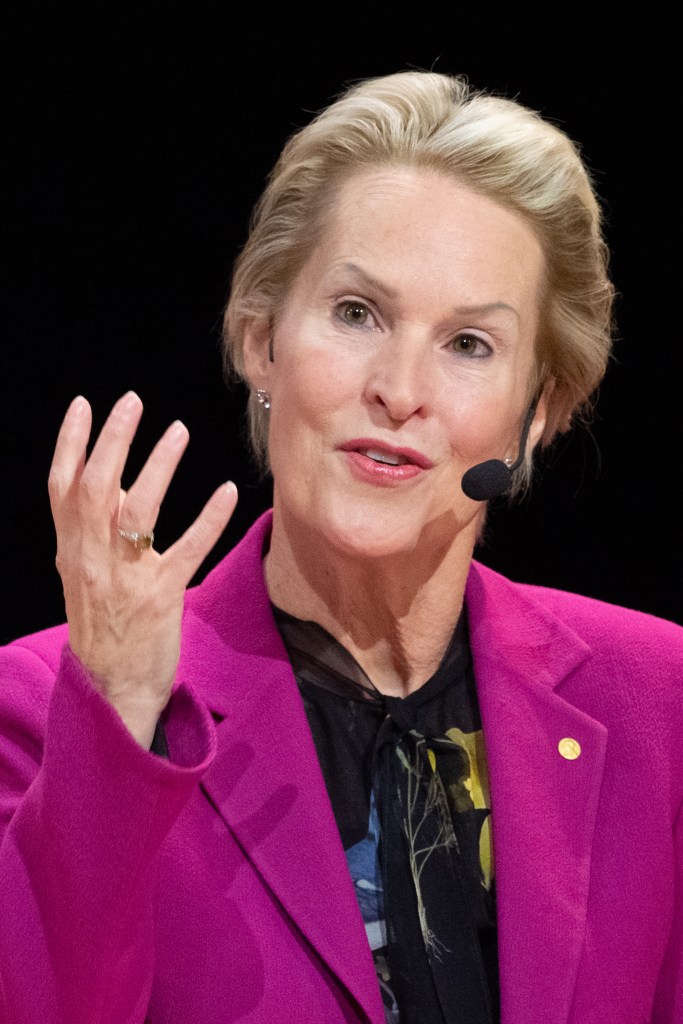
Co-inventor on over 40 patents, Frances Arnold is best known for using directed evolution to create enzymes with novel function. In 2018, she was the first American woman to win the Nobel Prize in Chemistry.
Frances Arnold (Wikimedia Commons)
Virginia T. Norwood – suggested by Curtis V. Price, South Dakota School of Mines & Technology
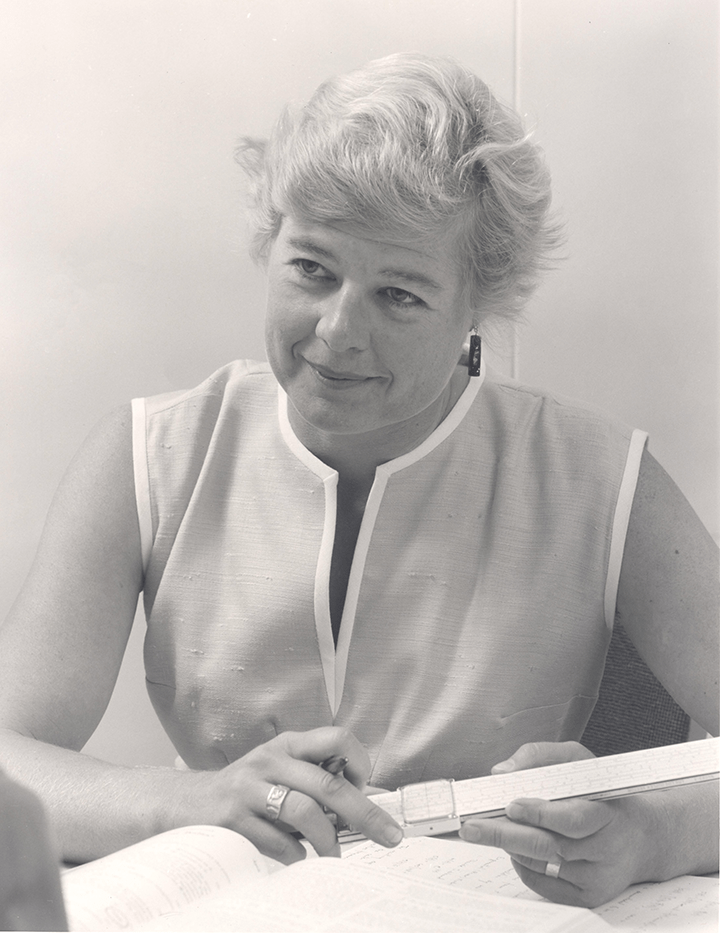
Sometimes called the Mother of Landsat, Virginia T. Norwood – a physicist – was instrumental in designing the Landsat program that made modern Earth observation possible. She embraces the title “Mother of Landsat,” saying, “Yes. I like it, and it’s apt. I created it; I birthed it; and I fought for it.”
Virginia T. Norwood
Winifred Goldring– one more suggestion from me (Christy Tidwell)
Winifred Golding was a paleontologist working in the early 20th century, best known for her work on Devonian crinoids . She was the first State Paleontologist of New York, and she used that position to design exhibits for educating visitors. These exhibits reflected a more modern and engaging approach to science communication at the time. She fascinates me not only because of her actual paleontological work but because she is said to have invented special pants for women to wear in the field and because this is one of the commonly shared pictures of her.
We are happy to welcome Dr. Qin Zhu of the Colorado School of Mines as a guest speaker this week! On Tuesday, March 30th, from 7-8 pm (Mountain time), he will address ethical issues that arise from humans interacting with robots. He will draw on both Confucian ethics and research from human-robot interaction studies. For more, see the poster below! (Zoom link)
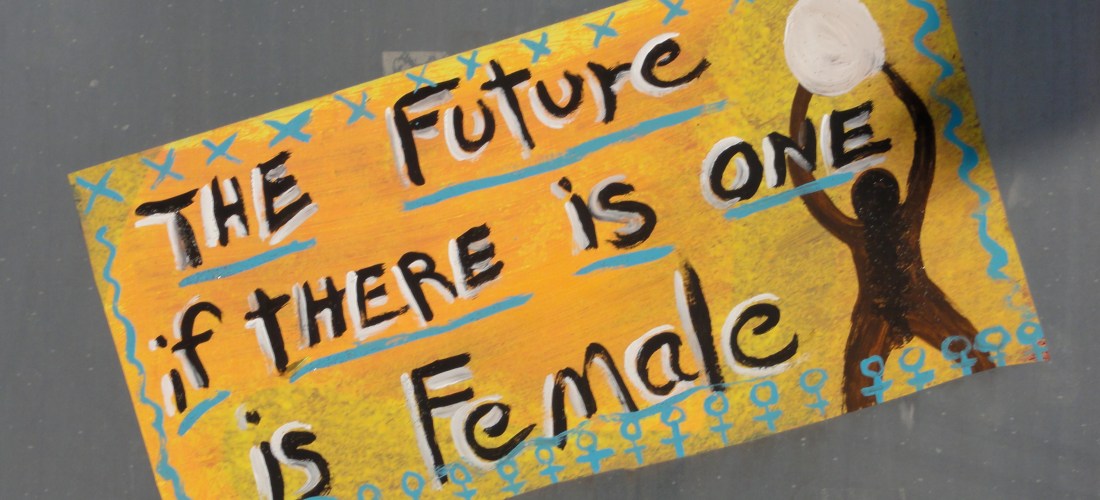
In this third entry in our women in science and technology series, we focus on women working right now and on the impacts women can continue to have into the future. Two of today’s entries deal with weather and climate, attesting to the importance of climate to our present and future; two emphasize the relationship between science and the arts; and one illustrates the potential our students here at South Dakota Mines have to build on the accomplishments of past women in STEM and to shape the future.
Katherine Hayhoe – selected by Frank Van Nuys
Canadian-born Katherine Hayhoe is a well-known figure in climate activism circles, in large part because of her down-to-earth and engaging skills as a science communicator. After completing a B.S. in physics and astronomy at the University of Toronto, she switched to atmospheric science for her M.S. and Ph.D. at the University of Illinois-Champaign. She is currently a professor of Political Science at Texas Tech University, where she also co-directs that institution’s Climate Center. In addition to more than 125 peer-reviewed publications, Hayhoe has contributed to climate change studies by the National Academy of Sciences and the Intergovernmental Panel on Climate Change. As an evangelical Christian, Dr. Hayhoe has tried to bridge the gap between science and religion, particularly on climate change. Between 2016 and 2019, she hosted and produced a PBS web series, Global Weirding: Climate, Politics, and Religion.
Nathalie Miebach – selected by Matt Whitehead
Nathalie Miebach is an artist who uses weather data to create sculptures and collaborative musical scores. In her sculptures she uses basket weaving techniques, assigning different reed thickness, colors, and other objects to specific types of weather data, often focusing on extreme weather events such as hurricanes. As she says in her TED talk, “Weather is an amalgam of systems that is inherently invisible to most of us. So I use sculpture and music to make it, not just visible, but also tactile and audible.” Science is important, but if it cannot be communicated to others and understood – both intellectually and emotionally – its importance is limited. Miebach’s work helps communicate science to a broader audience and also shows that art and science can be understood together. Learn more about her work at her site, and check out her TED talk about her art using weather data below.
Laurie Spiegel – selected by Matthew Bumbach
Laurie Spiegel (b.1945) is a computer graphics specialist who has worked at Bell Laboratories since 1973. She is also a classical composer, guitarist, and lutist. Spiegel has found a way to combine her passions through the medium of electronic music both as a composer and as a programmer. Though she is a well-known composer and performer, she is most celebrated as the creator of the program Music Mouse.
Music Mouse demonstration
Music Mouse is an “intelligent” algorithmic music composition software. With a built-in knowledge of chords use, scale conventions, and stylistic practices, the software allows the user to create real-time compositions by simply moving the mouse. Spiegel has used the software for several compositions, including Cavis muris (1986) and Sound Zones (1990).
Laurie Spiegel - The Expanding Universe (1980)
Laurie Spiegel’s revolutionary work in the field of technology has led to countless innovations. Her influence as a composer and performer, however, has propelled electronic music forward at warp speed. While science, technology, engineering, and mathematics (STEM) profoundly impact our world, Laurie Spiegel’s ground-breaking career illustrates the potential impact of arts integration (STEAM).
Kiley Westergaard – selected by Karen Westergaard
Without even knowing it, we rely on scientists for information in our everyday lives. We take products, and our scientists behind the scenes, for granted. Behind the scenes, a female scientist tests and labels our products, ensures they are safe, quality products for us to use. She’s behind that nutrition label on your food products. At her lab, she tests for the protein, the fat, the fiber, all the items on your nutrition label. She then generates the product nutritional label so that you know what you are consuming. For instance, those trending seltzers right now? She’s testing each seltzer and creating the nutritional label for each. Ever wonder how long a certain food lasts before it becomes rancid? She’d know. She tests products for that too. That’s why you have the convenience of product expiration labeling. Worried about consuming products with GMOs? She’s got that too. She tests products like corn and soybeans to determine if they are genetically modified. She’s the reason you can find products labeled non-GMO. Worried about your food containing traces of chicken, beef, pork, alligator, kangaroo, goat, or rabbit? With meat speciation, she tests to ensure the product that reaches your home is safe to consume and is labeled accurately. Ever think about who’s behind the scenes? Scientists like you. Scientists like Kiley Westergaard, Chem ’19, SD Mines.
If you missed them, check out our first and second entries in this series, too!
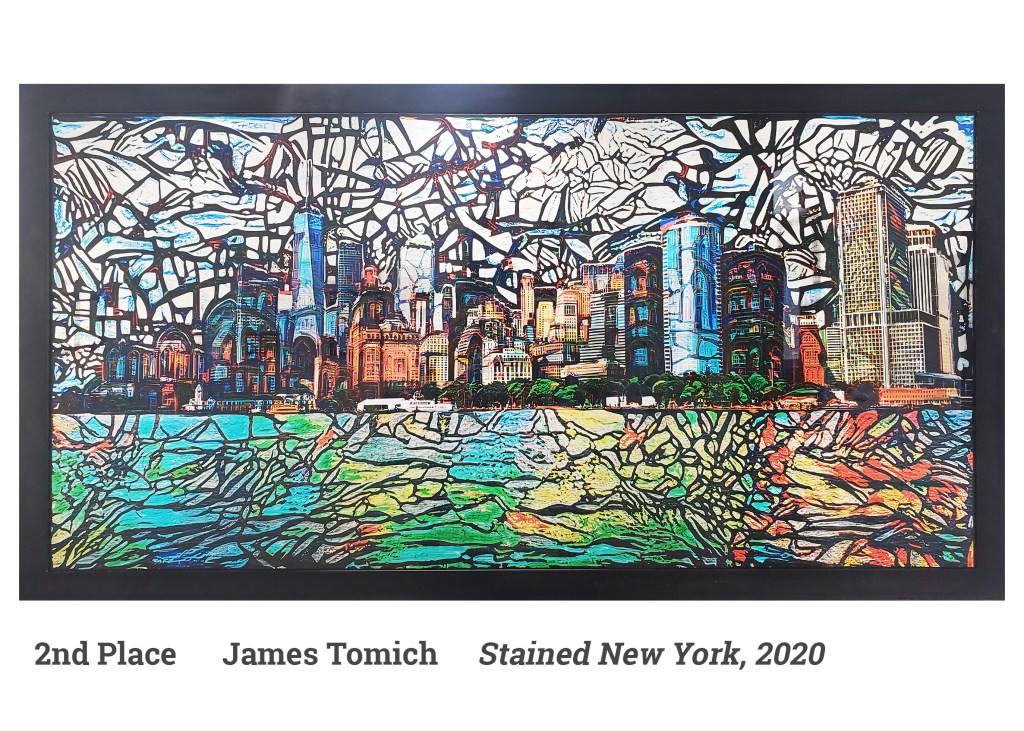
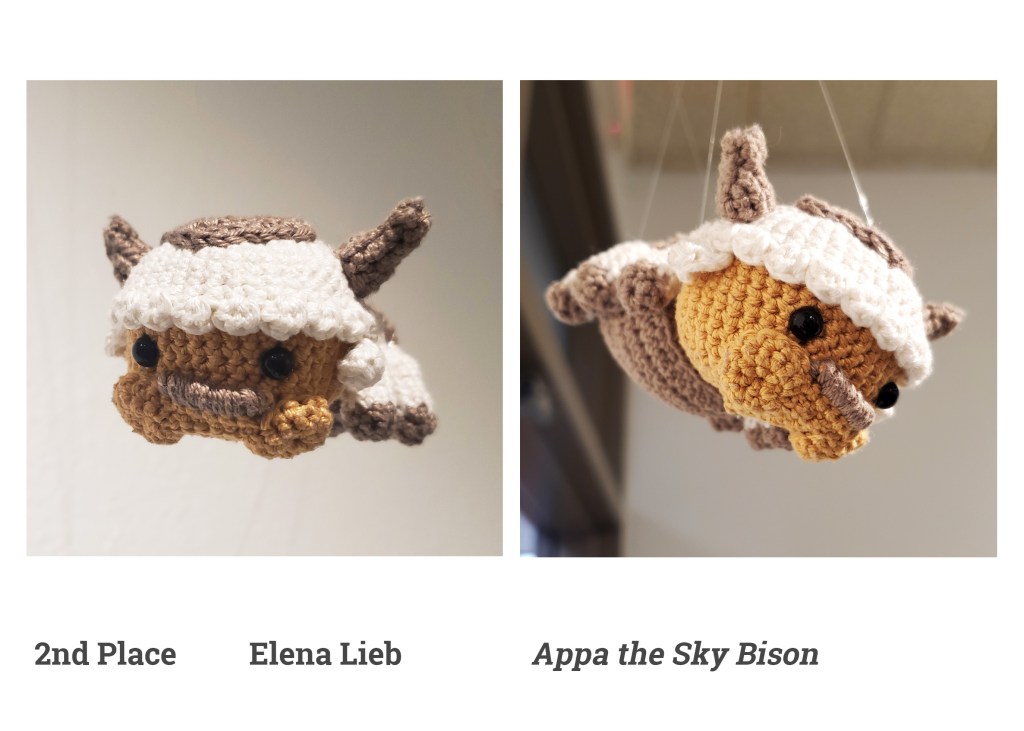
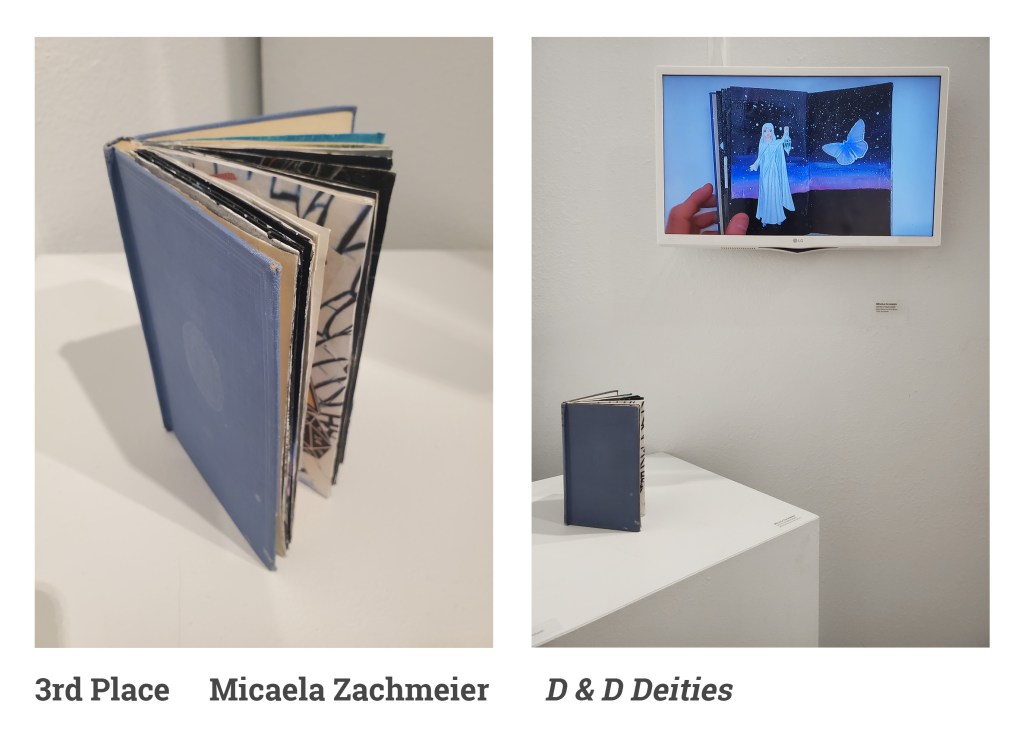
The 2021 Student Art Show at South Dakota Mines has just concluded and, while it may have gotten less attention than previous years, it was a great success. With over 50 submissions, the works demonstrated the wide variety of talents our students have. The show consisted of paintings, drawings, crochet, photography, sculpture, beadwork, mixed media collage, blacksmithing, and musical performances.
Over the last month, people who were able to visit the APEX Gallery in person had the opportunity to vote for their favorite piece.
Here are the results of our Viewer’s Choice Awards:
Congratulations to our winners and a big thank you to all who participated! And if you weren’t able to visit the Apex Gallery to see the show, you can check it out in this walkthrough video!






 The Novum