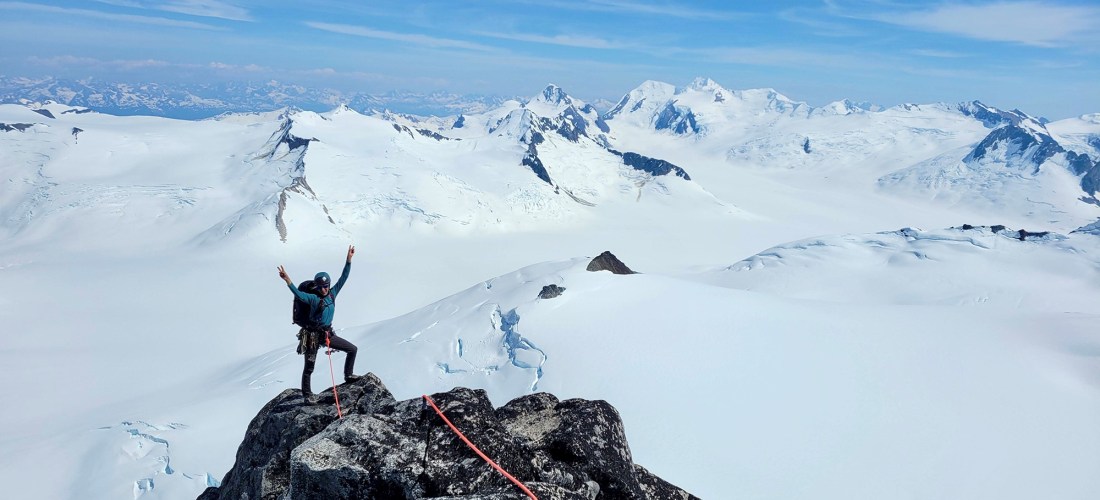
Our STS professors do cool things both inside and outside the classroom! This press release features one of Dr. Mary Witlacil’s recent climbing accomplishments.
RAPID CITY, SD (Sept. 30, 2025) – Rising nearly 9,000 feet above the Pacific Ocean, Alaska’s Devil’s Thumb is as infamous as it is remote—a jagged peak known for brutal weather, frequent avalanches, sheer ice walls and a history of turning climbers back. Few have ever stood on its summit. None had done so as an all-women team.
Until this summer.
Mary Witlacil, Ph. D., a South Dakota Mines assistant professor of political science, and her climbing partner, Sarah Malone, etched their names into mountaineering history when they conquered the mountain’s eastern ridge.
Last week, Matt Whitehead and I gave a presentation about the relationship between poetry and science for National Poetry Month as part of the STEAM Cafe series at Hay Camp Brewing. If you were not able to attend, this is a brief version of what we presented.
As members of the Humanities, Arts, and Social Sciences department, Matt and I (as Art and English faculty, respectively) spend a lot of time thinking about how to get students thinking creatively and engaging in creative projects. Given our work with the Science, Technology, & Society degree, we also work with connections between humanities/arts and science/technology, and we encourage our students to see creativity as something that they don’t do only in our classes but that is a part of their scientific and engineering work, too.
Our core question grows out of this work: What does poetry have to do with science?
The two might seem fundamentally dissimilar, belonging to different realms, but both offer opportunities to look carefully, communicate observations, make connections, and understand the world more fully – piece by piece, experience by experience.
As we begin this academic year, the Science, Technology, & Society program has plenty of news to share and exciting events coming up. Check out some of what’s been going on with us and keep an eye out for events you can attend in the coming weeks and months!
Faculty News
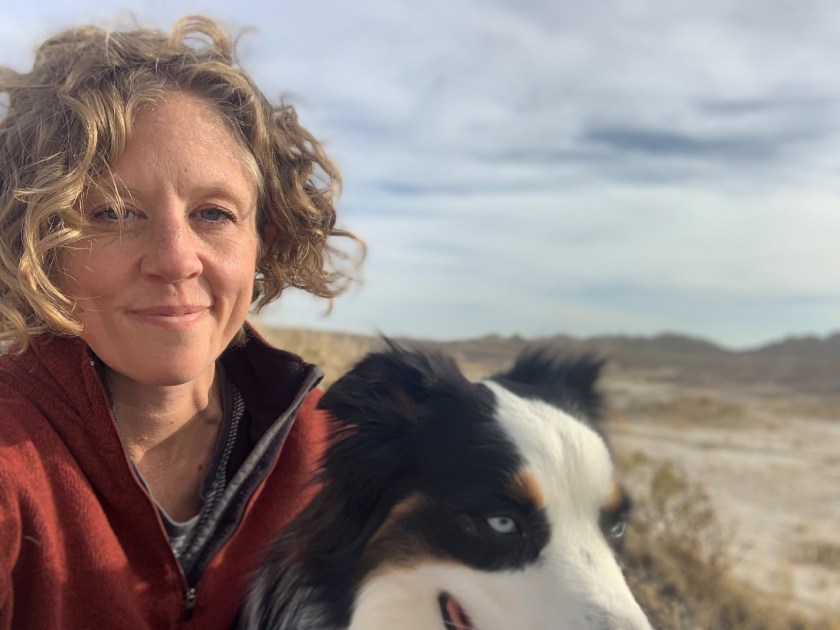
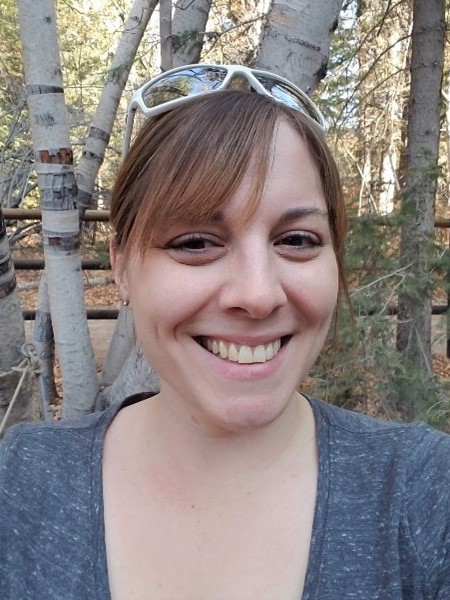
We are excited to welcome Carlie Herrick as a Lecturer in English. She has taught English classes here at South Dakota Mines for many years already and is a wonderful colleague, so we’re glad to have her take on this new position! We are also pleased to announce that Kayla Pritchard has been promoted from Associate Professor and is now Professor of Sociology.
Carlie Herrick (and dog)Kayla Pritchard
STS Program News
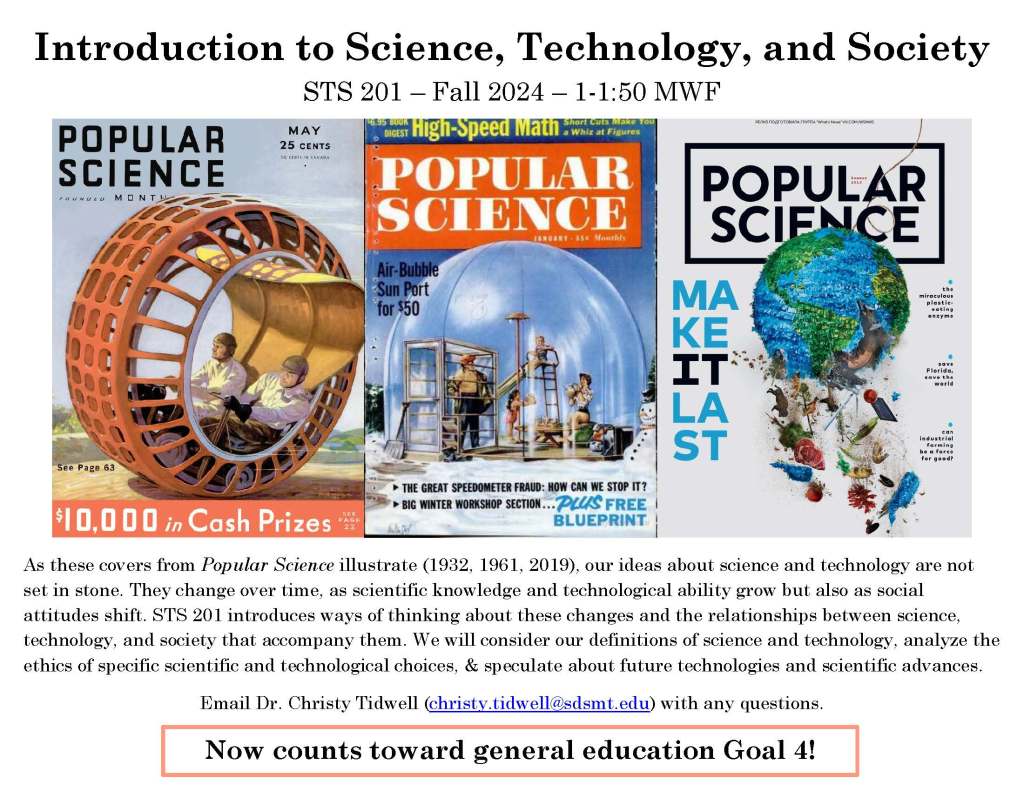
One of our core STS courses – STS 201: Introduction to Science, Technology, & Society – now counts as a Goal 4 general education course. This doesn’t change the course itself in any significant way, but it does mean that there’s now a good reason for students of all majors to take the course. The class gives students a chance to do the kind of work STS scholars do and to gain a different perspective on their own disciplines. In STS 201, students thoughtfully examine the relationships between science, technology, and society; explore the ways we define these terms and the effects of defining them in these ways; and learn about the history and ethical consequences of scientific research and technological innovations.
Upcoming Events
If you’re looking for cool things to do, STS has you covered this year! Here’s a list of upcoming events sponsored by the STS program and/or the Humanities, Arts, and Social Sciences (HASS) department. Add them to your calendar and come to as many as you can!
The Office of Student Engagement and Department of Humanities, Arts, and Social Sciences (the STS program’s home) are hosting a 2024 Local Election Forumthe evening of Thursday, September 12 (7-9 pm), in the Beck Ballroom in Surbeck Center. Come hear from local candidates, learn about ballot initiatives, and ask questions!
On Tuesday, September 17 at 6 pm, Erica Haugtvedt, Associate Professor of English, will present an introduction to George Eliot, the Victorian novel, and science as part of the university’s STEAM Cafe series. These presentations are free to the public and take place at Hay Camp Brewing Company (601 Kansas St., Rapid City).
The STS program is sponsoring a series of zinemaking events, culminating in a zinefest at the end of the fall semester. We will set up with materials, examples, instructions, and plenty of enthusiasm for a zinemaking event from 9:30-2:30 on Wednesday, September 18, on the second floor of the Classroom Building and then for another from 9:30-2:30 on Wednesday, November 13, on the first floor of the Devereaux Library. Zinefest will show off some of what has been created this semester as well as featuring some information about the history of zines, and will take place in the Apex Gallery (2nd floor of the Classroom Building) on Wednesday, December 4.
The STS program is also sponsoring an STS Book Club beginning this semester. It’s open to faculty, staff, students, and their friends and will provide a space to read and discuss books related to science, technology, and society. The first book will be Annalee Newitz’s Autonomous, a science fiction novel, but future books (to be determined by participants) may include science writing, biographies of scientists/inventors, histories of science and technology, memoirs, or other fiction addressing science. The group’s first meeting will be held in CB 334 (the Stoltz faculty and staff lounge) – Thursday, September 26 at 5 pm.
A grant-funded collaboration between South Dakota Public Broadcasting, Dick Termes, and South Dakota Mines presents an event exploring connections between art and science. The event is scheduled for Saturday, October 5, from 1-4:30 pm on the second floor of the Devereaux Library and will include a screening of parts of the new Ken Burns documentary about Leonardo Da Vinci, a talk by Dick Termes, a chance to use VR goggles to explore Termespheres, and screenprinting with Matt Whitehead (Director of the Apex Gallery and Lecturer in art) and SD Mines students. All are welcome to come check out the various parts of the event at their own pace.
Fundraising
Finally, we want to highlight a fundraising effort to support SD Mines music students. The South Dakota Mines Concert Choir has been invited to perform in the festival choir at the 2025 Salzburg International Choral Festival next summer. Choir members are raising money now to fund their trip, so if you’re able to donate, please consider doing so – it would help them immensely! This supports not only STS students and HASS faculty but students from across the university. You can find out more and donate to support their trip here.
What’s your area of expertise? What do you primarily research and/or teach? And what drew you to this field?
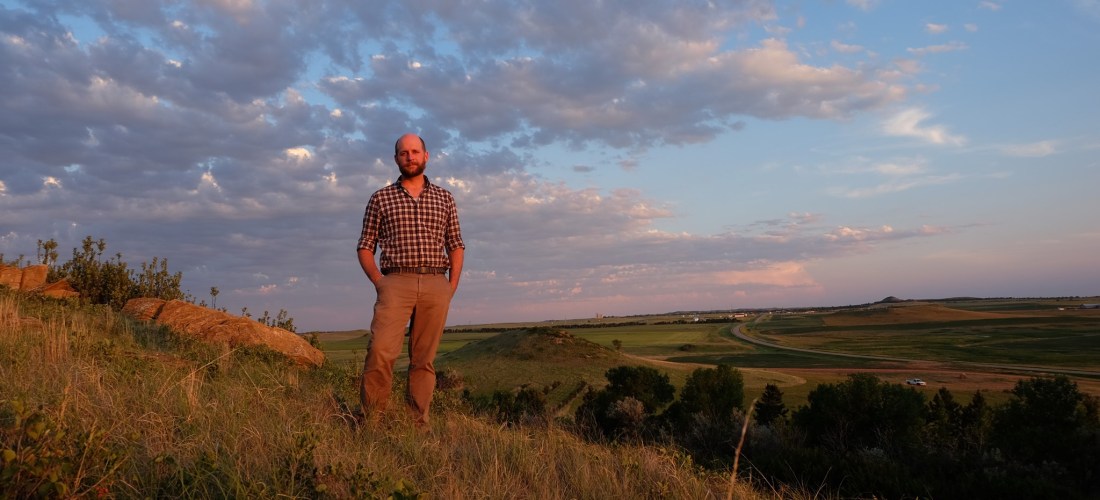
My field is rhetoric, by which I mean the study of how we use discourse (usually words, but not always) to make stuff happen. I’m mainly interested in rhetoric and space/place, especially at the regional level. A lot of my research comes back again and again to the Great Plains, maybe because it’s my home, but also because it perennially faces difficult questions about what it means to consider a place a region and how that regional identity is leveraged in civic life. These themes of place and community almost always worm their way into every course I teach.
Like a lot of communication scholars, I think I wound up in the field by accident. The nice thing about rhetoric is that you can use it as an excuse to study just about anything. My initial dissertation proposal was on ancient Irish rhetoric, but some of those same themes led me yet again to studying the Great Plains.
What’s one of your favorite courses, topics, or specific texts to teach? Why?
Over the past couple of semesters I’ve realized that I cherish teaching Introduction to Humanities. Part of it is the flexibility of the course—“Introduction to Humanities” is a broad mandate, so it gives both my students and me the opportunity to play with ideas and explore possibilities. I use the idea of “place” as a central theme of the course. We read historians, geographers, communication scholars, poets, and more, but we use the place as a locus to see how different approaches ask different questions and yield different results. All of my students have something to say about place, so it’s a great tool to make connections between fields, including STEM fields. And, of course, because it’s so broad, if I read something interesting and want to talk about it in class, it’s pretty easy to find an opportunity to make it relevant!
What’s something you’ve done that you’re really proud of?
An article I published a couple years ago was cited in a book that was just published this month. The author, a geographer, called my a piece “a thoughtful analysis,” which is about as high a compliment as I can ask for.
What is a book, movie, or another work of art or media you’ve enjoyed recently that you would like to recommend?
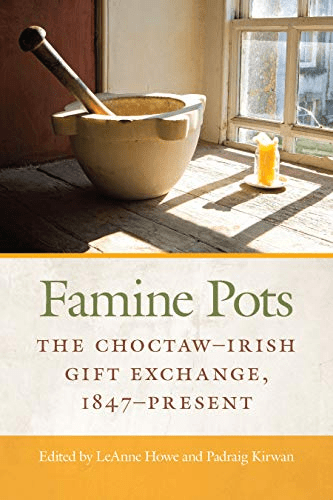
I’m just finishing a book titled Famine Pots: The Choctaw-Irish gift exchange, 1847-present. It is a series of essays, poems, and meditations on one of the most profound gifts in history: in 1847, members of the Choctaw Nation took up a collection to send to Ireland to provide relief during the Irish Famine. They ultimately sent $172 (some sources say $721), or about $5,000 today. This happened just a few years after the Choctaw were forcibly relocated to Oklahoma from their homelands in the south-eastern US, an act of ethnic cleansing commonly called “The Trail of Tears.” It’s a haunting read and raises a host of interesting questions about what connects people and places.
Tell us something about yourself outside of work. What do you enjoy doing? What’s a detail about you that your students might not already know?
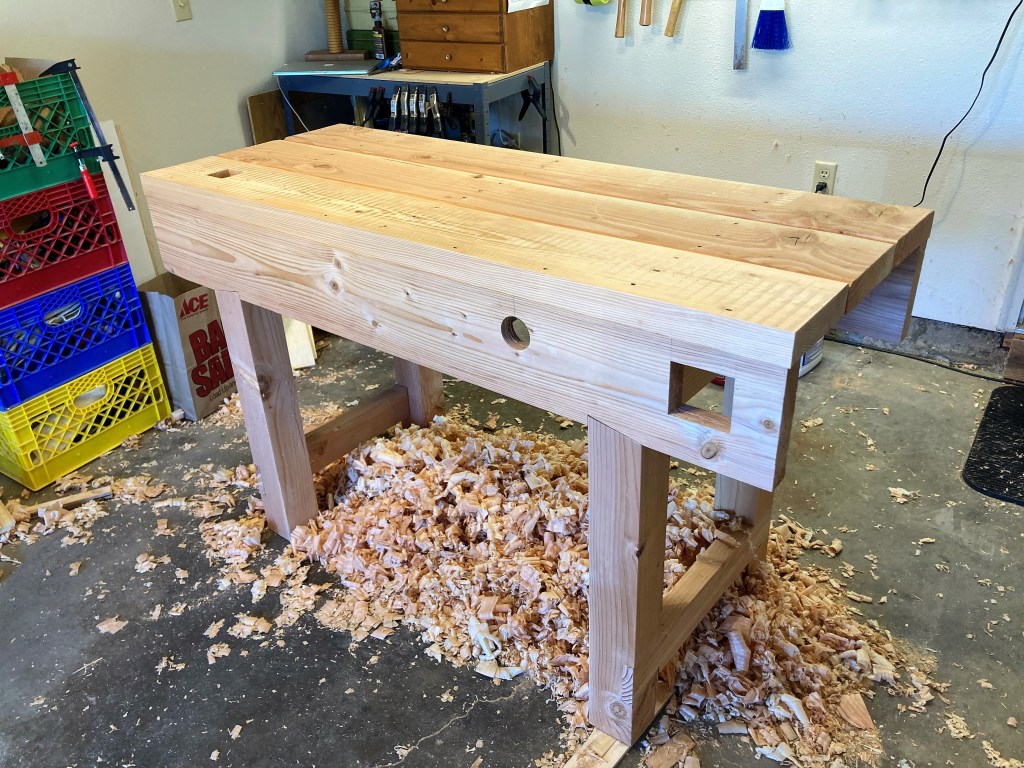
Over the past year or so, I’ve taken up woodworking, using almost exclusively hand tools. Since January I’ve been working on a traditional English-style woodworking bench, which I’ll hopefully complete by the end of this semester. It has been a good reminder that the first step to being good at something is to be quite bad at it for some time.
As the 2021-2022 academic year ends, we are looking forward to welcoming new members to the STS program in the fall, but we are also saying goodbye to a faculty member who will be greatly missed.
Happy Welcomes
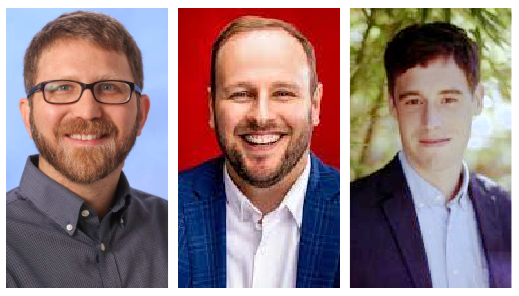
After the retirement last year of our previous department head, Allison Gilmore, and the capable leadership of Frank Van Nuys this spring, we will begin the 2022-2023 year with a new department head: Kyle Knight. He comes to us from the University of Alabama in Huntsville, where he was Associate Professor of Sociology and Chair of the Department of Sociology. He has an emphasis in environmental sociology, which will add new expertise to the STS program’s environment & sustainability track.
We also welcome two new assistant professors: Gerrit Scheepers as Assistant Professor of Music and Paul Showler as Assistant Professor of Philosophy!
We are excited to get to know and work with all of them. Look for more about and/or from each of them in the future!
Kyle Knight (left), Gerrit Scheepers (center), and Paul Showler (right)
And a Sad Goodbye
Even as we look forward to new people joining us, we are very sad to say goodbye to Laura Kremmel (Assistant Professor of English & Humanities), who has accepted a position at Brandeis University. She has been a wonderful colleague and friend for the years she has been here, and little we could write in this short space would adequately express our sadness that she is leaving. Nonetheless, we all wish her well and hope that her colleagues at Brandeis appreciate her!






 The Novum