Last week, Matt Whitehead and I gave a presentation about the relationship between poetry and science for National Poetry Month as part of the STEAM Cafe series at Hay Camp Brewing. If you were not able to attend, this is a brief version of what we presented.
As members of the Humanities, Arts, and Social Sciences department, Matt and I (as Art and English faculty, respectively) spend a lot of time thinking about how to get students thinking creatively and engaging in creative projects. Given our work with the Science, Technology, & Society degree, we also work with connections between humanities/arts and science/technology, and we encourage our students to see creativity as something that they don’t do only in our classes but that is a part of their scientific and engineering work, too.
Our core question grows out of this work: What does poetry have to do with science?
The two might seem fundamentally dissimilar, belonging to different realms, but both offer opportunities to look carefully, communicate observations, make connections, and understand the world more fully – piece by piece, experience by experience.
This semester, I am teaching a section of Connections: Humanities & Technology (HUM 200), which is one of our core STS courses as well as a general education course that students from across the university take to fulfill their humanities requirement. There are many ways to teach this course to get students to think more critically and more deeply about the relationships between the humanities and various technologies, and this particular semester’s class begins with a few weeks exploring printing technologies.
What better way to understand printing technologies than to try them out?
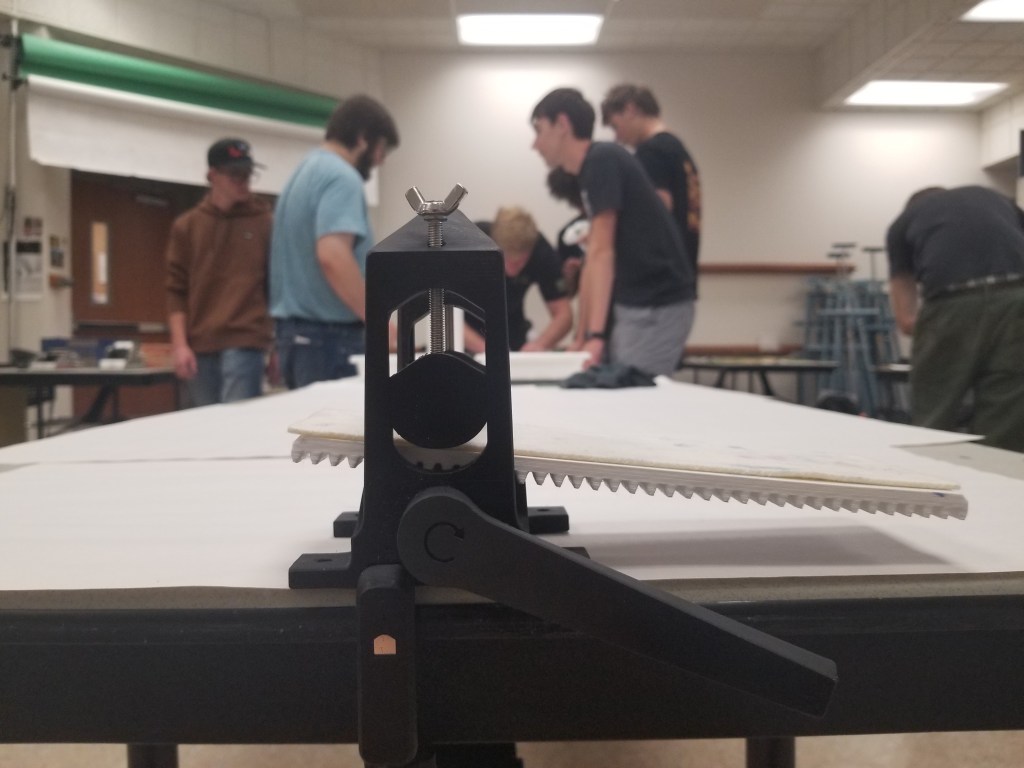
To incorporate a hands-on approach to printing in the class, I worked with our art professor, Matt Whitehead, to prepare an activity for students in the art room. We wanted to give students a chance to work with printing presses in a couple of different ways, to try using a typewriter and a Leroy lettering set, and to check out some old toy moveable type presses. These toy presses date from the 1940s and are no longer totally functional, so they were more on display than for use, but they still allowed students to get a better sense of what a moveable type printing press is like on a small scale.
A mini printing press from the Open Press Project, with students working in the background.
After a brief introduction to some basic printing techniques and explanation of what was available, students were given the freedom to explore these technologies in whatever order they wished. Some made an effort to try everything and even combined elements (the printing press with text from the typewriter or lettering set, for instance); some really focused in on one technology or technique and tried it multiple times or in multiple ways.
Frey speaking about his piece “Minesweeper World Map” (2018).
While here, Frey also visited Matt Whitehead’s Drawing class and worked with students on a poster creation project. In preparation for his visit, the class toured his show in the Apex Gallery and discussed the work and how it fit within the class’s idea of “the grid.” For the workshop, Frey started by discussing his take on the grid, which he sees as being all around us. He shared images that he took in his hotel that morning to help illustrate this. In his artwork he examines various ideas but is often looking for ways to challenge our understanding of the grid, while still working within it.
Asked to design posters for invented events and issues (using Nathaniel Russell’s fake flyer assignment described here), students invented lost animal posters with a twist, public service announcements about wearing sunscreen, warnings about birds, and much more. Many posters used similar design techniques even when their content was wildly different, illustrating how specific kinds of media (like informational posters) come with formal expectations that shape their content and presentation and connecting to Frey’s work in its focus on the idea of disrupting the social grid.
In this third entry in our women in science and technology series, we focus on women working right now and on the impacts women can continue to have into the future. Two of today’s entries deal with weather and climate, attesting to the importance of climate to our present and future; two emphasize the relationship between science and the arts; and one illustrates the potential our students here at South Dakota Mines have to build on the accomplishments of past women in STEM and to shape the future.
Katherine Hayhoe – selected by Frank Van Nuys
Canadian-born Katherine Hayhoe is a well-known figure in climate activism circles, in large part because of her down-to-earth and engaging skills as a science communicator. After completing a B.S. in physics and astronomy at the University of Toronto, she switched to atmospheric science for her M.S. and Ph.D. at the University of Illinois-Champaign. She is currently a professor of Political Science at Texas Tech University, where she also co-directs that institution’s Climate Center. In addition to more than 125 peer-reviewed publications, Hayhoe has contributed to climate change studies by the National Academy of Sciences and the Intergovernmental Panel on Climate Change. As an evangelical Christian, Dr. Hayhoe has tried to bridge the gap between science and religion, particularly on climate change. Between 2016 and 2019, she hosted and produced a PBS web series, Global Weirding: Climate, Politics, and Religion.
Nathalie Miebach – selected by Matt Whitehead
Nathalie Miebach is an artist who uses weather data to create sculptures and collaborative musical scores. In her sculptures she uses basket weaving techniques, assigning different reed thickness, colors, and other objects to specific types of weather data, often focusing on extreme weather events such as hurricanes. As she says in her TED talk, “Weather is an amalgam of systems that is inherently invisible to most of us. So I use sculpture and music to make it, not just visible, but also tactile and audible.” Science is important, but if it cannot be communicated to others and understood – both intellectually and emotionally – its importance is limited. Miebach’s work helps communicate science to a broader audience and also shows that art and science can be understood together. Learn more about her work at her site, and check out her TED talk about her art using weather data below.
Laurie Spiegel – selected by Matthew Bumbach
Laurie Spiegel (b.1945) is a computer graphics specialist who has worked at Bell Laboratories since 1973. She is also a classical composer, guitarist, and lutist. Spiegel has found a way to combine her passions through the medium of electronic music both as a composer and as a programmer. Though she is a well-known composer and performer, she is most celebrated as the creator of the program Music Mouse.
Music Mouse demonstration
Music Mouse is an “intelligent” algorithmic music composition software. With a built-in knowledge of chords use, scale conventions, and stylistic practices, the software allows the user to create real-time compositions by simply moving the mouse. Spiegel has used the software for several compositions, including Cavis muris (1986) and Sound Zones (1990).
Laurie Spiegel - The Expanding Universe (1980)
Laurie Spiegel’s revolutionary work in the field of technology has led to countless innovations. Her influence as a composer and performer, however, has propelled electronic music forward at warp speed. While science, technology, engineering, and mathematics (STEM) profoundly impact our world, Laurie Spiegel’s ground-breaking career illustrates the potential impact of arts integration (STEAM).
Kiley Westergaard – selected by Karen Westergaard
Without even knowing it, we rely on scientists for information in our everyday lives. We take products, and our scientists behind the scenes, for granted. Behind the scenes, a female scientist tests and labels our products, ensures they are safe, quality products for us to use. She’s behind that nutrition label on your food products. At her lab, she tests for the protein, the fat, the fiber, all the items on your nutrition label. She then generates the product nutritional label so that you know what you are consuming. For instance, those trending seltzers right now? She’s testing each seltzer and creating the nutritional label for each. Ever wonder how long a certain food lasts before it becomes rancid? She’d know. She tests products for that too. That’s why you have the convenience of product expiration labeling. Worried about consuming products with GMOs? She’s got that too. She tests products like corn and soybeans to determine if they are genetically modified. She’s the reason you can find products labeled non-GMO. Worried about your food containing traces of chicken, beef, pork, alligator, kangaroo, goat, or rabbit? With meat speciation, she tests to ensure the product that reaches your home is safe to consume and is labeled accurately. Ever think about who’s behind the scenes? Scientists like you. Scientists like Kiley Westergaard, Chem ’19, SD Mines.
If you missed them, check out our first and second entries in this series, too!





 The Novum