Giant Dinosaur Marionettes: Engineering Education, Art, and STS

Apex Gallery, art, Events, teaching

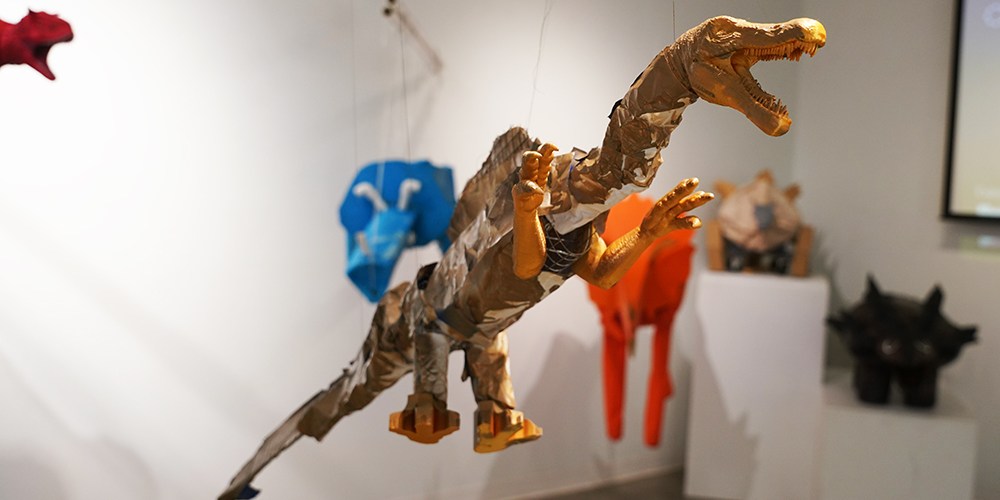
Sometimes people assume that engineers aren’t creative, but this is far from the truth, as the current Apex Gallery exhibit of dinosaur marionettes shows. In his introduction to mechanical engineering course, Dr. Cristian Vargas Ordóñez (in collaboration with Matt Whitehead, Senior Instructor of Art and Director of the Apex Gallery) asked students work in teams to use the engineering concepts they were learning to create and present large dinosaur marionettes.

This project shows what’s possible within engineering education and at the intersection of arts and engineering. It’s also a great illustration of a core principle of STS, which attends to how knowledge is created. Javier Lezaun, Noortje Marres, and Manuel Tironi write that “the larger aim of STS research and intervention . . . [is] to activate new collective imaginations of what an epistemically, technically, environmentally and materially engaged polity might be.” Working together as teams to create something new is a version of this aim at the scale of a college classroom, and it’s good practice for STS thinking and for working creatively with others in other areas! (Our Creativity and Collaboration in STEM minor further reinforces these connections.)

More details about the art exhibit are included in the press release below, and the marionettes will be on display in the Apex Gallery this week, with a reception this afternoon (Wednesday, 11/19) from 4-6 pm.


Art Exhibit Features Giant Dinosaur Marionettes Designed by Mines Mechanical Engineering Students

RAPID CITY, SD (Nov. 19, 2025) – South Dakota Mines mechanical engineering students brought engineering and imagination together to build large dinosaur marionettes, each one crafted with a variety of materials ranging from papier-mache and fabric to metal and 3D printed parts and designed with at least two movable parts.

The creatures are now on display in the Apex Gallery in the university’s Classroom Building. The project is part of the freshman introduction to mechanical engineering course taught by Cristian Vargas Ordóñez, Ph.D., assistant professor in the Leslie A. Rose Department of Mechanical Engineering.

Dr. Vargas Ordóñez in the Apex Gallery with the dinosaur marionettes.

How to Look at the World: Poetry, Science, and Creativity

art, Events, Humanities, Poetry, STS Faculty

By Christy Tidwell

Last week, Matt Whitehead and I gave a presentation about the relationship between poetry and science for National Poetry Month as part of the STEAM Cafe series at Hay Camp Brewing. If you were not able to attend, this is a brief version of what we presented.

As members of the Humanities, Arts, and Social Sciences department, Matt and I (as Art and English faculty, respectively) spend a lot of time thinking about how to get students thinking creatively and engaging in creative projects. Given our work with the Science, Technology, & Society degree, we also work with connections between humanities/arts and science/technology, and we encourage our students to see creativity as something that they don’t do only in our classes but that is a part of their scientific and engineering work, too.

Our core question grows out of this work: What does poetry have to do with science?

The two might seem fundamentally dissimilar, belonging to different realms, but both offer opportunities to look carefully, communicate observations, make connections, and understand the world more fully – piece by piece, experience by experience.

Zinefest: World-Making, Creativity, & Technology

Apex Gallery, Arts, Classes, communication, Events, Humanities

By Christy Tidwell

“[Zines] are practices of ‘poetic world-making’—poetic not in the sense of a poem on the page (although they can be this too),
but in the sense of poesis: the process of creating something that did not exist before.” 
– Gwen Allen

The classes I teach create communities. Students get to know each other as they learn the course material, and they share ideas and work with each other. This is a form of world-making, even if temporary, and I love this about my classes. But I don’t want the connections and sharing to stop at the classroom door or to be forgotten when the semester ends. The goal is for my students to connect what they’re learning in class with the rest of the world, to share what they’ve learned with others, to hear what others have learned, and to join and build other communities.

Finding ways to do this can be challenging, but it’s not impossible.

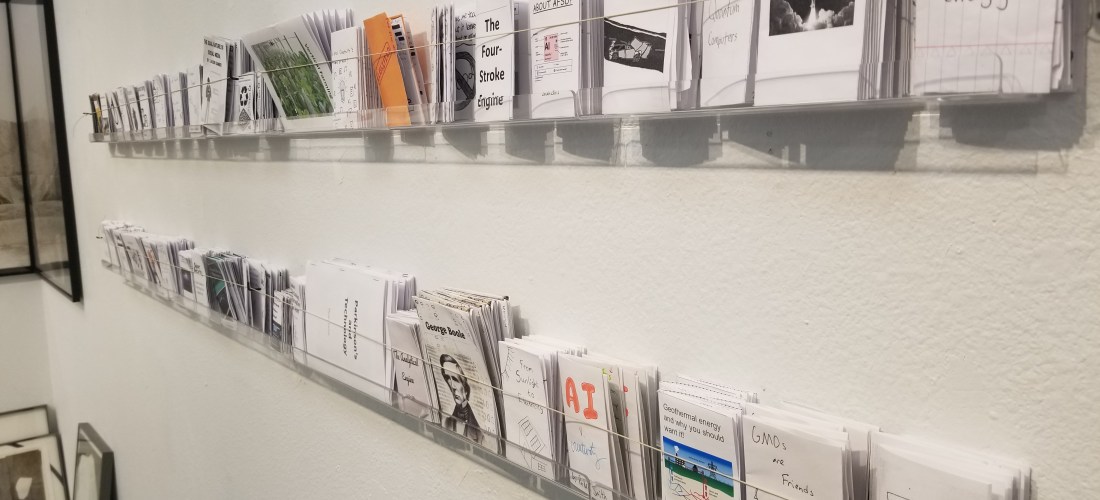
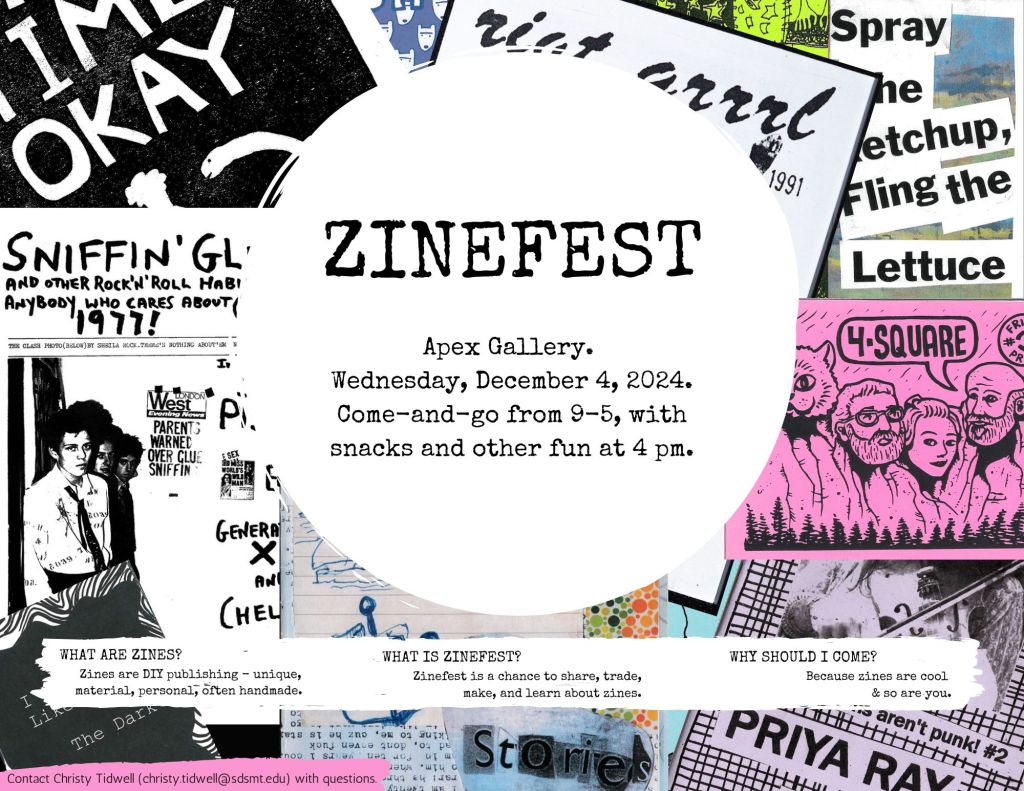
This semester, as a way for students to connect across classes and share work with broader audiences, a few of us in the Humanities, Arts, and Social Sciences department (myself, Matt Whitehead, Evan Thomas, Erica Haugtvedt, and Mary Witlacil) put on a series of zinemaking events that culminated in a Zinefest in the Apex Gallery on December 4th. Zinefest was an all-day come-and-go event that displayed the zines students made in classes (and, in a few cases, just for fun!), provided some examples of interesting zines made by others, and gave visitors a chance to make their own zines. (If you missed it this year, watch out for another event next year!)

This event let students share some of what they have learned this semester, giving them a broader audience, and it also connected them to students in other classes and to the audiences who came to Zinefest. While I did not count the number of visitors during Zinefest, the gallery filled several times and was rarely empty. Some people walked through relatively quickly and took in only a few zines; others stayed for quite a while, standing and reading multiple zines before finally deciding on some they wanted to keep. One student – who will remain nameless for obvious reasons – wrote in a reflection afterward, “I spent almost 2 hours there and accidentally missed class, so I would say I had a good time.” Although I would (of course) never encourage a student to miss class, this indicates that Zinefest offered this student something meaningful.

Because most students were asked to bring multiple copies of their zines, visitors could take a copy of one if they were particularly interested in its ideas or really loved it. Hopefully, they will re-read any zines they took, remember the event, and maybe even be inspired to make their own! Leaving with a material artifact helps the experience and community created through this event extend past Zinefest itself.

Two rows of zines displayed on the wall, with a handwritten sign above them: See a zine you like? Feel free to take it. Just don't take the last one! Thanks for stopping by.
Student zines on display with an invitation to take a zine.

As an event, Zinefest promoted connections and community; as a practice, making zines (even without an event like Zinefest) provides us all with an opportunity to create something new – to engage in world-making – and to share that something with others, without requiring elaborate technology or infrastructure, refined skills, or many resources. Anyone can make a zine, and that’s what’s so beautiful about them.