By Alexa Roth
Colorado experiences dozens of tornadoes every year, but despite this number there have been very few tornadoes rated EF-3 or higher In fact, many of these tornadoes are quite different than what many people might think of when they hear “tornado.” People may associate tornadoes with just the tornadoes that are connected with supercells; however, there are also tornadoes that are connected to non-supercell storms.
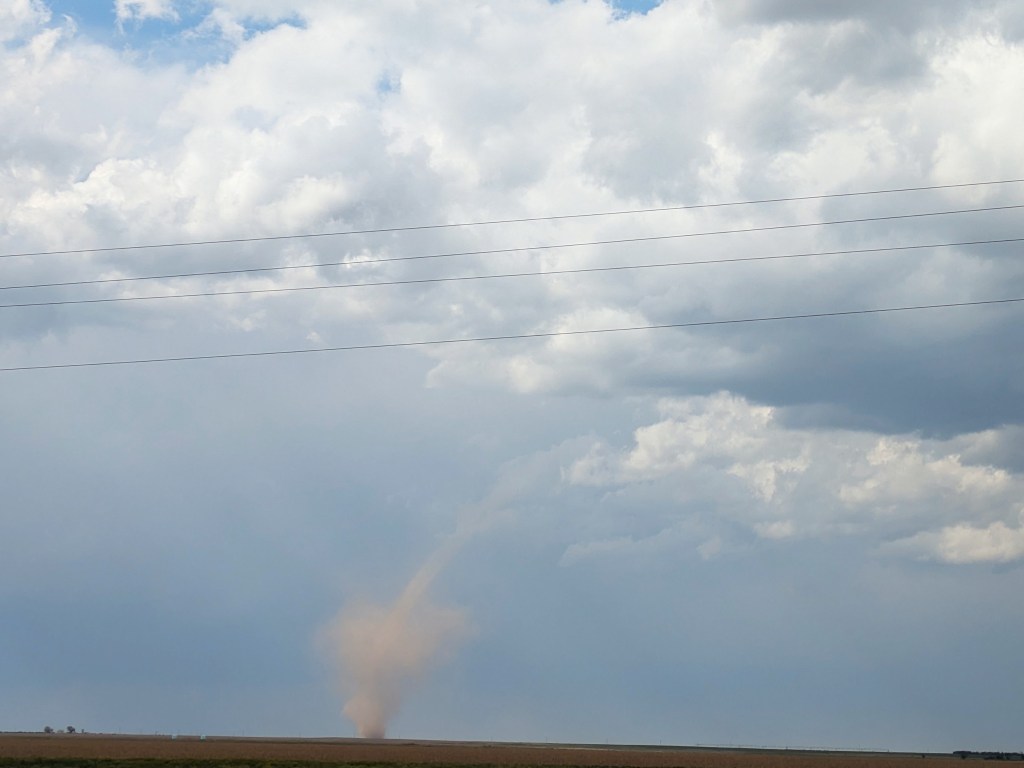
Sometimes these non-supercell tornadoes are referred to as landspouts. Landspouts are most common in Wyoming and the plains of Colorado. Despite being associated with a non-supercell parent cloud, these landspouts can produce strong winds and EF-2 and EF-3 damage. Tornadoes rated a 2 or 3 on the Enhanced Fujita scale indicate considerable levels of damage. Many of the areas in Colorado that are affected by landspouts are rural, farm communities, but the increasing population in Colorado leaves more people vulnerable to these systems. Colorado’s unique geography and location create unique conditions in the atmosphere. The Front Range in Colorado is associated with the Denver Convergence-Vorticity Zone, a region of convergent winds that result from winds near the ground interacting with an east-west ridge called the Palmer Divide. This convergence-vorticity zone affects the production of non-supercell tornadoes.
In my research, I am looking to study what conditions distinguish the days of supercell tornado production from days of non-supercell tornado production along the Front Range in Colorado, with the goal of better understanding the factors that distinguish the two. This will help improve forecasting both supercell and non-supercell related tornadoes.
Sources:
“Denver convergence-vorticity zone.” American Meteorological Society, https://glossary.ametsoc.org/wiki/denver-convergence-vorticity-zone/.
“Non-supercell Tornadoes.” National Weather Service, https://www.weather.gov/spotterguide/non_supercell.
“U.S. Tornadoes.” NOAA, National Centers for Environmental Information, https://www.ncei.noaa.gov/access/monitoring/tornadoes/climatology.
Bio:
My name is Alexa Roth, and I am currently a senior Atmospheric and Environmental Science major, specializing in meteorology. I have always had a fascination with observing and understanding the natural world. This led me to meteorology. I love how well-rounded the field is in many subjects: math, science, communication, among others. I enjoy applying the math and science concepts to real-world scenarios that have very real impacts on people. I am pursuing a career with the National Weather Service. I feel this is where I can best combine my skills and passions for science, weather, and people. In my free time I love picking up new crafting hobbies, but my primary hobby that I return to is cooking and baking for others.


