By Gerrit Scheepers
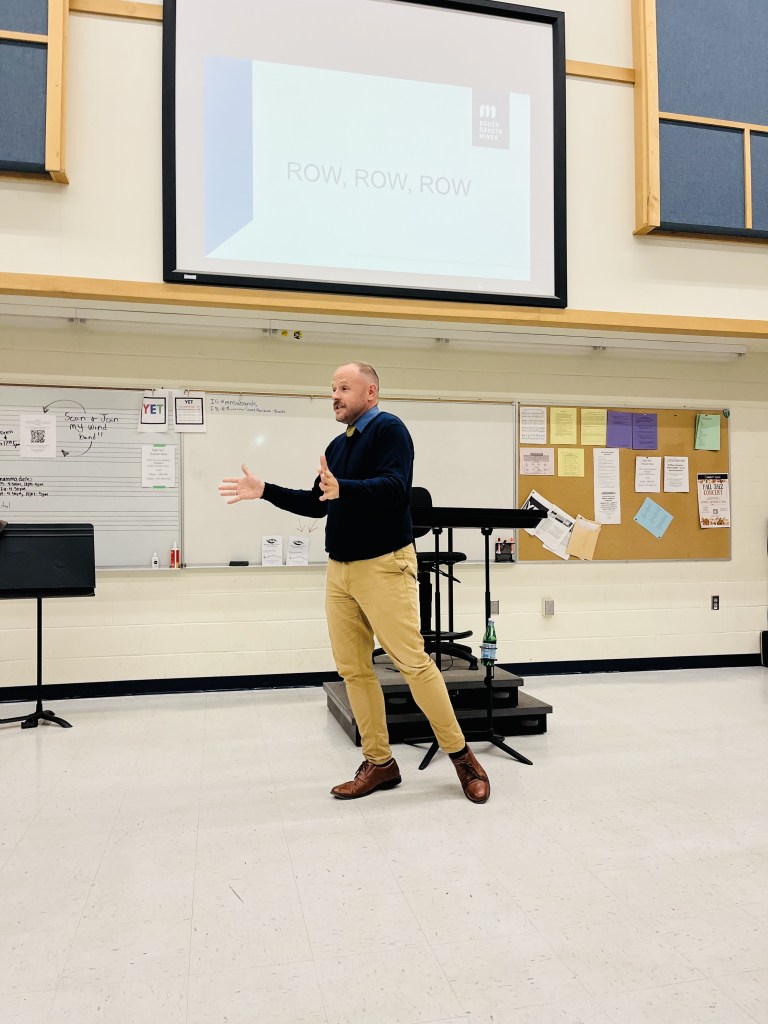
This past week, my colleague and friend Dr. Elisabeth Cherland invited me to serve as an Artist-in-Residence at Minnesota State University, in Mankato, MN. During my time on campus, I had the opportunity to give a guest lecture in a music education course and to work with two of the university’s choirs – the Concert Choir and their Chamber Singers.
It was a wonderful few days filled with music, conversation, and some particularly insightful discussions about how we communicate as conductors and educators. What made the experience especially meaningful was the chance to move back and forth between the classroom and the rehearsal room. In one space, I taught future music educators about conducting and communication. In the other, I put those same ideas into practice with the choirs.
This experience got me thinking about something I have witnessed countless times throughout my career: the remarkable moment when a room full of individual people suddenly become one.
When the Room Becomes One
There is a moment in every choir rehearsal when a room of individuals suddenly become one. I stand in front of the choir, raise my hand, take a breath, and wait. Forty singers are looking at me. Some are watching my hands; others are watching my face. They are listening to one another, feeling the pulse, reading the music, and waiting for some indication that it is time to begin. Then, I move. With an intake of air and an output of sound, they sing as one, a synchrony. It is such an ordinary moment in a choir rehearsal that it can often wash over me. But being with the MSU choir students reminded me of the magic of this synchrony – one I have experienced countless times as a conductor and teacher and continue to witness in my current role at South Dakota Mines, where music brings students together in meaningful and transformative ways. I also experienced this with Dr. Cherland on the podium this past week. She was pure magic with her students. I could tell they adore her.
If I am not careful, this synchrony can pass me by. But the more I conduct or teach about conducting and communication, the more remarkable this ordinary moment of becoming one seems to me. How is it that a gesture of one person’s hand coordinates the voices, breath, attention, and bodies of an entire group of people? During my time as Artist-in-Residence at MSU, I considered this question from several angles. What became increasingly apparent to me was that conducting is a form of communication that depends on much more than the conductor.
The Technology of a Raised Hand
The sign of the conductor’s raised hand does not inherently mean the choir should prepare to sing. A particular movement does not naturally communicate “softer,” “more energy,” “wait,” or “begin.” These gestures have meaning because musicians have learned how to interpret them. Over years of lessons, rehearsals, performances, and participation in musical communities, singers develop a kind of embodied knowledge. They learn not only to read music, but also to read people. They learn to recognize subtle changes in posture, facial expression, breath, gesture, and timing. Eventually, this knowledge becomes almost instinctual.
As I prepared for my lecture at MSU, this realization inspired me to think about conducting as a technology. Having spent the past four years of my career working in a STEM school, I typically encounter the word “technology” as a descriptor for things that are electronic, mechanical, or digital. But if we consider technology more broadly, as a way of organizing human activity, the conductor’s gesture begins to look like a technology of communication. The word technology comes from the Greek words tekhnē, meaning art, skill or craft, and –logia, meaning a study of, or discourse about. It also traces back to the Proto-Indo-European root teks-, meaning “to weave” or “to fabricate.” A conductor weaves together sounds to tell a story. A gesture allows one person to coordinate the actions of many without having to verbally explain every musical decision. Yet the gesture itself is not enough.
More Than the Hand
The concept of a conducting gesture works because an entire system surrounds it: the musical score, the trained bodies of the singers, the conventions of musical performance, the acoustics of the rehearsal space, the visual relationship between conductor and ensemble, and the shared expectations of everyone involved. Change any of these elements, and the communication changes.
An ensemble that understands one conductor’s style may respond differently to another conductor – and that was exactly the case with both the Concert Choir and Chamber Singers at MSU. Of course, Dr. Cherland has a different posture, physical presence, and conducting style than I do. As a result, even though her students were highly experienced musicians, they responded differently to my gestures when I got in front of the ensemble. That difference was not a failure of communication on anyone’s part: it was evidence of just how contextual a conductor’s communication actually is. A group of experienced singers often respond to the smallest movement, while beginning musicians might require something much more visually explicit.
The technology, in other words, is not simply the hand. It is the hand, the people watching it, the knowledge they bring with them, the space they occupy, and the social practices that have taught them what each gesture means. And the communication is not actually one-way, but of course a reciprocal act. From the front of the room, I might think I am telling the choir what to do, but the choir is constantly telling me things, too. Their sound lets me know whether my gesture was clear or confusing. Their breathing tells me whether the tempo is comfortable or too fast. Their faces and bodies tell me whether they are with me or struggling to follow. I adjust, they respond. They adjust, I respond. The distinction between communicator and receiver begins to break down. A synchrony.
And Then We Breathe Together
This is where I think my work as a musician intersects in fascinating ways with the work of my colleagues in the Science, Technology, and Society degree at South Dakota Mines. STS asks us to look closely at systems we often take for granted – to ask how knowledge is produced, how technologies shape human behavior, and how people and technologies work together. A choir rehearsal is a surprisingly rich place to consider those questions. Who has the authority to decide what a musical gesture means? How does someone become an expert at interpreting that gesture? How is knowledge transmitted when much of it cannot easily be put into words? How do bodies, tools, spaces, and institutions work together to produce something that none of them could produce alone?
Over the last couple of months, these questions have changed the way I think about my own teaching. When I teach a future music educator how to conduct, I am not simply teaching a collection of hand movements; I am helping them learn norms for communication. They are entering a community with its own technologies, conventions, forms of expertise, and relationships of authority. They are learning how to participate in a practice that is simultaneously physical, intellectual, social, and musical. One of the things I treasure most about opportunities like my experience in Mankato is the chance to return to the work of teaching conducting.
My current role at South Dakota Mines has been an incredibly rewarding opportunity to engage engineering students in ways that are meaningful, intellectually stimulating, and personally fulfilling. Although my work now offers fewer opportunities to teach aspiring conductors and future music educators directly, my passion for conducting and music pedagogy continues to shape my approach to teaching and learning. Reflecting on my experiences with music students has reaffirmed how much I enjoy helping aspiring conductors move beyond technique to discover the musical insight, artistic intention, and communicative purpose behind each gesture. These experiences have also strengthened my belief that meaningful teaching extends beyond clear instruction; it requires careful observation, thoughtful communication, and a willingness to respond to the needs of individual learners.
I see these same principles reflected in my work with engineering and science students, who are learning to interpret information, collaborate effectively, and navigate complex ideas. In many ways, my current role has deepened my appreciation for the lasting influence of my background in conducting and music education. It has allowed me to carry the teaching principles I value most into a new academic setting while continuing to foster the curiosity, communication, and personal growth that have always been central to my approach to teaching.
I am grateful for the ways my work with engineering students continues to challenge and inspire me, while my enduring interest in conducting keeps me curious about the many ways we can help students connect what they do with why it matters.
The final product is sound, but the process is profoundly social. A group of people learn to watch, listen, anticipate, respond, adjust, and trust. A tiny gesture can coordinate dozens of bodies, but only because those bodies have learned together what that gesture means. This is something I recognize not only in conducting but also in the classroom, where communication and learning depend on our ability to notice one another and respond in meaningful ways. So when I raise my hand at the beginning of a rehearsal – even with a group of students I have never conducted before – I am doing more than giving a cue: I am activating a technology of collective action, one built not from wires or screens, but from bodies, knowledge, trust, and shared experience.
And then, for a moment, they all breathe together.

