By Joshua Rowe
Since I was a kid, I have always had an interest in coastal weather. I saw the Pacific Ocean for the first time when I was four years old, and I was in awe of the immense size and natural harmony of the ocean. What sparked my interest in research in this field was the recent global change in tropical cyclone intensity. The warming of the oceans globally has led to an increase in the proportion of intense hurricanes (Holland, 2013). This struck me as immensely important because of the catastrophic impact that tropical storms can have on the lives and properties of anyone living in a coastal region. It is estimated that the average tropical storm in the US causes between seven and eleven thousand deaths per storm, and tropical storms have accounted for between 3.6 to 5.2 million deaths since 1930 in the U.S. (Garthwaite, 2024).

The United States is no stranger to tropical storms, and their unpredictability and aggression makes them a daunting task for coastal meteorologists to forecast. Hurricanes are formed as a result of a large amount of water vapor condensing and circulating over warm oceanic areas (Holland, 2014). When water vapor condenses into clouds, it releases large amounts of latent heat, which contributes to the available convective energy in the atmosphere. As the sea surface temperatures rise, the amount of evaporation over the ocean increases and subsequently the amount of available water vapor increases as well. This rise in available water vapor allows for more condensation and latent heat release, which creates a positive feedback relationship that is theorized to be the cause for the increased frequency, intensity, and location of intense hurricanes (Lackman, 2011).
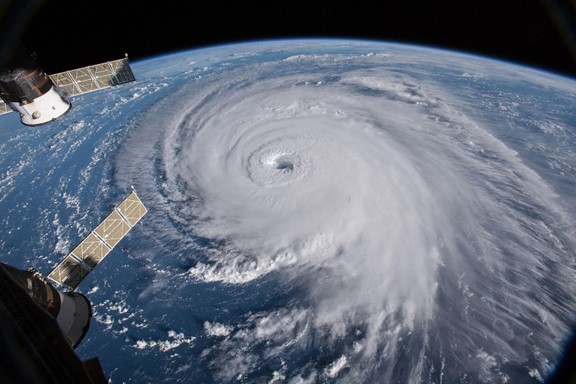
One phenomenon that hurricanes commonly experience is something called an Eyewall Replacement Cycle (ERC). For a hurricane to be able to experience an ERC, two conditions must be present: the inner eyewall reaches peak wind speed and the presence of a Secondary Outer Eyewall, which is theorized to be formed by strong rising motion outside the Inner Eyewall. The image below shows an example of the structure and features of a Tropical Cyclone. During ERC, the storm is forced to slow down and experience a period of weakening to replace the inner eyewall and begin the re-intensification process (Sitkowski, 2011). This is important because during these replacement cycles the winds slow down significantly, so they provide a moment of reprieve for people who are impacted by the hurricane.

Most recently, Hurricane Milton experienced an Eyewall Replacement Cycle a few hours prior to reaching landfall, which reduced the wind speeds from 160mph down to 120mph and brought the storm from a Category 5 to a Category 3. This reduction in winds and storm intensity reduces the amount of time needed for recovery in an affected area. Power outages last for a few days to weeks after a Category 3 storm, compared to several weeks to months after Category 5 (National Weather Service Melbourne, 2024).
In my capstone, I seek to understand the atmospheric conditions necessary for Secondary Eyewall Formation and the climatological changes in those conditions over time. I will be looking at the decadal change in the oceanographic conditions that are relevant to hurricane propagation and eyewall formation. To identify the conditions within hurricanes and to analyze the changes over time, I will be using the Ideal Best Track Archive for Climate Stewardship (IBTrACS). This international database has the most complete collection of tropical cyclone data available. This database has recorded data for all active and past hurricanes since 1985, like pressure, wind speeds, and distance from landfall. The database also includes shapefiles that I can use to provide additional visual modeling. I will be using this data in conjunction with satellite imagery and atmospheric soundings. Atmospheric soundings are collections of sampled atmospheric conditions measured by weather balloons like temperature, relative humidity, wind speed/direction, and mixing ratio which can help give a vertical profile of the atmosphere.
Eyewall Replacement Cycles (ERC) can only occur once secondary eyewall formation is achieved, and it is important to understand this topic so that the people impacted by these storms can have a better understanding of the magnitude of the storm’s impact. In ideal cases, an ERC just before the tropical storm reaches land can lead to far less damage than initially forecast for a powerful storm. With the already present rise in hurricane intensity accompanying climate change, it is important to understand the mechanisms of Secondary Eyewall Formation so that forecasters can more accurately predict the possibility of an ERC in real time while a storm is developing.
The anthropogenic warming in the global climate may have a noticeable impact on the mechanisms necessary for Secondary Eyewall formation. It is important to identify the role of climate change in this phenomenon because the global climate outlook is constantly evolving, hurricane intensification is a rapidly growing issue globally, and further climate findings will give credence to the importance of emission reduction. If forecasters could have a better understanding of ERCs then state and federal emergency management organizations like FEMA will have better impact-based decision support and can provide better response to affected areas.
References
- Garthwaite, J. (2024). Study links hurricanes to higher death rates long after storms pass. Stanford Report. https://news.stanford.edu/stories/2024/10/study-links-hurricanes-to-higher-death-rates-long-after-storms-pass.
- Holland, G., & Bruyère, C. L. (2014). Recent intense hurricane response to global climate change. Climate Dynamics, 42, 617-627.
- National Weather Service Melbourne, FL (2024). Hurricane Milton Impacts to East Central Florida. National Weather Service. https://www.weather.gov/mlb/HurricaneMilton_Impacts.
- Sitkowski, M., Kossin, J. P., & Rozoff, C. M. (2011). Intensity and Structure Changes during Hurricane Eyewall Replacement Cycles. Monthly Weather Review, 139(12), 3829-3847. https://doi.org/10.1175/MWR-D-11-00034.1
 The Novum
