2025 SURF Artist in Residence Showcases Interactive Sculptures at Mines APEX Gallery

Apex Gallery, art, Events, Guest Speakers

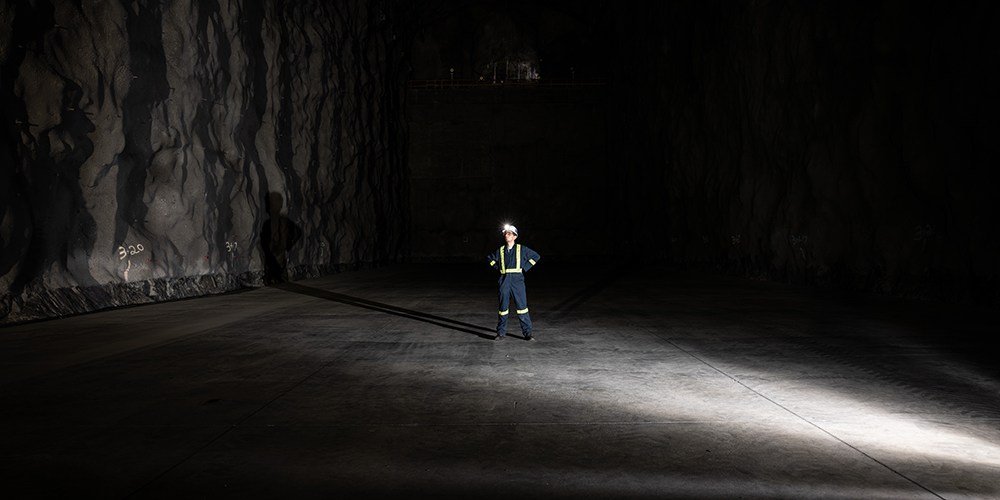
Last summer, Washington, D.C.-based artist Chris Combs swapped his urban studio at the Otis Street Arts Project for one that required a 10-minute open-cage elevator ride, personal protective equipment, and a brass tag etched with his name, indicating his presence nearly a mile underground.

As the 2025 Artist in Residence (AiR) at the Sanford Underground Research Facility (SURF), Combs brings his unique experience to life through an interactive exhibition at the South Dakota Mines APEX gallery. The exhibition opens with a reception from 4:30 – 6:30 p.m. on Friday, Jan. 23.
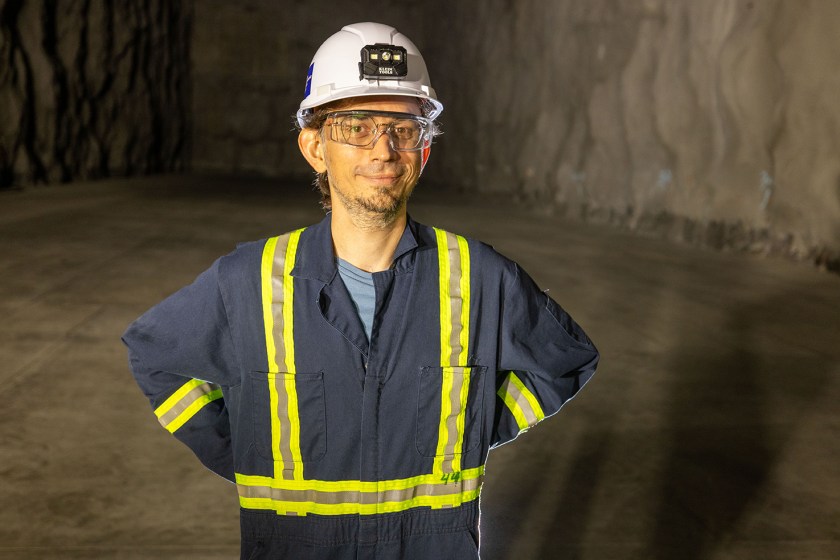
Photo credit: Matt Kapust, SURF

The show will feature interactive, time-based sculptures crafted from found objects, metal, wood and other industrial materials—many of them salvaged during Combs’ time at the Sanford Underground Research Facility (SURF) in Lead. By weaving discarded materials into his work, he aims to echo the layered history of the Homestake Mine and its evolution into a world-class underground laboratory, a dual legacy that drew him to apply for the SURF AiR program.

“I wanted to see firsthand the machinery of particle physics, and the human ‘machinery’ that constructs and maintains it nearly a mile underground in a dusty former gold mine with flood-marked walls,” Comb said. “In my art, I think a lot about how technologies have changed our world, and Homestake/SURF is two rounds of that: first, the transformation of a mountain into 370 miles of tunnels and drifts, and then the transformation of that mine into a container for globe-spanning experiments. The idea of astrophysics occurring a mile underground was very intriguing.”
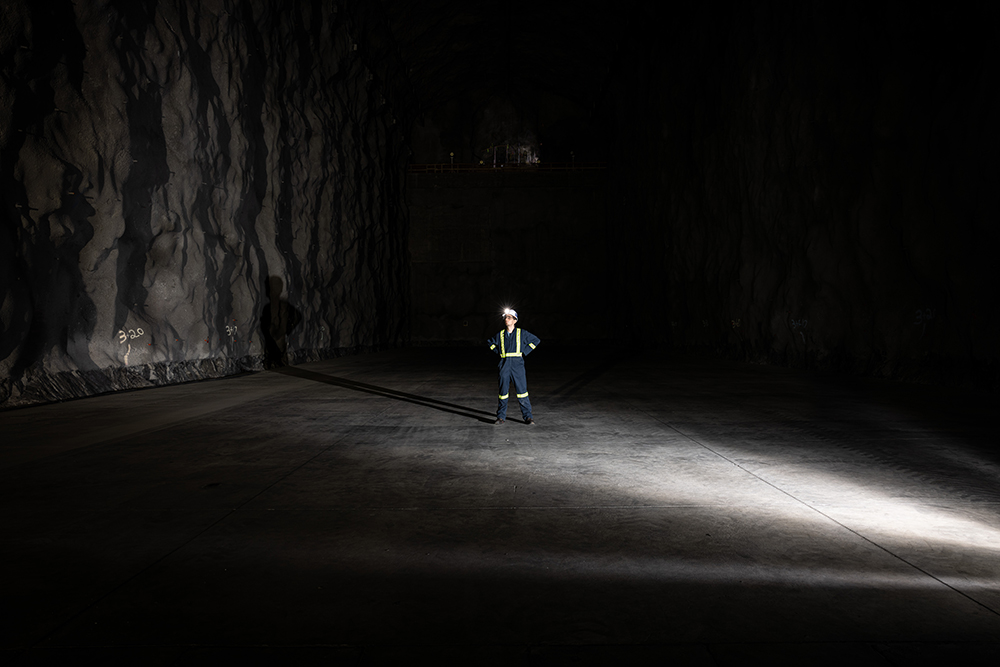
Photo credit: Stephen Kenny, SURF

Combs creates his pieces with the goal of having audience interaction. “I am lucky to get to make interactive artworks, where pushing a button or inserting a metal ball makes something happen,” he said. “At least for me, actively participating helps me remember it later. This extra little conversation between an artwork and its viewer also offers a challenge and a reward: do you dare to touch the thing? If so, here is an unexpected result. I hope that my artworks reward your curiosity.”

The Influence Arts-Based Instruction May Have on STEM Students

STS Students

By Elizabeth Benzmiller

Elizabeth Benzmiller is a senior in the Science, Technology, and Society: Policy & Law Major.  Throughout her time as a student at South Dakota Mines, she studied abroad in Limerick, Ireland, participated and held leadership roles in student organizations, and interned at the South Dakota Legislature and Raven Industries/Viaflex, Inc.

I was raised by two polar opposite parents. One chose a STEM career, worked in healthcare and laboratories, and was a very analytical and logical thinker. The other was a professional artist, singer, ballroom dance instructor, writer, and more. Growing up, I was able to see first hand how a STEM professional and an artist communicate and view the world very differently! One parent was a logical, straight to the point teacher who learned from a textbook and lectures, while the other was a creative, adventurous, empath who learned through experiences in their life.  

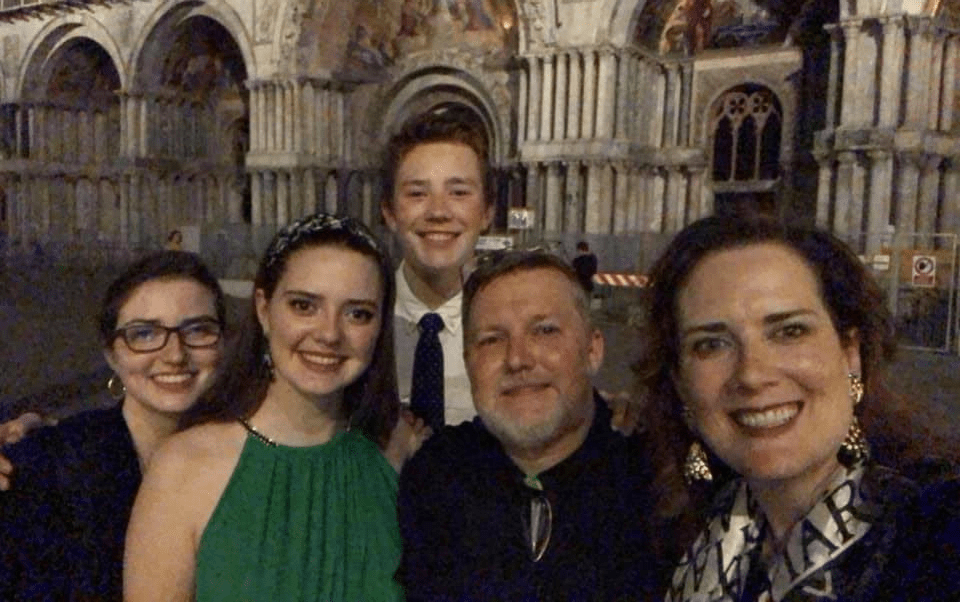
Photo of Elizabeth and her family.
This is my family in Italy, while we were visiting my sister while she performed in an opera. She did this before she graduated college with a degree in Computer Science and Data Analytics. From left to right, Sonya (older sister), Elizabeth (myself), Vincent (younger brother), James (father), and TracieLea (mother).

I was taught the importance of the arts and STEM from a young age and told I didn’t need to choose between the fields. From a young age, I was playing instruments, singing in proper form, reading like a true bookworm, and looking for any opportunity to get crafty and creative. We would have Craft Thursdays and Field Trip Fridays, exploring museums and historical centers, trying new things, and seeing the world from a new perspective each week. At the same time, I was encouraged to ask questions, research the world around me, explore nature and get my hands dirty.  I could build rockets, play with Legos, and learn how to use a microscope. I could travel the world and see new sights, cultures, and experience new things.

Every day, I was encouraged to explore my passions and be a lifelong learner. I didn’t have to choose between the Arts and STEM, and I was a more well-rounded individual because I could do both. I eventually decided to study in a STEM-field, but I never wanted to lose my grasp on influences that the arts had on me and I wanted to explore their interactions with the scientific community. This led me to my senior capstone project researching the influence and impact that arts-based instruction has on engineering and STEM undergraduate students. 

Protesters holding up a homemade sign saying "Science is the poetry of reality."

Poetry & Science: Connections

Poetry

By Christy Tidwell

April is National Poetry Month, and although people may not always think of poetry and science together, a wealth of poetry exists that addresses science, technology, and various STEM topics.

In his 2006 poem “Science” (read full poem here), for instance, Robert Kelly writes that “science is the same as poetry / only it uses the wrong words.” Science and poetry are both ways of looking carefully at the world, expressing those observations, and helping us all understand the world more fully – piece by piece, experience by experience.

Kelly also writes that “Science explains nothing / but holds all together as / many things as it can count.” Poetry, too, does not claim to explain the world so much as show it to us. And poetry frequently works by juxtaposing meanings, holding together ideas and images to give readers an opportunity to find new meanings in their combination.