What’s your area of expertise? What do you primarily research and/or teach? And what drew you to this field?
I like to study symbols and the way that symbols interact with machines. My specialization has to do with the strange combinations of images and texts that people made in the period after the invention of the printing press. In the terms of English PhDs, this makes me an “early modernist.” A more common term for my period of specialization is “the Renaissance.” I’m drawn to the Renaissance as a moment when individuals found a way to relate to the past and the future through their inner humanity. There’s a phrase used in the Renaissance, uomo universale, which points to the way that close critical attention to inner human life can be the basis for achieving historical connections. Renaissance humanists reached into the future by pulling technologies out of pure abstract thought, like linear perspective or the printing press; the humanists reached into the past by re-learning forgotten languages – in the process they re-animated ancient Greek philosophy. I try to practice some of this by keeping one foot in the classics and the other involved with current innovations in symbolic technology.
As for my personal background, I kind of like to think of myself as a transitional character in my corner of the academy. I want to break certain patterns that were part of my upper-level education. We’ve all seen some negative examples, so now let’s choose to do things in a better way. There are a lot of students at Mines who could use a fresh new approach to classes like Composition, and the best thing I can do here is to provide novel, intentional approaches.
What’s your area of expertise? What do you primarily research and/or teach? And what drew you to this field?
My area of expertise and what I got my graduate degree in is creative writing, short stories and poetry. Many years ago I got the opportunity to team-teach a creative writing class modeled after a writing group that I’ve been leading since 2000, and it was wonderful. However, to be honest, I have always loved teaching English 101. Watching students find their voice makes me smile.
What’s one of your favorite courses, topics, or specific texts to teach? Why?
Over the years, I’ve used many texts, essays, poems, and short stories, but one of my favorite essays of all time to use in English 101 is “Why Write?” by Paul Auster. It is timeless.
Mary Witlacil is Assistant Professor of Political Science.
What’s your area of expertise? What do you primarily research and/or teach? And what drew you to this field?
As a Fine Arts Major during my undergraduate studies, I would find myself getting into impassioned political discussions with my art professor. At some point, he mentioned his love of political science. The next semester, I registered for my first American Politics class, and I was hooked. By the following Fall, I changed majors to Political Science. Then, after working outside of academia, I decided to return to graduate school to study the politics of climate change.
By training, I am an environmental political theorist, and I have broad expertise and interest in environmental politics and policy, critical theory, the politics of climate change, contemporary political theory, and international relations. It might sound peculiar to some, but I am fascinated by the study of politics.
My research draws on contemporary political thought and critical theory to consider how we cope with climate change and environmental injustice. I am curious about what it means for politics and what it means to be human during a moment of massive and catastrophic environmental change.
As a professor at SD Mines, I cover all the political science courses including American Political Issues, Political Ideologies, American Government, and Introduction to International Relations. Next semester I am excited to teach Environmental Law and Policy, and in the Fall of 2024, I look forward to teaching the Politics of Nature and Technology.
What’s one of your favorite courses, topics, or specific texts to teach? Why?
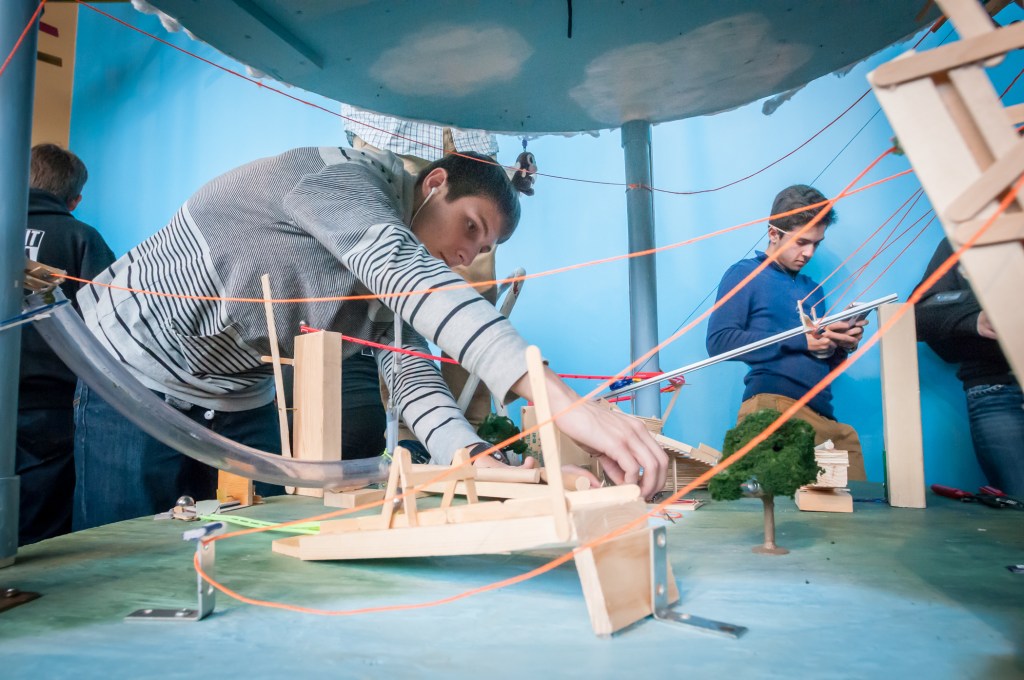
While I do not have a favorite course yet, I love teaching about political ideologies as well as the intersection between politics and the environment. This semester I have enjoyed watching students make connections between the functions (or dysfunctions) of American politics and more local or personal political issues. American politics is like a Rube Goldberg machine—or a chain-reaction machine designed to perform simple tasks in an absurdly indirect manner—where political institutions affect the functioning of the whole in bizarre and surprising ways. Whenever someone proposes or enacts a solution to a political problem, it alters and affects all the intermediary chain reactions, in a way that can be difficult to understand for years or decades. It has been fun to explore this conundrum with students.
31441D, Rube Goldberg contest 2016. Photograph by Mark Lopez (Flickr).
What’s your area of expertise? What do you primarily research and/or teach? And what drew you to this field?
My area of expertise is TESL and linguistics. I am a word nerd. I teach the general education writing/communication classes. I started college as a music major and realized that though I enjoy music, I was not that enthused about teaching it. In my junior year, I changed schools and switched from music to English. I love studying how language changes and how meaning flows with the cultural river and all its tributaries.
What’s one of your favorite courses, topics, or specific texts to teach? Why?
I don’t know that I necessarily have a favorite class that I teach or a favorite text; however, my favorite aspect of teaching is watching what happens in students from Composition 101 to junior or senior year. I like seeing the growth that can occur.
Primarily, I focus on interpersonal communication: listening, nonverbal, verbal, and written. I’ve taught communication and presentation skills in business, STEM fields, and performance. I also enjoy working with other people’s writing and helping them refine their skills and ability to communicate efficiently.
What do you primarily research and/or teach?
Although I have taught business writing, advanced writing, composition, and literature classes, I have found my niche in the STEM/technical communications courses. Teaching especially STEM Comm II (ENGL 289) has allowed me to work with students to hone their writing and speaking skills in their areas of expertise and passion. Their excitement in their work is contagious.
And what drew you to this field?
Literally, a mentor and professor at USD lured me in, suggesting I pursue graduate studies and apply for a TA position. Initially, this was far from my plan; I had never planned to pursue a teaching career. However, as I finished my undergraduate degrees in English and Speech Communications, my husband was entering his second year of law school at USD, so we would be in Vermillion, SD, for two more years. Although I was skeptical, I decided to give grad school with a TA position a try. It worked out. I’ve been teaching for 36 years; 2023 marks my 25th year at SD Mines. Making and maintaining connections with students over the years is my favorite part of teaching.
What’s one of your favorite courses, topics, or specific texts to teach? Why?
I do enjoy working with students in written communication, but I love to work with them in all areas of interpersonal communication, focusing on verbal and nonverbal skills in presenting. Listening and thinking critically are also vital for success. Seeing students strengthen their skills and confidence in presenting in classes is rewarding, but hearing of their successes in applying communication strategies in their careers is the best.
What’s something you’ve done that you’re really proud of?
Raising our six kids with my husband and watching them grow into the adults they are makes me feel accomplished; however, I am so much prouder of the people they have become than I am of anything I have ever done. It’s pretty gratifying seeing them do the things I did or say the things I said to them as they were growing up now in their own relationships and raising their own children. I am also immensely proud of my three granddaughters and two grandsons and the people they are becoming. As parents, we may sometimes not realize the daily impact we have on our children. Seeing it coming through in their everyday lives brings me great joy. I do tease them that they have become me. Occasionally, I feel I may need to add an apology for that! Regardless, they were raised to meet high standards in both personal and professional relationships, and they have.
Tell us about a book you’ve read recently, a movie you’ve seen recently, or another work of art or media you’ve engaged with recently that you really enjoyed and would like to recommend.
My reading typically centers on light-hearted books that take me away from my surroundings. However, a recent book that sticks with me is The Nightingale by Kristin Hannah. It is an historical fiction novel focused on the lives of two sisters in France during World War II and their struggle to survive and resist the German occupation of France. The story of each sister’s struggle to survive and of their contributions to France’s war efforts as well as their difficulties in maintaining their relationship in the midst of war is inspiring yet unsettling.
Tell us something about yourself outside of work. What do you enjoy doing? What’s a detail about you that your students might not already know?
The best thing that ever happened to me was getting pushed down the steps at school in kindergarten. This was my first encounter with my future husband. He had made the big move from country school to town school as a second grader, and my sister had a crush on him. Naturally, therefore, he had to pick on her, but he mistook me for her on the school steps. So, I took the fall for her. Rookie mistake, but it worked out for him. Apparently, I got past that; we started dating when I was just out of 8th grade and were married eight years later. We grew up together in rural southeastern South Dakota, sharing our families, our farms, and our lives. Through our years together, people would ask him if he had always wanted six kids. His reply every time was, “No; I wanted two, but my wife wanted six, so we compromised at six.” He eventually conceded that it was the best compromise he ever made. Growing up on a farm and working the land and livestock with family taught me a profound love of and respect for both family and the outdoors. That love transferred easily to my own family and the Black Hills. We spend our time together camping, hiking the hills, and relaxing at the lake. It’s amazing the impact, literally, that a rough push in kindergarten can have on a person’s future.
Paul Showler is Assistant Professor of Philosophy.
What’s your area of expertise? What do you primarily research and/or teach? And what drew you to this field?
When it comes to teaching and research, I am somewhat of a generalist, which is to say that I have wide-ranging interests and strive to incorporate a variety of philosophical methods and historical perspectives in both my writing and in the classroom. At SD Mines, I teach Introduction to Philosophy, Ethics, Logic, Philosophy and Literature, and I am excited to be teaching History and Philosophy of Science next fall.
Much of my past and current research focuses on problems in ethics or moral philosophy. Currently, I am especially interested in questions about the basis for our obligations to others. Most of us take it for granted that we have moral responsibilities towards other people, but what about non-human animals or machines displaying intelligence? I am also interested in questions about the nature of moral progress and the processes through which individuals and communities undergo moral transformations.
As an undergraduate student, I had the good fortune of attending a department with an active philosophy club. Among other things, the group organized a weekly “Bagel Tuesday” where students would get together to drink coffee, eat bagels, and talk philosophy. The sense of intellectual community that I discovered through my involvement in that club was something that drew me to philosophy. That and the free bagels.
What’s one of your favorite courses, topics, or specific texts to teach? Why?
Although I don’t have a favorite course, I especially enjoy teaching PHIL 100: Introduction to Philosophy. We get to cover a lot of ground in that class, which is both challenging and exciting. One of my favorite experiences as a teacher is when students make unexpected and illuminating connections between different philosophical topics, problems, or intellectual traditions. Because of its broad scope, I think that PHIL 100 lends itself well to this sort of syncretic thinking.
What’s something you’ve done that you’re really proud of?
In graduate school I was a three-time intramural floor hockey champion. And recently I have returned to the sport of ice hockey after a nearly fifteen-year hiatus.
What is your favorite book, movie, or other work of art or media? Why?
I am a big fan of the director Yorgos Lanthimos. For my part, I enjoy the dark humor in his films as well as their uncanny plots. The characters he depicts often exhibit bizarre behavior (such a brutal honesty or extreme pettiness) and inhabit worlds whose social norms differ in striking ways from our own. The result is something marvelously not-quite-human. If I had to choose, I would say The Lobster is my favorite film of his.
Tell us something about yourself outside of work. What do you enjoy doing? What’s a detail about you that your students might not already know?
Along with some of my colleagues in the Humanities and Social Sciences department, I have recently taken up the venerable sport of curling. For those who are unfamiliar, it is sort of like shuffleboard but played on a large sheet of ice.
Haley Armstrong is Director of Bands and Coordinator of Musical Activities.
What’s your area of expertise? What do you primarily research and/or teach? And what drew you to this field?
On paper I direct the University Band, Wind Ensemble, and Jazz Ensemble, as well as teaching lower and upper division music theory and topics while working a lot of the administration tasks to help the entire Music Center run smoothly. However, in reality my job is helping college students stay connected with music, any music, from pep band rock tunes to high level classical music. I’ve always loved music and teaching but what drew me to teaching at SD Mines is the fact that I get to support a mission bigger than just music. I believe that fine arts and humanities are extremely important elements to a well-rounded STEM education and while I love my subject I equally love connecting to our students in the fields they are majoring in and learning about the amazing careers they are planning for their lives.
What’s one of your favorite courses, topics, or specific texts to teach? Why?
I love teaching our upper division humanities music topic courses at SD Mines. It is a chance for me to talk about advanced concepts in music with a small group of students, and it always energizes me to see the world through their ideas. For example, this semester we have been looking at music history through the lenses of sacred, secular, and sacrilegious music, ending with a class trip to see the Tony award-winning musical Book of Mormon. During this class I know I pushed and challenged them but they pushed and challenged me to bringing up relevant ideas that I never would have considered!
What’s something you’ve done that you’re really proud of?
Even though I didn’t really mean to join the U.S. Air Force (that is a story for another day) I am extremely proud of my 22 years of service so far. Specifically, the 17 years I spent working with Air Force bands using music to inspire and bridge borders. Within this time, I was lucky to have two of my proudest moments documented. First was an outreach mission we did while I was living in Japan to the small town of Wakayama where we got to thank them for honoring our U.S. service members during WWII.
The second was about our mission during my second deployment. I was lucky to be in command of this group and SSgt Perry as we travelled around southwest Asia and her story here has represented this time for me more than any of my words ever had.
Tell us about a book you’ve read recently, a movie you’ve seen recently, or another work of art or media you’ve engaged with recently that you really enjoyed and would like to recommend.
I just finished the children’s book series The Incorrigible Children of Ashton Place by Maryrose Wood and highly recommend it, especially when you need something both light and occasionally thought-provoking. I’ve always been a voracious reader but, in all honesty, since having my son, I don’t have any time to sit and “read” books anymore but I have found great joy in listening to audiobooks. Written at a fifth-grade level, some might disregard these books as “childish” for a grown adult, but during the past few overwhelming years, these are the perfect books to enjoy having read out loud by a talented voice actor and an author that speaks to both children and adults.
Tell us something about yourself outside of work. What do you enjoy doing? What’s a detail about you that your students might not already know?
I think the most surprising thing for students and colleagues to learn about me is that I am truly an introvert. I know I come off as extroverted, which is a learned trait from years of trying to fit in in stereotypically extroverted musical communities. But I recharge by myself or with very small groups of people and after big concerts or events I am EXHAUSTED and need time with earbuds in and a good audiobook! I am very glad I have the capability to exist in both worlds because professionally both are needed, but it took me a long time to accept myself when I thought the world needed me to act one way. I just encourage everyone on the path to figure out how they tick and how to adapt to situations but stay true to themselves to keep going!
Gerrit Scheepers is Assistant Professor of Music and Director of Choirs.
What’s your area of expertise? What do you primarily research and/or teach? And what drew you to this field?
My terminal degree is in music performance with specialization in choral conducting. I mainly teach choir, and when the opportunity arises I teach the art of conducting as well as choral literature.
It has been an interesting journey to my current career field. I have always known since high school that I want to have a job that interacts with many people but also puts good out into the world. I wasn’t quite sure what exactly I wanted to do after graduating high school, so I started out as Bachelor of Medical Science student but also sang in the prestigious University of Pretoria (TUKS) Camarata choir. The turning point was during my sophomore year when the conductor resigned just prior to a scheduled Christmas concert and none of the seniors in the choir was available to conduct the choir. So, I was sort of obligated to conduct the performance by default. It went really well, so much so that several colleagues came up to me afterwards, asking if I am planning to pursue a career in conducting. The rest is history.
What’s one of your favorite courses, topics, or specific texts to teach? Why?
One of my favorite courses to teach is choral conducting, as well as choral literature. I really feel a sense of accomplishment when I see students grasping conducting concepts in the moment. Conducting equals moving, and moving in front of other people can be daunting. It requires a deep sense of vulnerability from the person moving (in this case conducting). Here at SDSMT I don’t get to teach conducting, but I can apply almost everything I have taught in the past to the choirs I am teaching every day.
What’s something you’ve done that you’re really proud of?
I am really proud of the legacy I left behind at Missouri State University. I was the very first South African to study for a Master of Music at MSU. Since my graduation in 2016, another four South African students have gone on to pursue a Master of Music degree at MSU. Three of them already graduated and the newest one just started this fall. I also had the opportunity to leave a mark there by starting the Scheepers Memorial fund in honor of my late parents in 2019. This endowment fund, for which I was just this past month awarded the Rick & Dee Uebel Award for “outstanding support and advocacy of the Missouri State University Choral Program,” was specifically created to give other international students the opportunities I had to fulfill their dreams via the MSU choral studies program. That fund will change the lives of future conductors from across the globe (and already has).
What is a book, movie, or another work of art or media you’ve enjoyed recently that you would like to recommend?
A musical artist I am currently obsessed with is Gregory Alan Isakov. We have some connection in terms of our country of birth. He was also born in South Africa but moved to the United States at an early age. His music combines indie and folk genres. His music reminds me of Leonard Cohen, who is another favorite of mine. The first time I encountered Isakov’s music was in 2017, while studying in Seattle for my DMA. My favorite album of his is This Empty Northern Hemisphere. He is just a master with words. One of my favorite lyrics perhaps is from his song “Big Black Car.”
Tell us something about yourself outside of work. What do you enjoy doing? What’s a detail about you that your students might not already know?
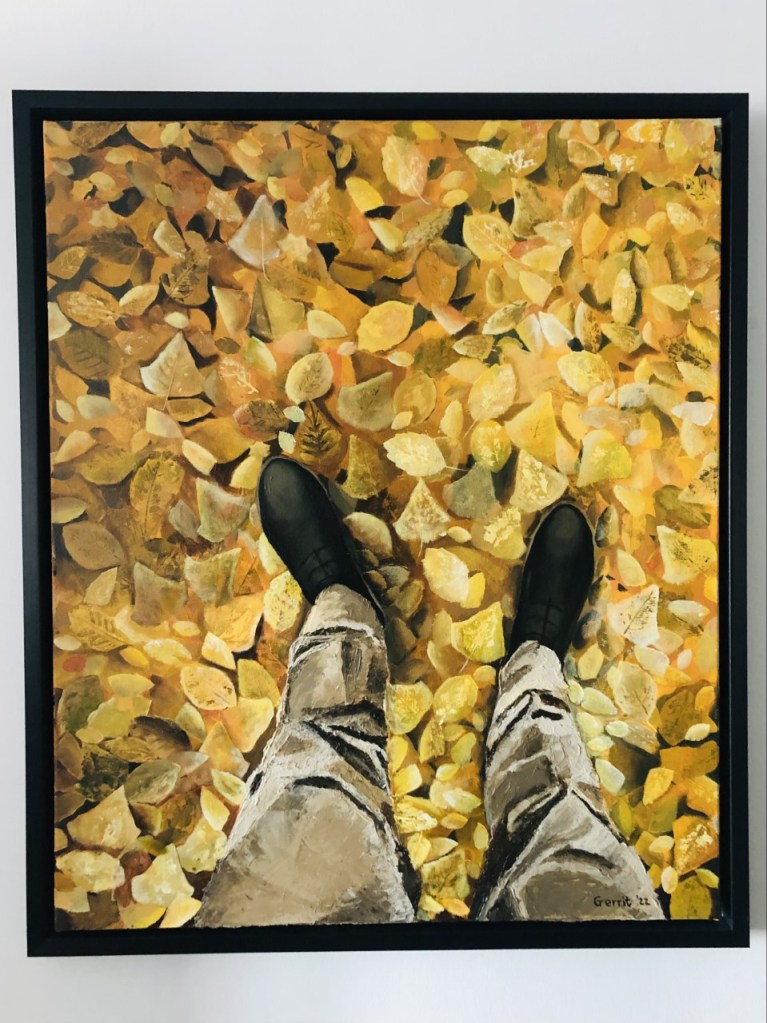
I am an avid and prolific painter, and I love to make pencil sketches as well. I have done art since an early age. In 2020 – after almost a 10-year hiatus – I dusted off my pencils and started sketching again. However, my favorite medium to work in is acrylic on canvas. I finished probably eight paintings in the first 6 months of 2022. I do not have a specific genre I paint in – portrait, still life, landscapes – I’ll paint it all. My current favorite painting I call “Autumn from a different perspective,” pictured below.
What’s your area of expertise? What do you primarily research and/or teach? And what drew you to this field?
My field is rhetoric, by which I mean the study of how we use discourse (usually words, but not always) to make stuff happen. I’m mainly interested in rhetoric and space/place, especially at the regional level. A lot of my research comes back again and again to the Great Plains, maybe because it’s my home, but also because it perennially faces difficult questions about what it means to consider a place a region and how that regional identity is leveraged in civic life. These themes of place and community almost always worm their way into every course I teach.
Like a lot of communication scholars, I think I wound up in the field by accident. The nice thing about rhetoric is that you can use it as an excuse to study just about anything. My initial dissertation proposal was on ancient Irish rhetoric, but some of those same themes led me yet again to studying the Great Plains.
What’s one of your favorite courses, topics, or specific texts to teach? Why?
Over the past couple of semesters I’ve realized that I cherish teaching Introduction to Humanities. Part of it is the flexibility of the course—“Introduction to Humanities” is a broad mandate, so it gives both my students and me the opportunity to play with ideas and explore possibilities. I use the idea of “place” as a central theme of the course. We read historians, geographers, communication scholars, poets, and more, but we use the place as a locus to see how different approaches ask different questions and yield different results. All of my students have something to say about place, so it’s a great tool to make connections between fields, including STEM fields. And, of course, because it’s so broad, if I read something interesting and want to talk about it in class, it’s pretty easy to find an opportunity to make it relevant!
What’s something you’ve done that you’re really proud of?
An article I published a couple years ago was cited in a book that was just published this month. The author, a geographer, called my a piece “a thoughtful analysis,” which is about as high a compliment as I can ask for.
What is a book, movie, or another work of art or media you’ve enjoyed recently that you would like to recommend?
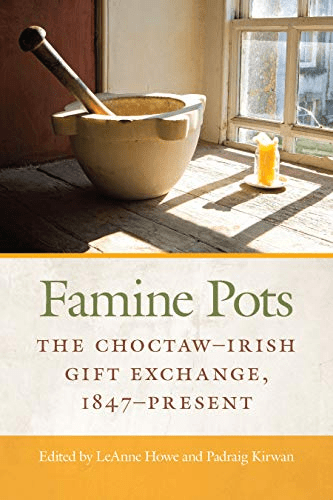
I’m just finishing a book titled Famine Pots: The Choctaw-Irish gift exchange, 1847-present. It is a series of essays, poems, and meditations on one of the most profound gifts in history: in 1847, members of the Choctaw Nation took up a collection to send to Ireland to provide relief during the Irish Famine. They ultimately sent $172 (some sources say $721), or about $5,000 today. This happened just a few years after the Choctaw were forcibly relocated to Oklahoma from their homelands in the south-eastern US, an act of ethnic cleansing commonly called “The Trail of Tears.” It’s a haunting read and raises a host of interesting questions about what connects people and places.
Tell us something about yourself outside of work. What do you enjoy doing? What’s a detail about you that your students might not already know?
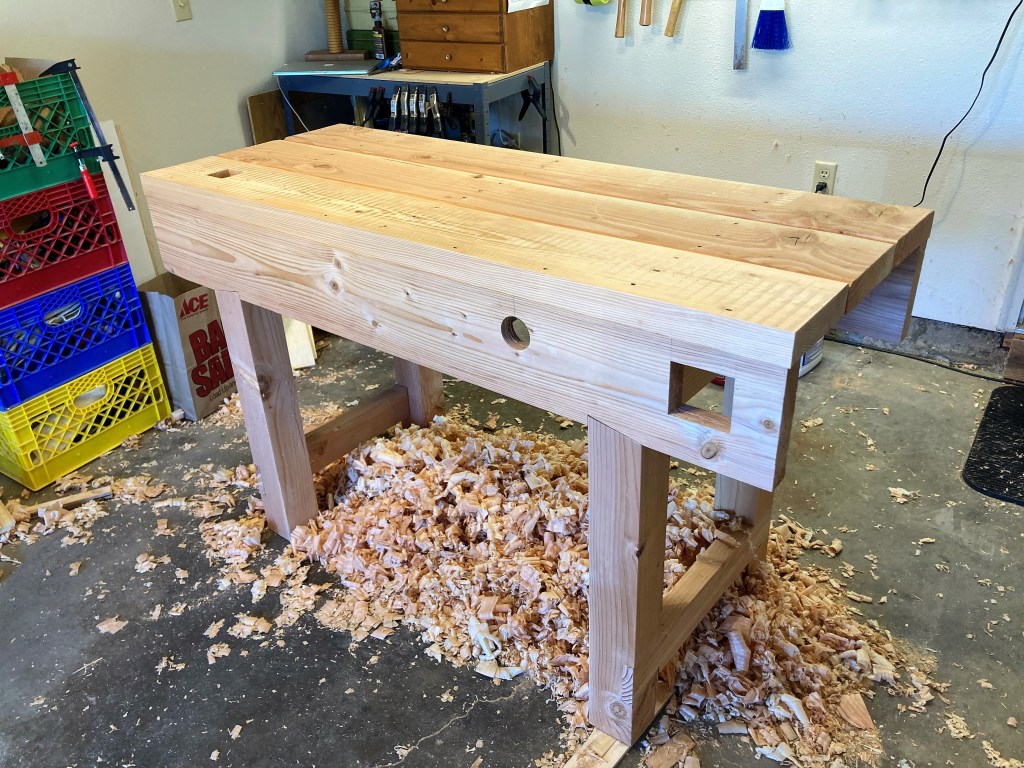
Over the past year or so, I’ve taken up woodworking, using almost exclusively hand tools. Since January I’ve been working on a traditional English-style woodworking bench, which I’ll hopefully complete by the end of this semester. It has been a good reminder that the first step to being good at something is to be quite bad at it for some time.
Kyle Knight is Department Head and Professor of Sociology.
What’s your area of expertise? What do you primarily research and/or teach? And what drew you to this field?
I’m an environmental sociologist. I primarily research the human dimensions of environmental change, which includes the social causes, consequences, and responses to environmental problems. Besides introductory, statistics, and methods courses in sociology, I’ve also taught courses on environmental sociology, environmental justice, and society and climate change. My research has lately focused on social patterns in climate change public opinion. For example, my most recent publication examined how outdoor recreation, such as hiking and birdwatching, might foster greater concern for climate change. My initial interest in sociology was motivated by questioning the centrality of materialism and consumerism in our society, and that blossomed into a drive to understand how we might achieve a more sustainable and equitable future.
What’s one of your favorite courses, topics, or specific texts to teach? Why?
One book I’ve used in my classes for a while now is Andrew Szasz’s Shopping Our Way to Safety, which I think provides an excellent illustration of how treating systemic social problems as individual-level issues to be solved by consumers not only doesn’t solve these problems but actually makes them worse. One of the biggest challenges in teaching environmental sociology is to get across the point that environmental problems are, at their root, social problems, and this book usually does the trick.
What’s something you’ve done that you’re really proud of?
While working on my Ph.D. at Washington State University, I co-authored and published an article with a fellow sociology graduate student and we received a departmental award for it. It was at this moment that I began to feel like a real scholar, and I continue to be proud of the work we did on our own to make it happen.
Tell us about a book you’ve read recently, a movie you’ve seen recently, or another work of art or media you’ve engaged with recently that you really enjoyed and would like to recommend.
I am a big music nerd and love all kinds of genres and traditions. I listen to music all day long, especially while working in my office, and enjoy reading album reviews. My musical tastes run the gamut – some of my favorite musical artists lately are Jake Xerxes Fussell, Yasmin Williams, Madlib, Cassandra Jenkins, Ben Chasny, Julian Lage, and Protomartyr. Right now, I’m fascinated by Marina Herlop’s new album titled Pripyat, which is named after the Ukrainian city abandoned in the aftermath of the Chernobyl nuclear disaster. Herlop is a classical pianist and experimental producer from Barcelona, and this album creates a wordless, other-worldly soundscape that is just completely captivating. My favorite track is “Shaolin Mantis” but the choir version of “Miu” is a close runner-up.
Tell us something about yourself outside of work. What do you enjoy doing? What’s a detail about you that Mines students might not already know?
I’m pretty boring and just enjoy spending time with my family outside of work. We especially like to hike, camp, and ride bicycles. We’re very excited to get to know the Black Hills and to eventually ride the Mickelson Trail when it’s not so hot!
















 The Novum