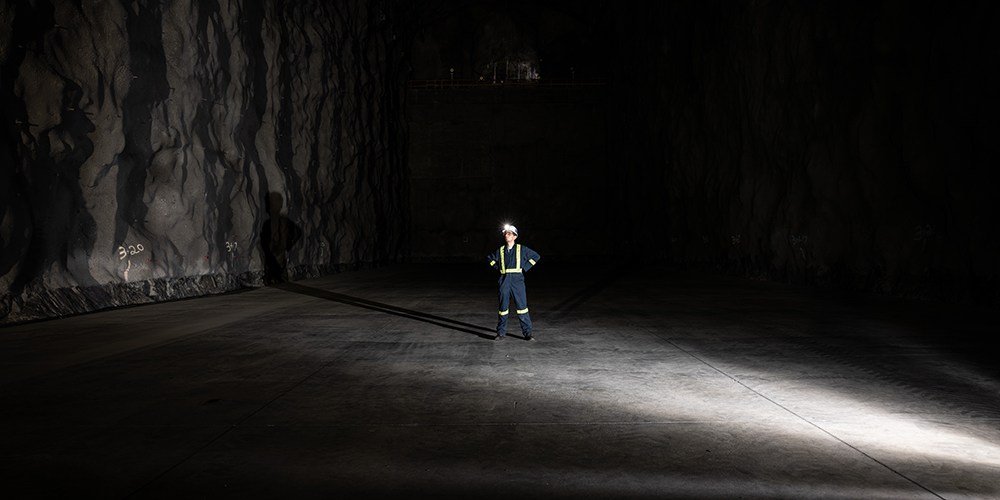
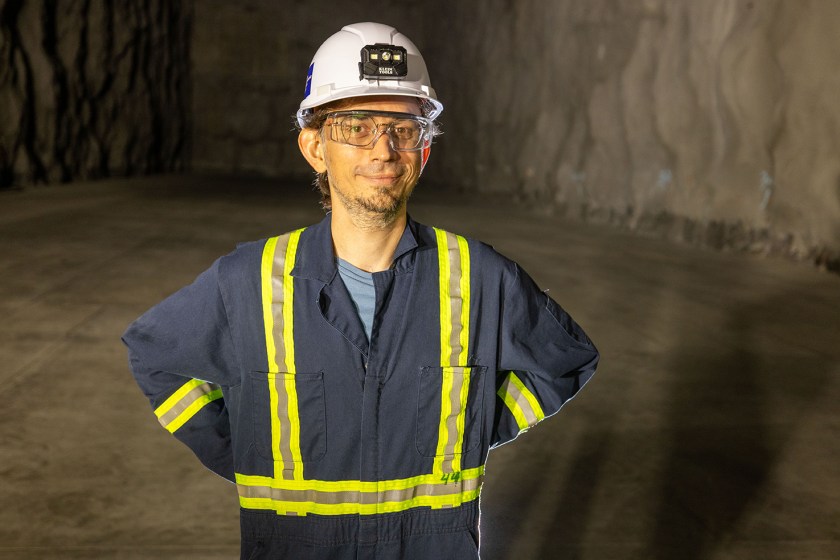
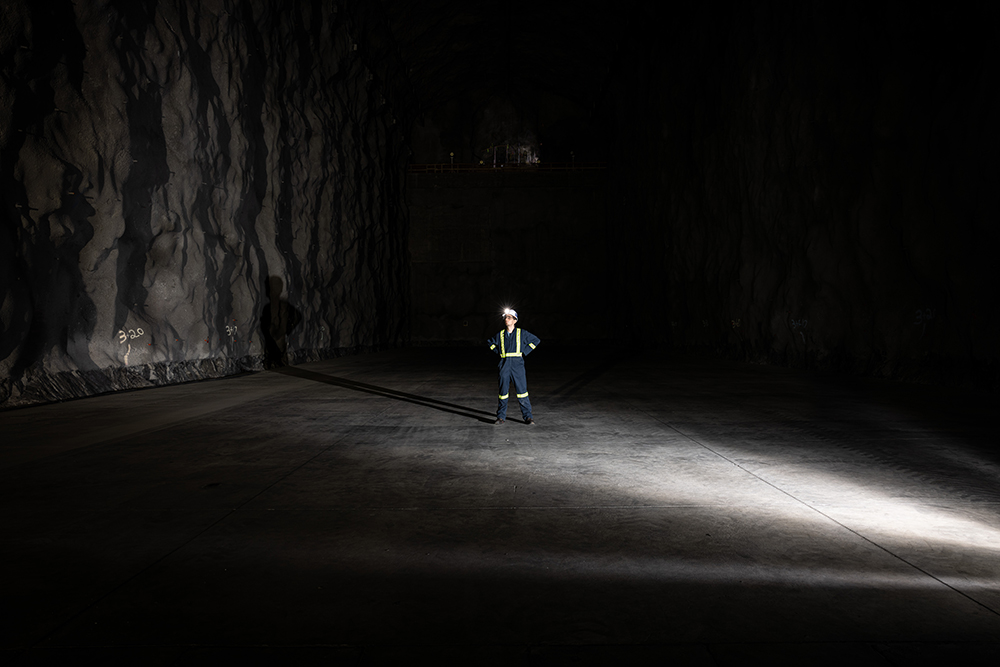
Last summer, Washington, D.C.-based artist Chris Combs swapped his urban studio at the Otis Street Arts Project for one that required a 10-minute open-cage elevator ride, personal protective equipment, and a brass tag etched with his name, indicating his presence nearly a mile underground.
As the 2025 Artist in Residence (AiR) at the Sanford Underground Research Facility (SURF), Combs brings his unique experience to life through an interactive exhibition at the South Dakota Mines APEX gallery. The exhibition opens with a reception from 4:30 – 6:30 p.m. on Friday, Jan. 23.
The show will feature interactive, time-based sculptures crafted from found objects, metal, wood and other industrial materials—many of them salvaged during Combs’ time at the Sanford Underground Research Facility (SURF) in Lead. By weaving discarded materials into his work, he aims to echo the layered history of the Homestake Mine and its evolution into a world-class underground laboratory, a dual legacy that drew him to apply for the SURF AiR program.
“I wanted to see firsthand the machinery of particle physics, and the human ‘machinery’ that constructs and maintains it nearly a mile underground in a dusty former gold mine with flood-marked walls,” Comb said. “In my art, I think a lot about how technologies have changed our world, and Homestake/SURF is two rounds of that: first, the transformation of a mountain into 370 miles of tunnels and drifts, and then the transformation of that mine into a container for globe-spanning experiments. The idea of astrophysics occurring a mile underground was very intriguing.”
Combs creates his pieces with the goal of having audience interaction. “I am lucky to get to make interactive artworks, where pushing a button or inserting a metal ball makes something happen,” he said. “At least for me, actively participating helps me remember it later. This extra little conversation between an artwork and its viewer also offers a challenge and a reward: do you dare to touch the thing? If so, here is an unexpected result. I hope that my artworks reward your curiosity.”
He also hopes his work inspires young people of all ages and backgrounds to experiment with electronics and other technologies. “It is fun to make things with your hands. Maybe it is a whimsical thing or maybe it is practical,” Combs said. “Maybe you consider your creation a game, a tool, or an artwork. All good.”
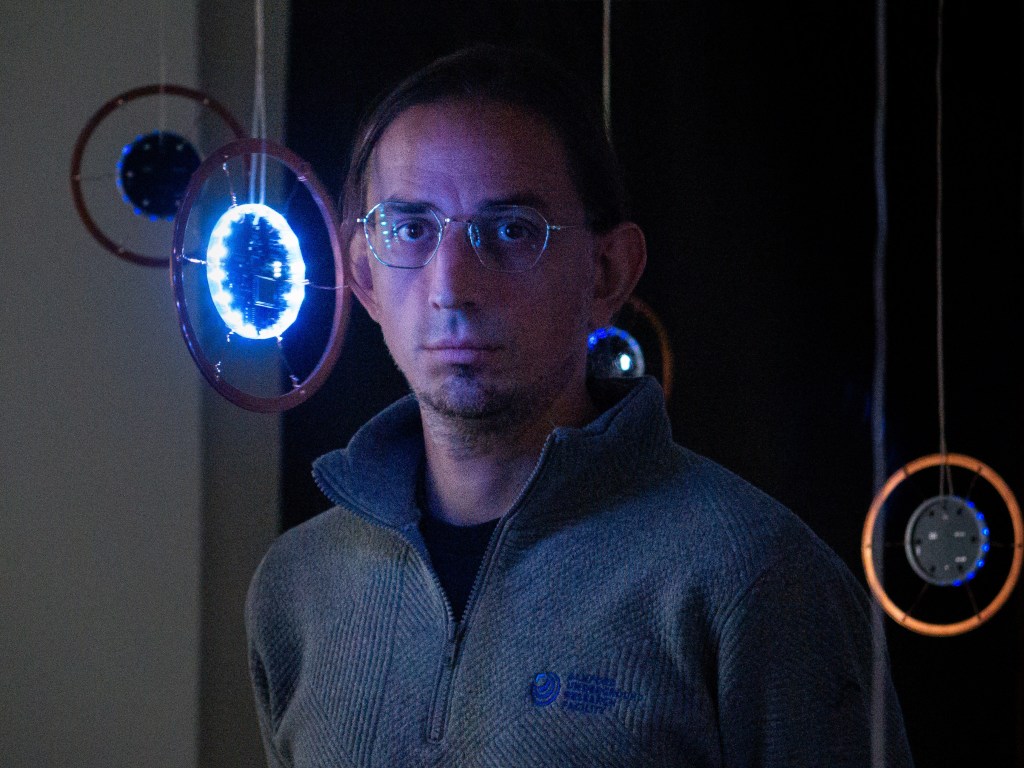
One central installation, “Little Ones”, places visitors into the perspective of the neutrino by allowing them to “collide” with hanging “atoms.” The work features copper gaskets from the LUX-ZEPLIN dark matter detector at SURF hanging from the ceiling in a darkened room. Custom-built circuit boards wired inside the copper gaskets light up and interact with those who choose to engage.
“I was wondering what it’s like to be a neutrino. You know, you’re this thing that can hurtle through a light-year or more of lead without ever encountering any of the atoms,” Combs said. “I hope to capture what it’s like to be propelled through a space and maybe you interact with an atom, or maybe not.”
In another artwork, titled “Starstuff,” Combs employs objects such as an old ammo box found in a former mine car, a discarded mirror from a locker once used at the SURF Foundry and a video of a Black Hills waterfall.
“If you peer in this mirror and you look around, you see sparkling stars reflected over you, and those are just me filming the surface of Roughlock Falls,” Combs said. “Each of the bright speckles from the sun reflecting off the waterfall turns into star shapes in the video. This seething mass of stars bubbling away from your reflection. And to me, it speaks to this idea that with all this research and all this work, we’re really sort of trying to figure out how and why we exist.”
Combs’ work celebrates both the scientific endeavor at SURF and the labor involved in operating the facility.
“I really enjoyed getting to explore so many areas of the facility maintenance and operations–the wastewater reclamation facility is fascinating,” Combs said. My absolute favorite was a few ‘time capsule’ buildings that are disused today but reflect the state of the Homestake Mine when it closed in 2002, particularly the Yates air compressor hall and the lower foundry building, where processed gold was melted into bars. It was an exceedingly rare privilege to explore them.”
The AiR program at SURF is now in its sixth year. This residency is modeled after various programs offered by government, science, and industry, including the National Park Service, CERN, and Fermilab. For more information, visit SURF AiR program website.
Combs is also the first speaker in the 2026 Spring STEAM Café, an ongoing series of free informal talks by Mines faculty, staff and visiting experts. His presentation, “The Art of the Invisible: Making Interactive Sculptures About Neutrinos”, will be held at 6 p.m. Tuesday, Jan. 20, at Hay Camp Brewing Company.
MEDIA CONTACT
Michelle Pawelski
Communications Manager
Marketing and Communications
605-394-6082
Michelle.pawelski@sdsmt.edu
About South Dakota Mines
Founded in 1885, South Dakota Mines is one of the nation’s leading engineering, science and technology universities. South Dakota Mines offers bachelor’s, master’s and doctoral degrees and a best-in-class education at an affordable price. The university enrolls 2,541 students with an average class size of 24. The South Dakota Mines placement rate for graduates is 97 percent, with an average starting salary of $77,067. For these reasons, South Dakota Mines is ranked among the best engineering schools in the country for return on investment. Find us online at www.sdsmt.edu and on Facebook, Twitter, LinkedIn, Instagram and Snapchat.
Mike Ray
Media Relations Manager
cray@sanfordlab.org
605.721.7865
Sanford Underground Research Facility
About SURF
Sanford Underground Research Facility (SURF) is America’s Underground Lab. SURF is operated by the South Dakota Science and Technology Authority (SDSTA) with funding from the Department of Energy’s Office of Science. SURF’s mission is to advance world class science and inspire learning across generations. Visit SURF at www.sanfordlab.org.
 The Novum