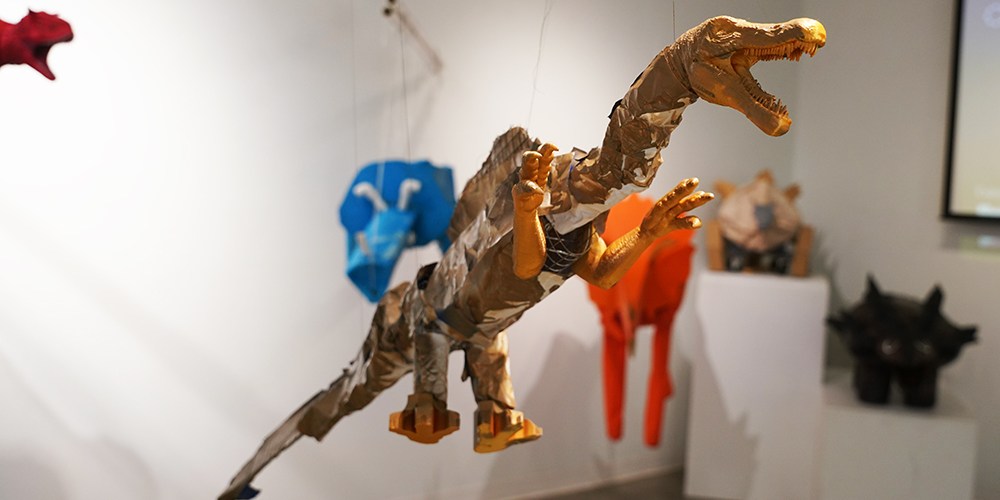
Sometimes people assume that engineers aren’t creative, but this is far from the truth, as the current Apex Gallery exhibit of dinosaur marionettes shows. In his introduction to mechanical engineering course, Dr. Cristian Vargas Ordóñez (in collaboration with Matt Whitehead, Senior Instructor of Art and Director of the Apex Gallery) asked students work in teams to use the engineering concepts they were learning to create and present large dinosaur marionettes.
This project shows what’s possible within engineering education and at the intersection of arts and engineering. It’s also a great illustration of a core principle of STS, which attends to how knowledge is created. Javier Lezaun, Noortje Marres, and Manuel Tironi write that “the larger aim of STS research and intervention . . . [is] to activate new collective imaginations of what an epistemically, technically, environmentally and materially engaged polity might be.” Working together as teams to create something new is a version of this aim at the scale of a college classroom, and it’s good practice for STS thinking and for working creatively with others in other areas! (Our Creativity and Collaboration in STEM minor further reinforces these connections.)
More details about the art exhibit are included in the press release below, and the marionettes will be on display in the Apex Gallery this week, with a reception this afternoon (Wednesday, 11/19) from 4-6 pm.
Art Exhibit Features Giant Dinosaur Marionettes Designed by Mines Mechanical Engineering Students
RAPID CITY, SD (Nov. 19, 2025) – South Dakota Mines mechanical engineering students brought engineering and imagination together to build large dinosaur marionettes, each one crafted with a variety of materials ranging from papier-mache and fabric to metal and 3D printed parts and designed with at least two movable parts.
The creatures are now on display in the Apex Gallery in the university’s Classroom Building. The project is part of the freshman introduction to mechanical engineering course taught by Cristian Vargas Ordóñez, Ph.D., assistant professor in the Leslie A. Rose Department of Mechanical Engineering.

 The Novum