
By Rayleigh Peterson
For my senior capstone, I will be writing about 3D bioprinting, or the creation of human tissues and tissue structures using 3D printing technology. Specifically, my research will be focused on the current and possible future impacts of 3D bioprinting becoming the main source of organs for transplantation surgeries. I will study and speculate on possible social, ethical, and economic impacts. This topic is important because of the world’s massive organ shortage. If this technology replaces organ donation, there will be significant changes in the current medical culture.
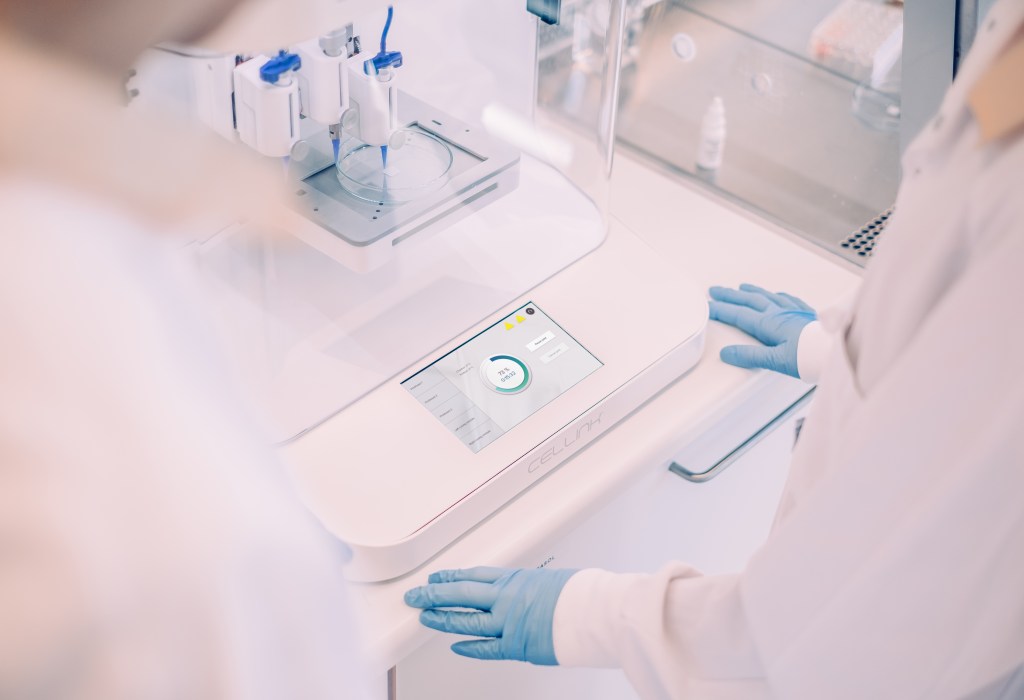
Because 3D bioprinting is a fairly new technology, it needs some additional explanation. According to Zhang et. al (2021), “3D bioprinting is a technology that combines computing science, biology and material engineering” (p. 1). 3D printing works by creating a computer model of a structure and building it layer by layer on a base plate using some kind of building material. This concept, combined with biological materials, gives us 3D bioprinting. There are several printing techniques and building materials, each with its own purpose, benefits, and drawbacks. The building materials, called bioinks, are filled with cells and cell-growing materials that help the cells develop into specialized cells. These are important because organs have many different types of cells that perform various complex functions. Think about a human heart, for example. Here’s a fun page where you can learn about the heart and its structures and complex functions. How can we print that? How can we build something with cell mush and leave holes and cavities in it without it falling over or turning into a puddle? How could it know to “beat” to pump blood? Will the different structures be able to exchange gases? These are important questions related to 3D bioprinting’s research and development.
Social impacts relating to this technology follow the current culture around social class, health inequality, and healthcare availability. Knowledge of, access to, ability to afford, and social support for health-protecting or -enhancing behaviors and practices greatly affect individual health, and those in higher socioeconomic groups are more likely to have all of these (Phelan, et. al, 2010). This is an important concept because bioprinting would likely be personalized medicine, which brings up concerns about financial availability and accessibility. Who will have access to this technology? If it is expensive, will people find ways to access it more cheaply? Will this cause underground operations leading to injuries or death? How would it affect people’s self-image if there was no organ donation? How would medicine change without organ shortage? These are some social considerations surrounding the development of 3D bioprinting.
Current studies of the ethical development of this technology discuss concerns of clinical testing. There are no regulations that pertain to this technology right now (Moss, 2023). Proper laws and procedures must be created to begin clinical testing. 3D-printed organs would likely be developed by taking genetic information from a patient, using it to develop a replacement organ, and then surgically implanting it back into that person. This raises ethical questions because there would be no way for a test subject to withdraw from testing and have the effects completely reversed (Gilbert, et. al, 2017). There is no guarantee of how the body will react to the new organ. How would clinical testing affect a person’s access to future treatment? Is this option more favorable compared to animal testing or organ donation?
The effects of this technology would be widespread and intense. Individuals’ access to organ transplants could be affected. Medical professionals would have to learn how to administer and care for patients undergoing these new procedures. Lawmakers and ethical guides will have to create new regulations. Engineers and biologists would also have new positions to fill for the continued development, requiring a shift in educational training. Everyone could be affected by this technology.
I am excited about continuing to research 3D bioprinting. There are so many questions that can be asked and explored. My critical literature review of this topic and its implications for the future will not be all-encompassing or definitive, but I will instead create a collection of knowledge on the topic that can be easily understood by a general audience in terms of the mechanical and technical functions and the social, ethical, and economic effects of 3D bioprinting taking over as the main source of human organs for transplant.
Works Cited
Gilbert, F.; O’Connell, C.; Mladenovska, T.; Dodds, S. (2018). Print Me an Organ? Ethical and Regulatory Issues Emerging from 3D Bioprinting in Medicine, Science & Engineering Ethics, 24, 73-91. https://doi.org/10.1007/s11948-017-9874-6.
Moss, M.F. (2023). Constructing appropriate bioprinting regulations: the ethical importance of recognizing a liminal technology, Journal of Medical Ethics, 0, 1-6. https://doi.org/10.1136/jme-2023-108925.
Phelan, J.C.; Link, B.G.; Tehranifar, P. (2010). Social Conditions as Fundamental Causes of Health Inequalities, Journal of Health and Social Behavior, 51, S28-S40. https://doi.org/10.1177/0022146510383498.
Zhang, Y.; Kumar, P.; Lv, S.; Xiong, D.; Zhao, H.; Cai, Z.; Zhao, X. (2021). Recent advances in 3D bioprinting of vascularized tissues, Materials and Design, 199, 109398. https://doi.org/10.1016/j.matdes.2020.109398.
Bailey, Regina. (2023, April 5). The Anatomy of the Heart, Its Structures, and Functions. Retrieved from https://www.thoughtco.com/heart-anatomy-373485.
Rayleigh Peterson is studying Industrial Engineering and IS: Pre-Professional Health. I have decided to go into an engineering career, specifically in manufacturing, but I have found many interesting overlaps between the two fields, illustrated by my engineering internship at a medical device manufacturing facility. My interest in interdisciplinary overlaps in science, like between engineering and medicine, inspired my senior capstone topic choice.
 The Novum