
Evan Thomas is Assistant Professor of English.
What’s your area of expertise? What do you primarily research and/or teach? And what drew you to this field?
I like to study symbols and the way that symbols interact with machines. My specialization has to do with the strange combinations of images and texts that people made in the period after the invention of the printing press. In the terms of English PhDs, this makes me an “early modernist.” A more common term for my period of specialization is “the Renaissance.” I’m drawn to the Renaissance as a moment when individuals found a way to relate to the past and the future through their inner humanity. There’s a phrase used in the Renaissance, uomo universale, which points to the way that close critical attention to inner human life can be the basis for achieving historical connections. Renaissance humanists reached into the future by pulling technologies out of pure abstract thought, like linear perspective or the printing press; the humanists reached into the past by re-learning forgotten languages – in the process they re-animated ancient Greek philosophy. I try to practice some of this by keeping one foot in the classics and the other involved with current innovations in symbolic technology.
As for my personal background, I kind of like to think of myself as a transitional character in my corner of the academy. I want to break certain patterns that were part of my upper-level education. We’ve all seen some negative examples, so now let’s choose to do things in a better way. There are a lot of students at Mines who could use a fresh new approach to classes like Composition, and the best thing I can do here is to provide novel, intentional approaches.
What’s one of your favorite courses, topics, or specific texts to teach? Why?
Every semester I get to teach the humanities is a good semester. A humanities class that I’m teaching this semester is HUM 200: Humanities and Technology. In that class, I’m emphasizing the distinctively human aspects that people commonly search for when they look to make or study great art, literature, music, and so on. I tend to find that people want to create or study the humanities because they’ve caught some spark of inspiration from something that burned with spontaneity, authenticity, and freedom – and now, of course, people want to show that the same fire is still burning inside humans. It’s an absolute treat to see people responding to our cultural examples of creativity with their own creativity.
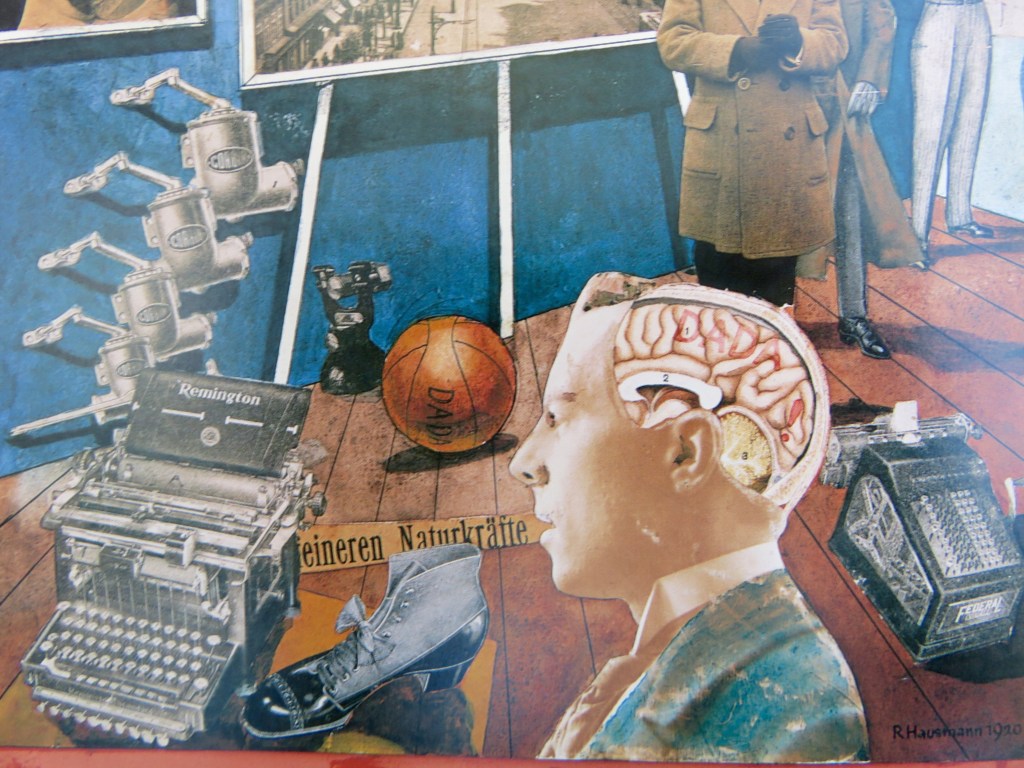
To give a specific example, one of my favorite class sessions in HUM 200 every semester is the lesson on Dadaism. There’s no straight-faced way to reflect on Dadaism. The only appropriate to Dadaism is to relish the absurdity. The last time I taught Dadaism I brought a bowl of popcorn to class – expecting I would find Dadaist discussion so entertaining – and one of my students “defined” Dadaism by pouring out my popcorn. That’s exactly what Dadaism is!
What’s something you’ve done that you’re really proud of?
I’ve been lucky to have the opportunity to create an original textbook for ENGL 101, and this semester I’ve been getting immediate, direct feedback from my students. Leading up to this, I felt like I had to create an original textbook directly addressed to the kinds of writers that I commonly see at Mines. At Mines, our students are “curious, smart, tenacious,” as the slogan says, but many are guarded when it comes to the technicalities of language arts. I’ve tried to write something that leverages our students’ strengths in critical thinking that also shows the value of critical thinking to the everyday work of making sense of things. That’s the ideal for the textbook, but the truth is that nobody gets it all right in the first draft, and I rely on honest feedback to get anywhere approaching that ideal.
My students – who are my editors – have been gracious, generous, and good-humored as they help me out. At the beginning of the semester I was nervous about starting this collaboration because I make just as many typos and dumb errors as anyone else. But in a funny way my students are farther along than I am in the way that they have their priorities in place: they quickly and directly fix those errors and refocus on the higher goals concerned with critical thinking. I think that professors would let students in on more collaborations if they could see how my students have made this such a constructive experience. So – to answer the original question – I’m proud of all of us for making this a constructive opportunity.
What is your favorite book, movie, or other work of art or media? Why?
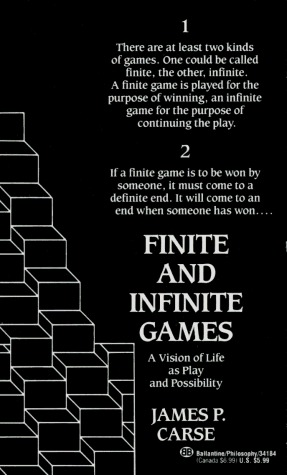
I am always looking for people to talk with me about James P. Carse’s book Finite and Infinite Games. Finite and Infinite Games is a book that illustrates the higher significance of creativity that follows from an existential sense of possibility, sincerity, and play. If I had to boil it down, I’d suggest that there are two methods of engaging with other people: in a finite game, players mutually try to conceal creativity and suppress the mysteries of life; in an infinite game, players unveil creativity and embrace the mysteries of life. The finite game can happen inside the infinite game, but not vice-versa. It’s a very nourishing read.
Tell us something about yourself outside of work. What do you enjoy doing? What’s a detail about you that your students might not already know?
I feel like most of what I’ve talked about this profile would be news to my students. I try not to talk about myself because it doesn’t feel professional to make myself the topic of conversation while at work. But in the spirit of the question, I feel like students will see me from time to time at the campus gym. Sometimes I go there to lift heavy things and put them down again. Carse says this about strength:
Strength … is an opening and not a closing act. … Power will always be restricted to a relatively small number of selected persons. [By contrast,] Anyone can be strong. … I am not strong because I can force others to do what I wish as a result of my play with them, but [I am strong] because I can allow them to do what they wish in the course of my play with them.
 The Novum